
Introduction
Every property buyer in Pakistan has heard the same advice from an uncle, a broker, or a well-meaning friend: “Yeh sasta mil raha hai, le lo” this one’s cheap, just take it. And on paper, it looks like a win. Lower price, smaller installment, an easy “yes.” But ask anyone who’s owned property for ten years, and they’ll tell you the same thing: the plot that seemed like a bargain in a quiet, disconnected area often stayed exactly where it was priced, while the slightly pricier one near a new road, a growing business district, or a gated community quietly doubled in value. Price is what you negotiate today. Location is what actually pays you back tomorrow. This blog breaks down exactly why, using real numbers from Pakistan’s own market.
Table of Contents
- What Really Determines Property Value
- Why Price Feels Like the Obvious Factor but Isn’t
- Economic Activity and Employment Hubs
- How Location Drives Long-Term Value: The Role of Infrastructure
- Location vs Price: A Side-by-Side Comparison
- Accessibility to Urban Amenities
- Rental Income, Yield, and Stability
- How to Choose the Ideal Location: What to Actually Look For
- How Location Affects Commercial vs Residential Property Differently
- Surrounding Communities and Neighborhood Quality
- Safety, Security, and Gated Living
- A Real-Life Case: Two Buyers, Two Choices
- Conclusion
1. What Really Determines Property Value
A property’s price tag is only ever a snapshot of today. Its real, long-term value is shaped by things that don’t change overnight: how close it is to jobs, how safe the area is, whether the roads and utilities work, and whether the neighborhood is actually growing or standing still. Experts consistently point to proximity to business districts, schools, hospitals, and transportation hubs as the biggest factors in how quickly and how much a property appreciates. In other words, the property itself is only half the story where it sits is the other half, and often the bigger one.
2. Why Price Feels Like the Obvious Factor But Isn’t

Price feels safe because it’s a number you can compare instantly. Location feels harder to judge, because its real value shows up slowly, over years, not on the booking form. This is exactly why so many buyers default to the cheaper option it’s the easier decision to make at the moment. But a lower price in a weak location often means paying less now and earning less later: slower appreciation, harder resale, and rental income that struggles to find tenants. A slightly higher price in a strong location, on the other hand, tends to reward patience — which is why real estate experts describe genuinely well-located properties as commanding higher prices precisely because buyers already sense, even instinctively, that location protects value better than a discount ever could.
3. Economic Activity and Employment Hubs
Property values follow jobs. Areas near growing business hubs, IT parks, and commercial centers see consistently stronger demand, because people want to live close to where they work. Islamabad is a clear example: its stable economy and thriving IT sector have made it one of the country’s most attractive investment hubs, with high demand for both residential and commercial property that consistently outstrips supply. The same pattern shows up in Faisalabad, where the city’s industrial strength drives steady demand for property nearby, and in Gwadar, where major port and CPEC-linked development has turned a once-quiet coastal town into a serious long-term investment location
4. How Location Drives Long-Term Value: The Role of Infrastructure

Nothing moves property values quite like a new road, metro line, or interchange. Infrastructure projects highways, metro systems, airport expansions reliably increase demand, and therefore prices, in the areas around them, while areas with poor infrastructure or frequent utility problems tend to lag behind.
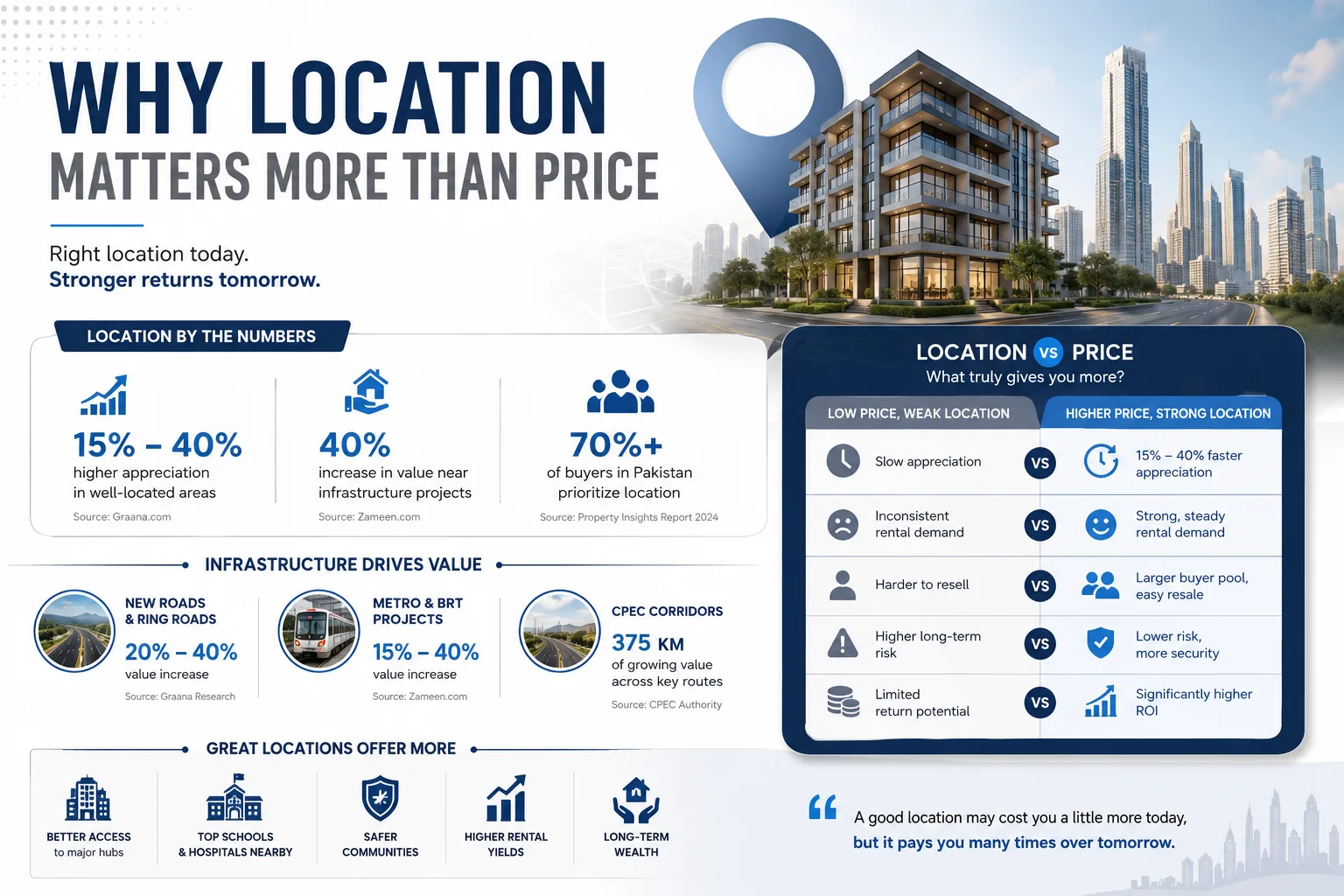
The numbers back this up clearly. Land along the Rawalpindi Ring Road corridor and DHA Phase 5 Islamabad appreciated 20 to 40% in a single year. In Karachi, catchment areas around the Green Line BRT and the revived Karachi Circular Railway have seen 15 to 40% appreciation, as improved connectivity turns previously overlooked neighborhoods into serious investment zones. Along the Islamabad Lahore Motorway corridor, the ongoing China-Pakistan Economic Corridor (CPEC) has quietly reshaped an entire 375-kilometer stretch of land values, as industrial activity and population growth follow the new road network outward from both cities.
The lesson here is simple: wherever infrastructure goes, property values follow and it’s far more predictable than most people realize.
5. Location vs Price: A Side-by-Side Comparison
| Factor | Cheaper, Weaker Location | Slightly Higher Price, Strong Location |
| Appreciation speed | Slow, often flat for years | 15–40% in strong infrastructure corridors |
| Rental demand | Inconsistent, longer vacancies | Strong, steady tenant demand |
| Resale ease | Harder to find a buyer | Larger, more active buyer pool |
| Long-term risk | Higher depends on future development that may never arrive | Lower value is already supported by existing activity |
| Best for | Very short-term speculation only | Long-term wealth building |
6. Accessibility to Urban Amenities
Beyond jobs and roads, people simply want to live near the things daily life depends on schools, hospitals, markets, and recreational spaces. Properties close to these essentials consistently sell faster and hold their value better than those far from them. Developments that include amenities like parks, gyms, and swimming pools within the community itself are increasingly valued higher than similar properties without them, because buyers are no longer just purchasing a home, they’re purchasing a lifestyle they don’t have to drive far to reach. (Source)
7. Rental Income, Yield, and Stability
Location doesn’t just affect what a property is worth, it directly affects what it earns you every month. As a general Pakistani benchmark, a gross rental yield above 6% for residential property, and above 10% for commercial property, is considered strong. Karachi illustrates this well: standard residential areas average 6 to 7% rental yield, while high-demand commercial zones can reach 10 to 15%
Location also determines how stable that income is. In strong, well-connected areas like DHA and Bahria Town Islamabad, vacancy periods between tenants typically run just 2 to 6 weeks. In areas with poor access or an oversupply of similar units, that same gap can stretch to 3 to 6 months of lost income, a difference that adds up fast over a year. A slightly higher purchase price in the right location often pays for itself many times over simply through fewer empty months.
8. How to Choose the Ideal Location: What to Actually Look For
Before falling for a low price, run any property through these checks:
- Proximity to jobs and business hubs is the area near where people actually work, or growing toward it?
- Infrastructure signals: is there a new road, interchange, or metro line planned or already under construction nearby? These are the earliest, most reliable signs of future appreciation.
- Access to essentials schools, hospitals, markets, and mosques within easy reach.
- Rental demand history checks how quickly similar properties in the area get rented, not just what they rent for.
- Security and community structure gated access, 24/7 surveillance, and a managed community consistently support stronger long-term value.
- 3–5 year price trend, not just today’s asking price a property’s recent trajectory tells you far more than a single snapshot.
9. How Location Affects Commercial vs Residential Property Differently
Location works differently depending on what you’re buying. For commercial property, location is almost entirely about footfall and business activity. A shop or office on a busy boulevard earns far more than an identical unit on a quiet street, because its income depends on the people walking past it every day. For residential property, location is about livability safety, schools, and community matter more than raw foot traffic. Interestingly, areas like Blue Area in Islamabad show investors willingly accepting a lower immediate rental yield in exchange for exceptional long-term capital appreciation proof that in prime commercial locations, buyers are consciously paying for location itself, not just current income.
10. Surrounding Communities and Neighborhood Quality
A property doesn’t exist in isolation its neighbors matter. A well-maintained, actively growing community, with responsible management and a consistent standard of upkeep, protects and grows property values over time. A neighborhood in decline, even with a beautiful individual house inside it, will struggle to hold its value against outside market pressure. This is one of the most overlooked parts of location — you’re not just buying a plot, you’re buying into everything being built and maintained around it.
11. Safety, Security, and Gated Living
Security has become one of the strongest value drivers in Pakistani real estate. Areas with lower crime rates and visible security measures, gated entry points, boundary walls, 24/7 surveillance are consistently more desirable, and properties in these areas tend to appreciate faster than those in less secure regions. This is exactly why gated communities have become such a dominant force in the market; some reports now describe gated developments as making up the large majority of premium real estate investment in cities like Karachi. Beyond crime, safety also includes resilience properties in areas prone to flooding or other natural risks that tend to see depressed values compared to those in more stable, secure zones.
12. A Real-Life Case: Two Buyers, Two Choices
Picture two cousins, each with the same budget, buying property in the same year. One buys a plot in a far-out, undeveloped area purely because it was the cheapest option available, no nearby roads, no clear development plan, no real community around it. The other buys a smaller unit, at a slightly higher price, inside a gated community close to a growing commercial corridor with a new interchange under construction nearby.
Five years later, the first cousin’s plot has barely moved in value there’s still no real infrastructure around it, and finding a buyer takes months of waiting. The second cousin’s property has appreciated well above the original price, rents out within weeks whenever a tenant leaves, and could be sold quickly if needed. Neither cousin made an emotional mistake — both were simply following the advice they trusted at the time. But one paid for a lower price. The other paid for a better location. Only one of them actually built wealth.
This is the story that plays out, in different forms, across Pakistan every single year and it’s exactly why understanding location isn’t optional homework. It’s the difference between a property that just sits there, and one that actually works for you.
13. Conclusion
Price is a number you agree on for a single day. Location is a decision that keeps working or keeps struggling for every day after that. The infrastructure, jobs, safety, and community around a property are what actually determine whether it becomes a real asset or a quiet disappointment. The smartest move isn’t chasing the lowest price, it’s understanding that a well-located property, even at a slightly higher cost, is very often the cheaper decision in the long run.