
Introduction
Buying your first apartment is one of the biggest financial decisions you’ll make and buying an apartment in Pakistan comes with its own set of questions that generic international guides simply don’t answer. What documents actually prove clear ownership? What taxes will you really pay in 2026? Can a non-filer or an overseas Pakistani legally buy? And how do you avoid the fraud cases that make headlines every year?
This guide is the apartment buying checklist that answers all of it in one place combining practical buying steps with the legal and tax specifics that apply in Pakistan today, linking directly to the official government portals you’ll actually need, so you can move from “just looking” to “confidently owning” without the guesswork.
If you’re specifically looking in Islamabad, this checklist is also the exact standard ISMMART Group of Industries holds its own projects to every unit we offer comes with verified CDA approvals and transparent documentation from day one, which is exactly what this guide will teach you to check for yourself before buying from anyone.
Table of Contents
- Who Can Buy an Apartment in Pakistan?
- Understand Your Buying Options
- Plan Your Budget Including the Costs Nobody Mentions
- Financing Your Apartment: Bank Loans & Roshan Apna Ghar
- Choosing the Right Location and Developer
- The Complete Legal Checklist & Documentation
- Understanding Property Taxes in 2026
- Step-by-Step Buying & Registration Process
- A Special Note for Overseas Pakistanis
- Common Mistakes First-Time Buyers Make
- FAQs
1. Who Can Buy an Apartment in Pakistan?

Before anything else, it helps to know where you stand legally:
- Pakistani nationals have unrestricted rights to buy property anywhere in the country.
- Overseas Pakistanis enjoy relatively relaxed buying conditions but still need to follow proper legal and tax procedures, including obtaining a National Tax Number (NTN) through the FBR’s official IRIS portal.
- Foreigners can buy property in Pakistan, but only after securing a No Objection Certificate (NOC), and certain areas may be restricted depending on the province.
- Non-filers can legally buy an apartment too but they now pay a noticeably higher withholding tax than active tax filers, so registering as a filer on FBR’s IRIS system before your purchase can save you a significant amount.
2. Understand Your Buying Options
Not every apartment purchase looks the same. Before you fall in love with a unit, understand which category it falls into because each comes with a different risk and reward profile.
Ready-to-Move-In: The apartment is complete and available for immediate possession. You can physically inspect the actual unit multiple times before buying, which lowers risk. The trade-off is a higher purchase price and slower future appreciation compared to buying early.
Under-Construction: Lower entry cost, flexible payment plans, and generally higher appreciation potential by the time of completion. The risk is possession delays, so this option only makes sense with a builder who has a verified delivery track record.
New Launch Projects: The earliest and usually cheapest entry point, but also the highest-risk category you’re buying largely on trust and marketing material, so developer verification becomes non-negotiable here.
Resale Apartments: You get to see exactly what you’re buying and can often negotiate on price, but resale units require extra diligence on ownership history, outstanding dues, and mutation records.
If you want lower risk and can pay a premium, go ready-to-move. If you want better appreciation and can tolerate some construction risk, under-construction from a proven developer is usually the smarter financial move.
3. Plan Your Budget — Including the Costs Nobody Mentions
The listed price of the apartment is not what you’ll actually pay. Budget for these on top of the unit price:
- Property registration fees (typically 1–3% of transaction value, varies by province)
- Stamp duty
- Capital Value Tax (CVT)
- Withholding tax (rate depends on filer status check yours via FBR’s Active Taxpayer List verification)
- Society or building maintenance deposit
- Parking charges, where applicable
- Legal and documentation fees if you’re using a lawyer or consultant
First-time buyers frequently budget only for the sale price and get blindsided by these additions at the registration stage. Set aside an additional buffer as a rule of thumb budgeting an extra 5–7% above the sale price covers most of these costs comfortably.
4. Financing Your Apartment: Bank Loans & Roshan Apna Ghar
If you’re not paying entirely from savings, you have real financing options in 2026 and they’re more affordable than they’ve been in years, following the State Bank’s policy rate cuts from a 22% peak in 2023 to roughly 10.5–11.5% today.
Standard bank loan process:
- Check your credit score and loan eligibility
- Compare interest rates across banks
- Choose between fixed or floating rates based on your risk tolerance
- Submit income proof, identity documents, and property paperwork
- Bank verifies the property and approves the loan
- Sign the loan agreement and begin EMI payments
Fixed vs. Floating rates: Fixed rates are typically higher but stay constant, giving predictable EMIs ideal if you have a limited or fixed income and want stability. Floating rates are usually lower and carry no prepayment penalty, but they move with the market, so they suit buyers who can tolerate some fluctuation.
For overseas Pakistanis: The State Bank’s Roshan Apna Ghar scheme allows non-resident Pakistanis to digitally buy, build, or renovate property with simplified paperwork, with financing available from 3 to 25 years in both conventional and Shariah-compliant formats. It’s paired with a Roshan Digital Account for remittance and payments you can open one directly through any RDA-participating bank’s website.
5. Choosing the Right Location and Developer
Location determines both your daily comfort and your resale value. Before deciding, check:
- Proximity to your workplace and the city center
- Access to schools, hospitals, and main roads
- Public transport availability
- Neighborhood safety and basic infrastructure (especially water supply)
- Upcoming development projects nearby that could boost future value
Verify the society’s regulatory approval directly with the relevant authority — never take a developer’s word for it.
In Islamabad, this means checking a society’s NOC status with the Capital Development Authority (CDA). In Rawalpindi, the equivalent authority is the Rawalpindi Development Authority (RDA) — a society advertised as being “near Islamabad” or “twin cities” is not automatically CDA-approved just because it borders the capital; confirm which of the two bodies actually approved it, since CDA and RDA jurisdictions are separate and a project can be legitimate under one but unapproved or informally developed under the other. In Lahore, check with the LDA, and in Karachi, with the SBCA.
Developer verification matters just as much. Between 2019 and 2020 alone, roughly 1,000 developers launched apartment projects in Islamabad and Rawalpindi by 2024, only about 100 were still active. Before committing, check the builder’s completed project history, delivery timelines, and whether they’re still actively delivering projects today, not just marketing new ones. This is exactly the standard ISMMART Group of Industries holds itself to across its real estate ventures transparent documentation and a verifiable delivery record, not just marketing promises. You can review our portfolio at ismmartindustries.com.
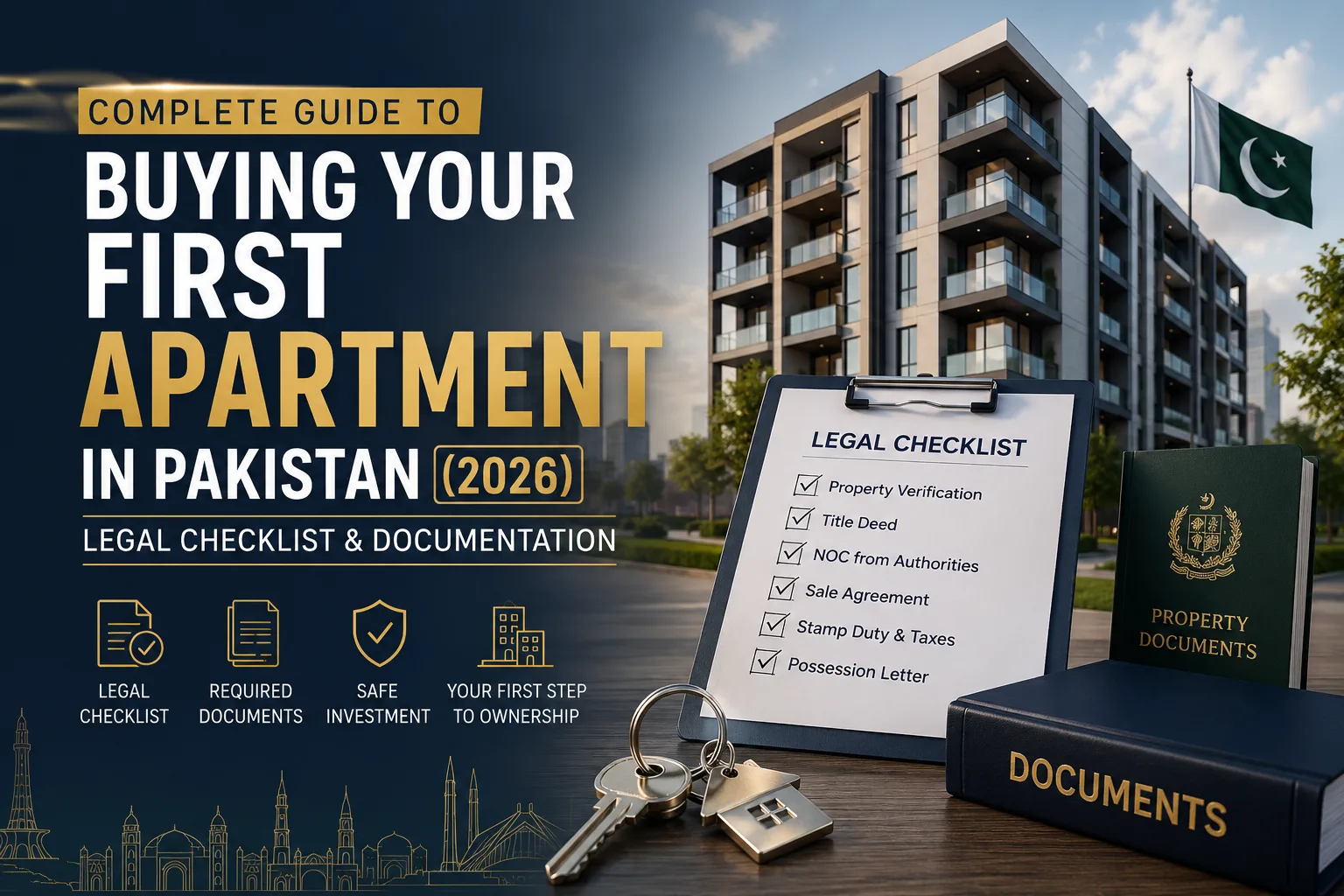
6. The Complete Legal Checklist & Documentation
This is the section most guides rush through and where most fraud actually happens. Go through every item below before you pay a single rupee beyond a token/booking amount.
Documents to Verify Before Buying
| Document | Purpose | Why It Matters |
|---|---|---|
| Title Deed | Confirms current legal ownership | Core proof the seller actually owns the property |
| Sale/Allotment Letter | Proof of ownership in a housing scheme or from the original developer | Confirms the chain of ownership |
| NOC (No Objection Certificate) | Permission from relevant authority (CDA, RDA, LDA, or SBCA depending on city) for the sale | Without this, the sale may not be legally enforceable |
| Mutation Documents | Records the transfer of ownership in land records | Shows the property’s ownership history is clean |
| Tax Receipts | Proof that property taxes are fully paid | Avoids inheriting the previous owner’s tax disputes |
| Building Approval Plan / Map | Local authority-approved layout | Confirms the structure itself is legally built |
| Occupancy/Completion Certificate | Confirms the building was constructed as per approved plans | Essential for ready or newly completed apartments |
| Encumbrance Certificate | Confirms no outstanding loans, liens, or legal dues | Protects you from inheriting hidden liabilities |
Your Step-by-Step Verification Checklist
- Confirm the seller’s identity and ownership request the original title deed and mutation documents, not photocopies.
- Verify NOCs and approvals with the relevant local development authority CDA for Islamabad, RDA for Rawalpindi, or the LDA/SBCA equivalent for Lahore/Karachi.
- Check for a clear title confirm there are no mortgages, liens, or ongoing disputes attached to the unit.
- Request a tax clearance certificate, and cross-check the seller’s filer status through FBR’s Active Taxpayer List, to ensure all dues are settled before you take over.
- Ask for litigation history confirmation a simple written confirmation that no court case is attached to the property.
- Review the sale agreement carefully payment schedule, possession date, and penalty clauses should all be explicit in writing, never verbal.
- Complete registration at the relevant land/sub-registrar’s office, followed by mutation to formally record the change of ownership.
A verbal agreement, however trustworthy the seller seems, is nearly impossible to enforce later insist on formal, written documentation at every stage.
7. Understanding Property Taxes in 2026
Taxes are where most first-time buyers get caught off guard. Here’s what actually applies:
| Tax Type | Typical Rate | Who Pays |
|---|---|---|
| Capital Value Tax (CVT) | Varies by province | Usually the buyer |
| Stamp Duty | Varies by province and property type | Paid at registration |
| Withholding Tax (Filers) | Reduced significantly under 2026 reforms | Deducted from the transaction |
| Withholding Tax (Non-Filers) | Noticeably higher than filer rate | Deducted from the transaction |
Key 2026 update: The federal budget for FY2026–27 reduced the combined withholding tax rate for active filers to a flat 1.25% on purchase (2.75% for sellers) and formally abolished the Section 7E deemed-income tax on undeveloped land, after Pakistan’s Federal Constitutional Court declared it unconstitutional in May 2026 (Chakor Ventures, Trustpoint) collectively lowering the cost of buying and holding property this year compared to previous years. If you’re not currently a tax filer, registering with the FBR through IRIS before your purchase is one of the simplest ways to reduce your overall transaction cost.
8. Step-by-Step Buying & Registration Process
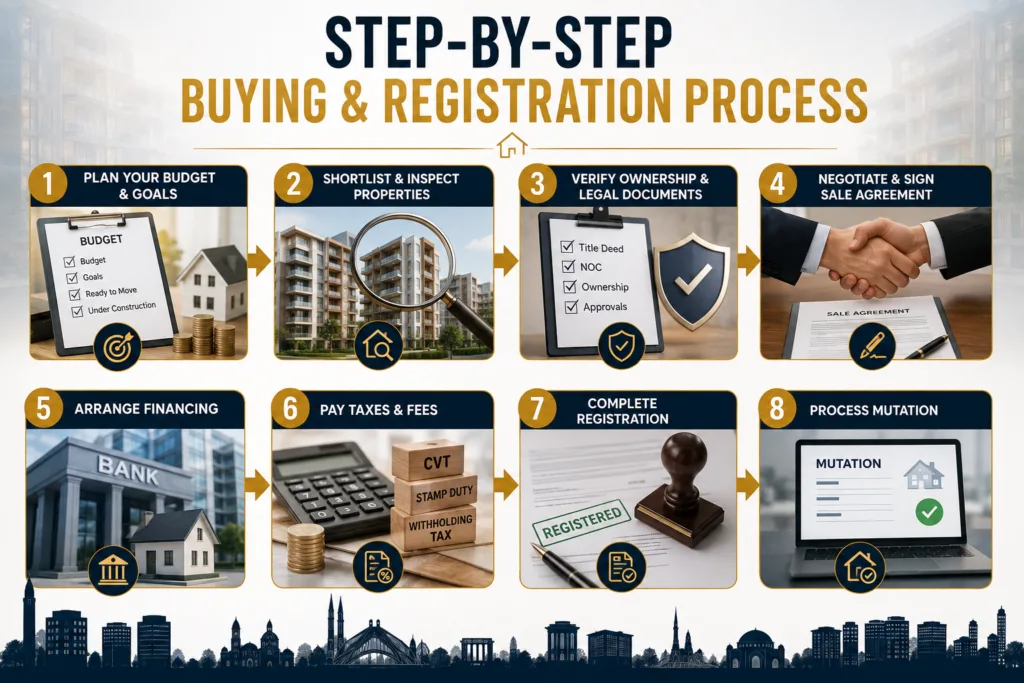
- Define your budget and goals decide between ready-to-move and under-construction based on your risk appetite.
- Shortlist and inspect properties never buy sight-unseen unless you’ve engaged a trusted representative to inspect on your behalf.
- Verify ownership and legal documents using the checklist above, including a direct NOC check with CDA, RDA, or the relevant city authority.
- Negotiate and sign the sale agreement, with every clause price, schedule, and possession date in writing.
- Arrange financing, if applicable, and complete bank verification including through Roshan Apna Ghar if you’re an overseas buyer.
- Pay applicable taxes and fees CVT, stamp duty, and withholding tax.
- Complete registration at the local land registry office.
- Process mutation to officially record your ownership in revenue records.
9. A Special Note for Overseas Pakistanis
If you’re buying from abroad, the process needs a few extra steps built in:
- Get your NTN (National Tax Number) from the FBR it’s mandatory for property registration and can be obtained online through the FBR IRIS portal without visiting Pakistan.
- Open a Roshan Digital Account to handle payments through formal, traceable banking channels most major banks let you open one entirely online.
- If you plan to buy, build, or renovate a home, apply through Roshan Apna Ghar, which offers financing from 3 to 25 years and lets you use your RDA holdings as collateral.
- Appoint a trusted representative ideally a professional with a Special Power of Attorney, attested by your nearest Pakistani Embassy or Consulate, to handle inspections, negotiations, and paperwork on your behalf.
- Request video tours and geotagged photos of the actual unit, and have your representative physically inspect it before you commit funds.
- Keep a Foreign Remittance Certificate for all funds transferred this can help you avoid certain withholding tax complications later.
- Verify 30–40 years of ownership history where possible, especially for resale units, to rule out disputed titles and confirm the society’s NOC directly with CDA, RDA, LDA, or SBCA rather than relying on the seller’s claim.
Overseas buyers are, unfortunately, a common target for fraud simply because physical verification is harder from a distance which makes a trustworthy local representative, a developer with a verified track record, and direct authority-level NOC verification the most important safeguards you have.
10. Common Mistakes First-Time Buyers Make
- Budgeting only for the sale price and ignoring registration fees, taxes, and maintenance deposits
- Choosing a location based on price alone, ignoring connectivity and future growth
- Not verifying the developer’s actual delivery track record
- Relying on verbal promises instead of a written, detailed sale agreement
- Skipping a professional inspection before finalizing
- Overlooking loan eligibility and realistic repayment capacity
- Buying under sales pressure or “limited-time” discount offers
- Not checking for unpaid taxes or utility dues tied to the property
- Trusting a society’s marketed location (“near Islamabad,” “twin cities”) instead of confirming which authority CDA or RDA actually approved it
- For overseas buyers specifically: skipping physical verification entirely and relying only on photos or brochures
11. FAQs
Is it a good idea to buy an apartment as a first-time investment in Pakistan? Yes apartments generally offer steady rental demand and lower maintenance responsibility compared to houses, especially in urban centers where land is scarce and vertical living is growing fast.
Can a non-filer legally buy an apartment in Pakistan? Yes, but non-filers pay a higher withholding tax than active filers. Registering as a filer through FBR’s IRIS portal before your purchase is a simple way to reduce your total cost.
What is the single most important document to verify before buying? The title deed, cross-checked against mutation records, since it confirms the seller actually has the legal right to sell the property.
Is buying an under-construction apartment safe? It can be, provided the developer has verified NOCs from the relevant authority (CDA, RDA, LDA, or SBCA), approvals, and a proven history of completing projects on time.
What documents do overseas Pakistanis need to buy an apartment? CNIC/NICOP, an NTN certificate (obtainable via FBR IRIS), proof of remittance through a Roshan Digital Account, and if using a representative an attested Special Power of Attorney.
Final Word
Buying your first apartment doesn’t have to feel like a gamble. The buyers who run into trouble are almost always the ones who skipped documentation checks, trusted verbal promises, or rushed the decision under sales pressure. Take the process step by step verify directly with the relevant authority, document everything in writing, and choose a developer whose track record you can actually confirm.
That last point is where most projects fall short and it’s exactly where ISMMART Group of Industries is built differently. Every apartment we offer in Islamabad comes with verified CDA-approved documentation, a transparent payment structure, and a delivery record you can check for yourself rather than take on faith. If you’re evaluating apartments in Islamabad and want a developer that already meets every item on this checklist, explore our current portfolio at ismmartindustries.com.