

Trust and Transparency over Price
Every business owner eventually faces the same temptation: win the deal by cutting the price. It works, sometimes. But it rarely builds anything that lasts. The partnerships that survive years, the ones that grow instead of just close, are almost never the ones built on the lowest number they’re built on two things that don’t show up on an invoice: trust and transparency. When a client trusts you and understands exactly what they’re paying for, price stops being the deciding factor. This blog breaks down what trust and transparency actually mean in business, why they consistently outperform price as a deciding factor, and what it looks like when a business genuinely builds a partnership around trust and transparency instead of a discount.
Table of Contents
- Defining Trust and Transparency in Business
- The Benefits of Trust and Transparency
- How Trust Leads to More Effective Decision-Making
- How Transparency Reduces Risk
- How Trust and Transparency Turn Deals into Real Partnerships
- Aligning Goals
- Building Open Communication Channels
- Creating Ownership and Responsibility
- Establishing Long-Term Trust
- A Real-World Example
- FAQs
- Conclusion
1. Defining Trust and Transparency in Business
Trust is the belief that the other side in a business relationship will do what they say, treat you fairly, and act in good faith even when no one is checking. It’s not something a contract can force; it’s something built up through consistent, honest behavior over time.
Transparency is what makes trust possible in the first place. It means openly sharing information pricing, timelines, risks, mistakes instead of hiding it until someone asks, or until it becomes impossible to hide. Where trust is the feeling, transparency is the action that earns it.
Together, they answer the one question every business partner is really asking whether they say it out loud or not: “Can I actually rely on you?”
2. The Benefits of Trust and Transparency
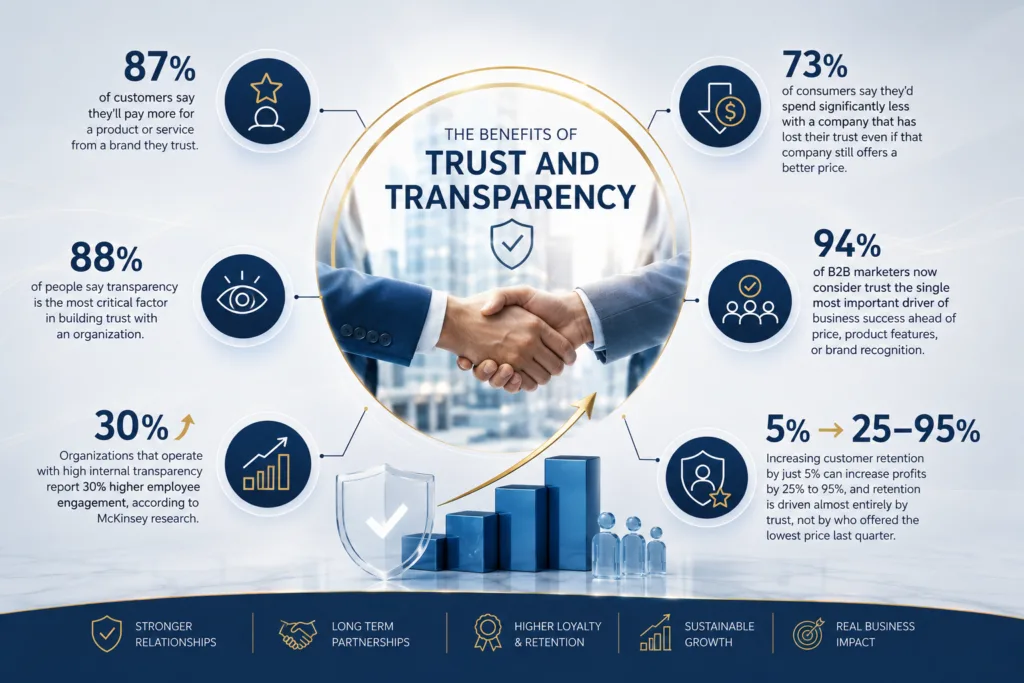
The data on this is remarkably consistent across studies:
- 87% of customers say they’ll pay more for a product or service from a brand they trust.
- 73% of consumers say they’d spend significantly less with a company that has lost their trust even if that company still offers a better price. (Source)
- According to the Edelman Trust Barometer, 88% of people say transparency is the most critical factor in building trust with an organization. (Source)
- A 2025 LinkedIn/Ipsos study found that 94% of B2B marketers now consider trust the single most important driver of business success ahead of price, product features, or brand recognition. (Source)
- Organizations that operate with high internal transparency report 30% higher employee engagement, according to McKinsey research meaning transparency doesn’t just help external partnerships, it strengthens the team behind them too. (Source)
The benefit isn’t abstract it shows up directly in retention and revenue. Research from Bain & Company found that increasing customer retention by just 5% can increase profits by 25% to 95%, and retention is driven almost entirely by trust, not by who offered the lowest price last quarter. (Source)
3. How Trust Leads to More Effective Decision-Making
When two sides of a partnership trust each other, decisions get made faster and better. Here’s why: without trust, every decision gets filtered through suspicion “are they telling me the full picture?” which slows everything down and often leads to defensive, overly cautious choices on both sides.
With trust in place, partners can share real information, including bad news, without fear of it being used against them. That means problems get raised earlier, solutions get found faster, and decisions get made based on facts instead of guesswork or hidden agendas. This is exactly why 82% of consumers say trust in a company is very important when deciding who to do business with trust removes the need to second-guess every decision the other party makes.
4. How Transparency Reduces Risk
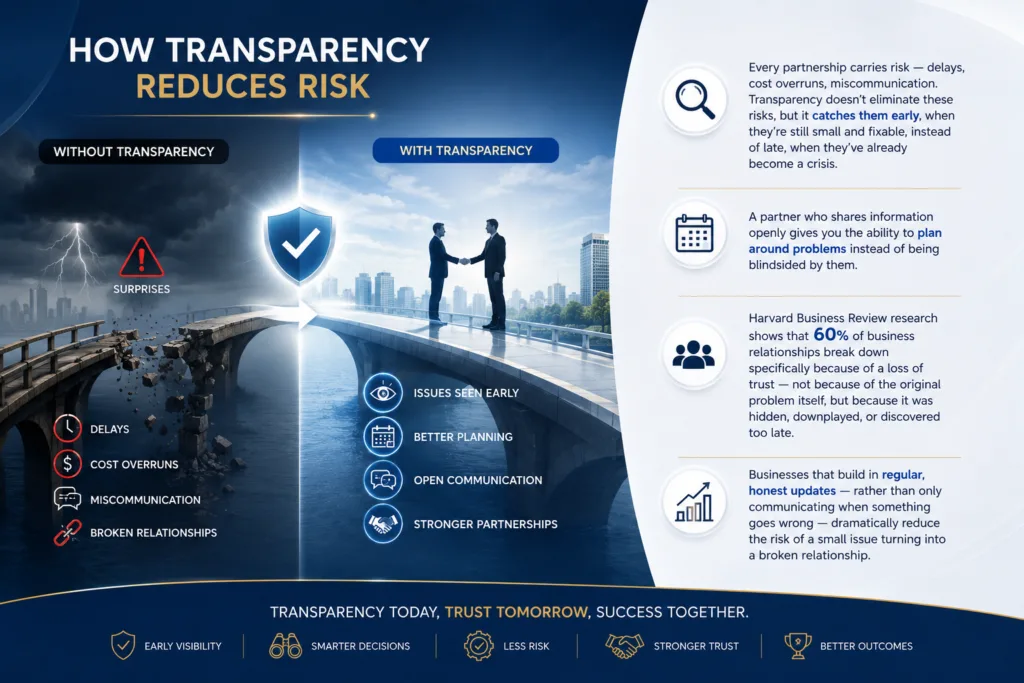
Every business partnership carries risk delays, cost overruns, miscommunication. Transparency doesn’t eliminate these risks, but it catches them early, when they’re still small and fixable, instead of late, when they’ve already become a crisis.
A partner who shares information openly gives you the ability to plan around problems instead of being blindsided by them. This is also why research from Harvard Business Review found that 60% of business relationships break down specifically because of a loss of trust not because of the original problem itself, but because it was hidden, downplayed, or discovered too late. (Source) Businesses that build in regular, honest updates — rather than only communicating when something goes wrong dramatically reduce the risk of a small issue turning into a broken relationship.
5. How Trust and Transparency Turn Deals Into Real Partnerships
A one-time deal and a real, lasting partnership are built differently. Here’s what actually moves a business relationship from “just a transaction” to a genuine partnership.
Aligning Goals
Every strong partnership starts with both sides being honest about what they actually want out of the relationship not just what sounds good in a meeting. When goals are stated openly instead of assumed, both sides can plan around the same outcome instead of quietly working toward different ones, which is one of the most common, and most avoidable, reasons partnerships quietly fall apart.
Building Open Communication Channels
Trust needs a channel to travel through. That means regular check-ins, clear points of contact, and a habit of sharing updates good and bad before they’re asked for. Partnerships that only communicate when there’s a problem tend to associate every conversation with bad news, which slowly erodes trust even when the underlying relationship is fine.
Creating Ownership and Responsibility
A transparent partnership is one where both sides are willing to say “that was on us” when something goes wrong, instead of deflecting or staying quiet. This kind of accountability is what separates a partner you can rely on from one you have to constantly double-check and it’s very hard to fake over time.
Establishing Long-Term Trust
Trust isn’t built in one meeting it’s built transaction by transaction, promise by promise. Every time a business does what it said it would do, it adds to a track record. Over enough time, that track record becomes the actual reason a partner stays loyal, far more than any single price point ever could.
6. A Real-World Example
Buffer, a social media management platform, built its reputation almost entirely around radical transparency publicly sharing its revenue, its financial metrics, and even the exact formula it uses to calculate every employee’s salary. Instead of damaging the company, this openness built a loyal customer base that appreciated being let into the company’s real journey, including its setbacks, resulting in strong media coverage and long-term customer loyalty. (Source)
Patagonia offers another clear example. The outdoor apparel company built its brand around openly sharing its supply chain practices and the environmental impact of its products including admitting when a popular product had a larger environmental footprint than expected. Rather than hurting the brand, this transparency deepened customer loyalty, and the company’s sales grew to nearly a billion dollars in 2019. (Source)
Perhaps the most well-known case is Johnson & Johnson’s response to the 1980s Tylenol crisis, still taught in business schools today. When the company faced a serious product safety crisis, it responded with immediate transparency taking responsibility publicly and communicating openly with customers throughout, rather than minimizing the issue. That transparent response is widely credited with rebuilding public trust and positioning the company as a long-term leader in ethical business practice. (Source)
The common thread in all three: none of these companies were the cheapest option in their industry. What made customers and partners stay was the confidence that these businesses would tell the truth, even when the truth wasn’t flattering.
7. FAQs
Why does trust matter more than price in a business partnership? Because price is a one-time decision, but trust determines whether the relationship survives problems, delays, and unexpected changes which every long-term partnership eventually faces.
Can transparency actually hurt a business? It can invite more scrutiny, since sharing more information means more can be questioned but studies consistently show the trust it builds outweighs that risk, especially over the long term.
How do you build trust with a new business partner quickly? Start by being transparent early share pricing clearly, communicate realistic timelines, and follow through on small commitments before asking for larger ones. Trust builds fastest through consistency, not promises.
What’s the difference between trust and transparency? Transparency is the action openly sharing information. Trust is the result the confidence that builds up in the other person because of that openness over time.
8. Conclusion
Price will always be part of any business decision, but it’s rarely the reason a partnership actually lasts. The businesses and partnerships that survive through delays, mistakes, and market changes are the ones built on trust that was earned honestly, through transparency that didn’t wait to be asked for. In the long run, a partner you can rely on is worth more than a partner who was simply cheaper.
Read Also: Real Estate vs Pharma vs Hospitality: Which Is the Best Investment in Pakistan 2026?