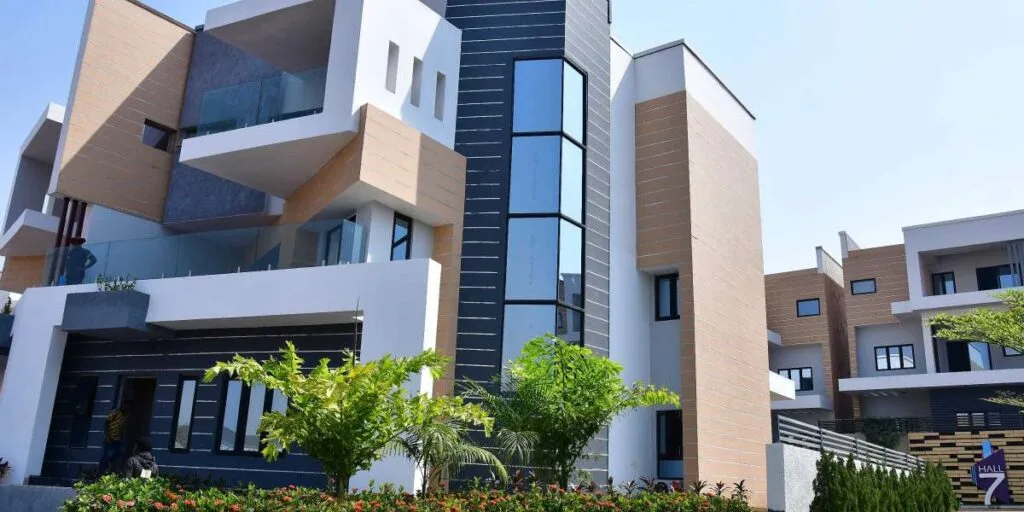

Complete Guide to Buying Your First Apartment in Pakistan (2026): Legal Checklist & Documentation

Introduction

Buying your first apartment is one of the biggest financial decisions you’ll make and buying an apartment in Pakistan comes with its own set of questions that generic international guides simply don’t answer. What documents actually prove clear ownership? What taxes will you really pay in 2026? Can a non-filer or an overseas Pakistani legally buy? And how do you avoid the fraud cases that make headlines every year?

This guide is the apartment buying checklist that answers all of it in one place combining practical buying steps with the legal and tax specifics that apply in Pakistan today, linking directly to the official government portals you’ll actually need, so you can move from “just looking” to “confidently owning” without the guesswork.

If you’re specifically looking in Islamabad, this checklist is also the exact standard ISMMART Group of Industries holds its own projects to every unit we offer comes with verified CDA approvals and transparent documentation from day one, which is exactly what this guide will teach you to check for yourself before buying from anyone.

Table of Contents

  1. Who Can Buy an Apartment in Pakistan?

  2. Understand Your Buying Options
  3. Plan Your Budget Including the Costs Nobody Mentions
  4. Financing Your Apartment: Bank Loans & Roshan Apna Ghar
  5. Choosing the Right Location and Developer
  6. The Complete Legal Checklist & Documentation
  7. Understanding Property Taxes in 2026
  8. Step-by-Step Buying & Registration Process
  9. A Special Note for Overseas Pakistanis
  10. Common Mistakes First-Time Buyers Make
  11. FAQs

1. Who Can Buy an Apartment in Pakistan?

Before anything else, it helps to know where you stand legally:

  • Pakistani nationals have unrestricted rights to buy property anywhere in the country.
  • Overseas Pakistanis enjoy relatively relaxed buying conditions but still need to follow proper legal and tax procedures, including obtaining a National Tax Number (NTN) through the FBR’s official IRIS portal.
  • Foreigners can buy property in Pakistan, but only after securing a No Objection Certificate (NOC), and certain areas may be restricted depending on the province.
  • Non-filers can legally buy an apartment too but they now pay a noticeably higher withholding tax than active tax filers, so registering as a filer on FBR’s IRIS system before your purchase can save you a significant amount.

2. Understand Your Buying Options

Not every apartment purchase looks the same. Before you fall in love with a unit, understand which category it falls into because each comes with a different risk and reward profile.

Ready-to-Move-In: The apartment is complete and available for immediate possession. You can physically inspect the actual unit multiple times before buying, which lowers risk. The trade-off is a higher purchase price and slower future appreciation compared to buying early.

Under-Construction: Lower entry cost, flexible payment plans, and generally higher appreciation potential by the time of completion. The risk is possession delays, so this option only makes sense with a builder who has a verified delivery track record.

New Launch Projects: The earliest and usually cheapest entry point, but also the highest-risk category you’re buying largely on trust and marketing material, so developer verification becomes non-negotiable here.

Resale Apartments: You get to see exactly what you’re buying and can often negotiate on price, but resale units require extra diligence on ownership history, outstanding dues, and mutation records.

If you want lower risk and can pay a premium, go ready-to-move. If you want better appreciation and can tolerate some construction risk, under-construction from a proven developer is usually the smarter financial move.

3. Plan Your Budget — Including the Costs Nobody Mentions

The listed price of the apartment is not what you’ll actually pay. Budget for these on top of the unit price:

  • Property registration fees (typically 1–3% of transaction value, varies by province)
  • Stamp duty
  • Capital Value Tax (CVT)
  • Withholding tax (rate depends on filer status check yours via FBR’s Active Taxpayer List verification)
  • Society or building maintenance deposit
  • Parking charges, where applicable
  • Legal and documentation fees if you’re using a lawyer or consultant

First-time buyers frequently budget only for the sale price and get blindsided by these additions at the registration stage. Set aside an additional buffer as a rule of thumb budgeting an extra 5–7% above the sale price covers most of these costs comfortably.

4. Financing Your Apartment: Bank Loans & Roshan Apna Ghar

If you’re not paying entirely from savings, you have real financing options in 2026 and they’re more affordable than they’ve been in years, following the State Bank’s policy rate cuts from a 22% peak in 2023 to roughly 10.5–11.5% today.

Standard bank loan process:

  1. Check your credit score and loan eligibility
  2. Compare interest rates across banks
  3. Choose between fixed or floating rates based on your risk tolerance
  4. Submit income proof, identity documents, and property paperwork
  5. Bank verifies the property and approves the loan
  6. Sign the loan agreement and begin EMI payments

Fixed vs. Floating rates: Fixed rates are typically higher but stay constant, giving predictable EMIs ideal if you have a limited or fixed income and want stability. Floating rates are usually lower and carry no prepayment penalty, but they move with the market, so they suit buyers who can tolerate some fluctuation.

For overseas Pakistanis: The State Bank’s Roshan Apna Ghar scheme allows non-resident Pakistanis to digitally buy, build, or renovate property with simplified paperwork, with financing available from 3 to 25 years in both conventional and Shariah-compliant formats. It’s paired with a Roshan Digital Account for remittance and payments you can open one directly through any RDA-participating bank’s website.

5. Choosing the Right Location and Developer

Location determines both your daily comfort and your resale value. Before deciding, check:

  • Proximity to your workplace and the city center
  • Access to schools, hospitals, and main roads
  • Public transport availability
  • Neighborhood safety and basic infrastructure (especially water supply)
  • Upcoming development projects nearby that could boost future value

Verify the society’s regulatory approval directly with the relevant authority — never take a developer’s word for it.
In Islamabad, this means checking a society’s NOC status with the Capital Development Authority (CDA). In Rawalpindi, the equivalent authority is the Rawalpindi Development Authority (RDA) — a society advertised as being “near Islamabad” or “twin cities” is not automatically CDA-approved just because it borders the capital; confirm which of the two bodies actually approved it, since CDA and RDA jurisdictions are separate and a project can be legitimate under one but unapproved or informally developed under the other. In Lahore, check with the LDA, and in Karachi, with the SBCA.

Developer verification matters just as much. Between 2019 and 2020 alone, roughly 1,000 developers launched apartment projects in Islamabad and Rawalpindi by 2024, only about 100 were still active. Before committing, check the builder’s completed project history, delivery timelines, and whether they’re still actively delivering projects today, not just marketing new ones. This is exactly the standard ISMMART Group of Industries holds itself to across its real estate ventures transparent documentation and a verifiable delivery record, not just marketing promises. You can review our portfolio at ismmartindustries.com.

6. The Complete Legal Checklist & Documentation

This is the section most guides rush through and where most fraud actually happens. Go through every item below before you pay a single rupee beyond a token/booking amount.

Documents to Verify Before Buying

Document Purpose Why It Matters
Title Deed Confirms current legal ownership Core proof the seller actually owns the property
Sale/Allotment Letter Proof of ownership in a housing scheme or from the original developer Confirms the chain of ownership
NOC (No Objection Certificate) Permission from relevant authority (CDA, RDA, LDA, or SBCA depending on city) for the sale Without this, the sale may not be legally enforceable
Mutation Documents Records the transfer of ownership in land records Shows the property’s ownership history is clean
Tax Receipts Proof that property taxes are fully paid Avoids inheriting the previous owner’s tax disputes
Building Approval Plan / Map Local authority-approved layout Confirms the structure itself is legally built
Occupancy/Completion Certificate Confirms the building was constructed as per approved plans Essential for ready or newly completed apartments
Encumbrance Certificate Confirms no outstanding loans, liens, or legal dues Protects you from inheriting hidden liabilities

Your Step-by-Step Verification Checklist

  1. Confirm the seller’s identity and ownership request the original title deed and mutation documents, not photocopies.
  2. Verify NOCs and approvals with the relevant local development authority CDA for Islamabad, RDA for Rawalpindi, or the LDA/SBCA equivalent for Lahore/Karachi.
  3. Check for a clear title confirm there are no mortgages, liens, or ongoing disputes attached to the unit.
  4. Request a tax clearance certificate, and cross-check the seller’s filer status through FBR’s Active Taxpayer List, to ensure all dues are settled before you take over.
  5. Ask for litigation history confirmation a simple written confirmation that no court case is attached to the property.
  6. Review the sale agreement carefully payment schedule, possession date, and penalty clauses should all be explicit in writing, never verbal.
  7. Complete registration at the relevant land/sub-registrar’s office, followed by mutation to formally record the change of ownership.

A verbal agreement, however trustworthy the seller seems, is nearly impossible to enforce later insist on formal, written documentation at every stage.

7. Understanding Property Taxes in 2026

Taxes are where most first-time buyers get caught off guard. Here’s what actually applies:

Tax Type Typical Rate Who Pays
Capital Value Tax (CVT) Varies by province Usually the buyer
Stamp Duty Varies by province and property type Paid at registration
Withholding Tax (Filers) Reduced significantly under 2026 reforms Deducted from the transaction
Withholding Tax (Non-Filers) Noticeably higher than filer rate Deducted from the transaction

Key 2026 update: The federal budget for FY2026–27 reduced the combined withholding tax rate for active filers to a flat 1.25% on purchase (2.75% for sellers) and formally abolished the Section 7E deemed-income tax on undeveloped land, after Pakistan’s Federal Constitutional Court declared it unconstitutional in May 2026 (Chakor Ventures, Trustpoint) collectively lowering the cost of buying and holding property this year compared to previous years. If you’re not currently a tax filer, registering with the FBR through IRIS before your purchase is one of the simplest ways to reduce your overall transaction cost.

8. Step-by-Step Buying & Registration Process
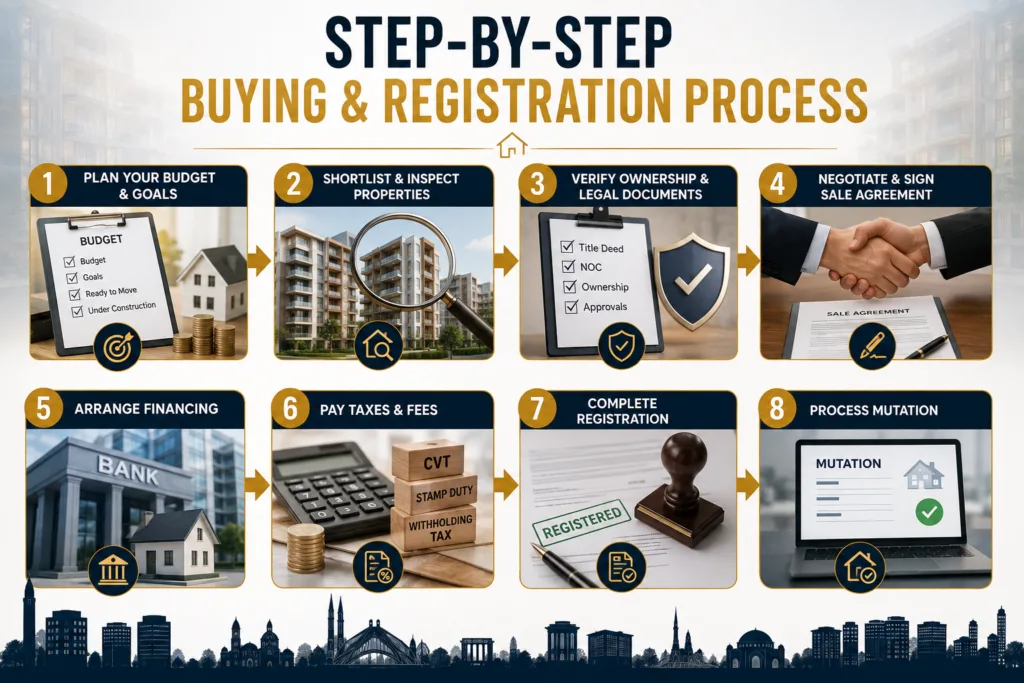
  1. Define your budget and goals decide between ready-to-move and under-construction based on your risk appetite.
  2. Shortlist and inspect properties never buy sight-unseen unless you’ve engaged a trusted representative to inspect on your behalf.
  3. Verify ownership and legal documents using the checklist above, including a direct NOC check with CDA, RDA, or the relevant city authority.
  4. Negotiate and sign the sale agreement, with every clause price, schedule, and possession date in writing.
  5. Arrange financing, if applicable, and complete bank verification including through Roshan Apna Ghar if you’re an overseas buyer.
  6. Pay applicable taxes and fees CVT, stamp duty, and withholding tax.
  7. Complete registration at the local land registry office.
  8. Process mutation to officially record your ownership in revenue records.

9. A Special Note for Overseas Pakistanis

If you’re buying from abroad, the process needs a few extra steps built in:

  1. Get your NTN (National Tax Number) from the FBR it’s mandatory for property registration and can be obtained online through the FBR IRIS portal without visiting Pakistan.
  2. Open a Roshan Digital Account to handle payments through formal, traceable banking channels most major banks let you open one entirely online.
  3. If you plan to buy, build, or renovate a home, apply through Roshan Apna Ghar, which offers financing from 3 to 25 years and lets you use your RDA holdings as collateral.
  4. Appoint a trusted representative ideally a professional with a Special Power of Attorney, attested by your nearest Pakistani Embassy or Consulate, to handle inspections, negotiations, and paperwork on your behalf.
  5. Request video tours and geotagged photos of the actual unit, and have your representative physically inspect it before you commit funds.
  6. Keep a Foreign Remittance Certificate for all funds transferred this can help you avoid certain withholding tax complications later.
  7. Verify 30–40 years of ownership history where possible, especially for resale units, to rule out disputed titles and confirm the society’s NOC directly with CDA, RDA, LDA, or SBCA rather than relying on the seller’s claim.

Overseas buyers are, unfortunately, a common target for fraud simply because physical verification is harder from a distance which makes a trustworthy local representative, a developer with a verified track record, and direct authority-level NOC verification the most important safeguards you have.

10. Common Mistakes First-Time Buyers Make

  • Budgeting only for the sale price and ignoring registration fees, taxes, and maintenance deposits
  • Choosing a location based on price alone, ignoring connectivity and future growth
  • Not verifying the developer’s actual delivery track record
  • Relying on verbal promises instead of a written, detailed sale agreement
  • Skipping a professional inspection before finalizing
  • Overlooking loan eligibility and realistic repayment capacity
  • Buying under sales pressure or “limited-time” discount offers
  • Not checking for unpaid taxes or utility dues tied to the property
  • Trusting a society’s marketed location (“near Islamabad,” “twin cities”) instead of confirming which authority CDA or RDA actually approved it
  • For overseas buyers specifically: skipping physical verification entirely and relying only on photos or brochures

11. FAQs

Is it a good idea to buy an apartment as a first-time investment in Pakistan? Yes apartments generally offer steady rental demand and lower maintenance responsibility compared to houses, especially in urban centers where land is scarce and vertical living is growing fast.

Can a non-filer legally buy an apartment in Pakistan? Yes, but non-filers pay a higher withholding tax than active filers. Registering as a filer through FBR’s IRIS portal before your purchase is a simple way to reduce your total cost.

What is the single most important document to verify before buying? The title deed, cross-checked against mutation records, since it confirms the seller actually has the legal right to sell the property.

Is buying an under-construction apartment safe? It can be, provided the developer has verified NOCs from the relevant authority (CDA, RDA, LDA, or SBCA), approvals, and a proven history of completing projects on time.

What documents do overseas Pakistanis need to buy an apartment? CNIC/NICOP, an NTN certificate (obtainable via FBR IRIS), proof of remittance through a Roshan Digital Account, and if using a representative an attested Special Power of Attorney.

Final Word

Buying your first apartment doesn’t have to feel like a gamble. The buyers who run into trouble are almost always the ones who skipped documentation checks, trusted verbal promises, or rushed the decision under sales pressure. Take the process step by step verify directly with the relevant authority, document everything in writing, and choose a developer whose track record you can actually confirm.

That last point is where most projects fall short and it’s exactly where ISMMART Group of Industries is built differently. Every apartment we offer in Islamabad comes with verified CDA-approved documentation, a transparent payment structure, and a delivery record you can check for yourself rather than take on faith. If you’re evaluating apartments in Islamabad and want a developer that already meets every item on this checklist, explore our current portfolio at ismmartindustries.com.
Apartment vs House vs Plot: Which Is the Smartest Investment in Pakistan (2026)?

Introduction

Every property conversation in Pakistan eventually lands on the same question: apartment, house, or plot which one is the smartest investment? Most guides answer it with a generic pros-and-cons list written years ago, comparing only two of the three options and ignoring how much the market and the cities themselves have actually changed.

2026 is not the same market it was even twelve months ago. The State Bank of Pakistan has cut its policy rate from a 22% peak in 2023 down to roughly 10.5–11.5%. The FY2026–27 federal budget abolished Section 7E the deemed-income tax on undeveloped land after Pakistan’s Federal Constitutional Court declared it unconstitutional in May 2026 (Chakor Ventures, Trustpoint). RERA has introduced formal investor protection for the first time in the country’s history. These shifts have quietly changed the return profile of all three asset types and most existing blogs simply haven’t caught up.

This guide breaks the decision down with real 2026 data, city-by-city society comparisons, the regulatory authorities you need to verify against, and real case histories not just opinions so you have a clear framework for deciding which option actually fits your goals.

Table of Contents

  1. What Is an Apartment, House, and Plot? — Quick Definitions
  2. Apartments: The Income Play
  3. Houses: The Balanced Choice
  4. Plots: The Long-Game Capital Growth Asset
  5. Side-by-Side Comparison Table
  6. City-by-City Reality Check: Societies, Authorities & Case Histories
  7. What Changed in 2026 That Nobody’s Talking About
  8. Which One Fits Your Investor Profile?
  9. The Mistake Most Investors Make
  10. Final Word

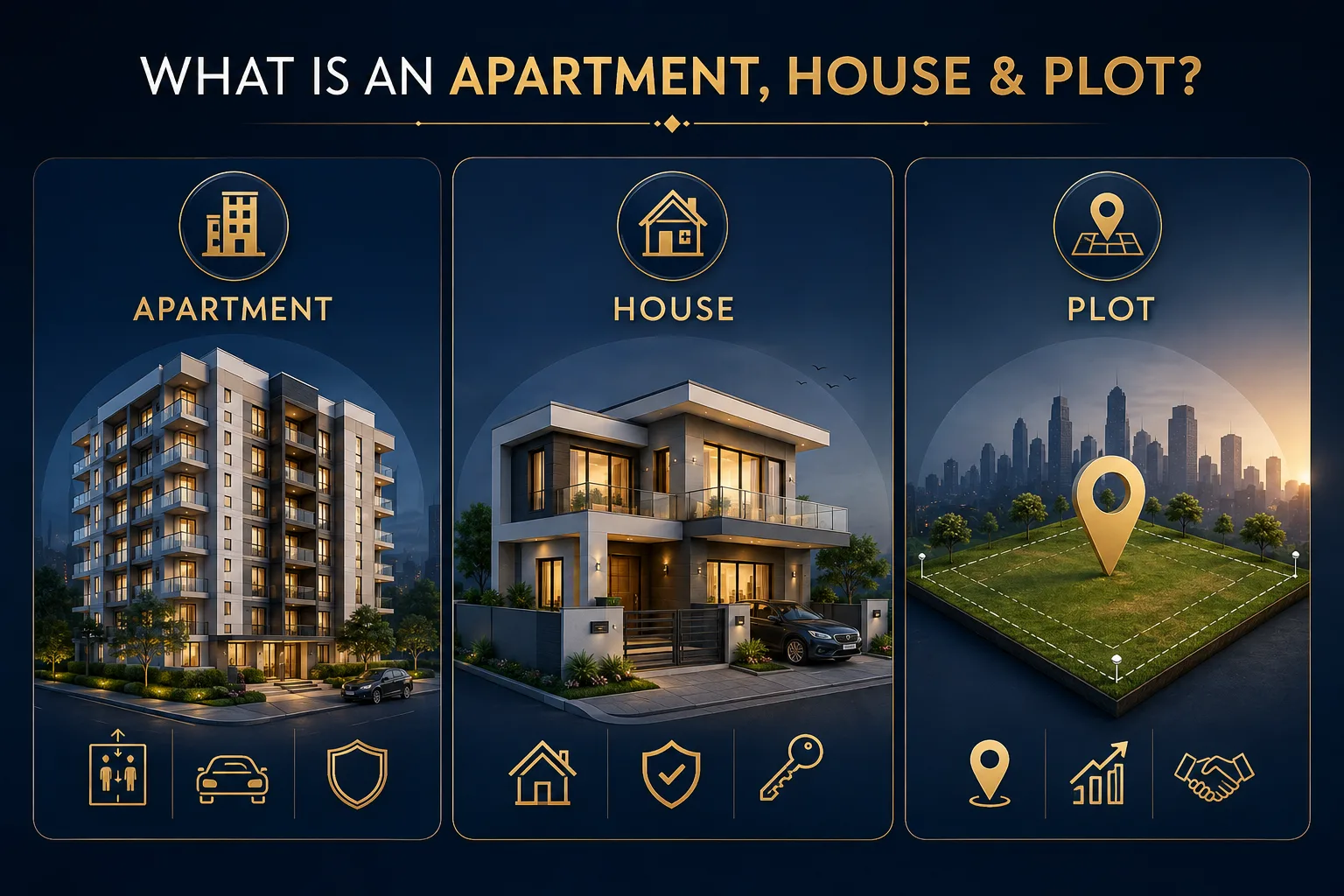
What Is an Apartment, House, and Plot?

Before comparing returns, it helps to be clear on what each option actually means as an investment class in Pakistan.

Apartment (Flat): A residential unit within a multi-story building, typically part of a housing society or standalone tower, managed collectively through society or building maintenance fees. Ownership covers the unit itself, with shared rights to common areas like lifts, parking, and amenities.

House: A standalone or semi-detached residential structure built on its own plot of land, usually within a housing society, offering full ownership of both the structure and the land beneath it. A house can be purchased ready-built or constructed by the owner.

Plot: A parcel of undeveloped or partially developed land, purchased with the intention to build on it later, hold it for appreciation, or resell it. Plots are sold as residential, commercial, or agricultural, depending on the zoning of the housing society or area.

Each of these behaves differently as an investment in income potential, appreciation speed, liquidity, and risk. Here’s how they compare in detail.

Apartments: The Income Play

Apartments have become Pakistan’s fastest-growing property category as land scarcity pushes cities like Karachi, Lahore, and Islamabad to build vertically.

What the data says in 2026:

  • Gross rental yields for apartments across Pakistan average 6.24% nationally, according to Global Property Guide research.
  • Karachi’s residential market recorded an average gross rental yield of 6.67% in Q1 2026, among the strongest in the country (IQI Global).
  • In Lahore, apartments in Gulberg and DHA are pushing 7–8% net yield after service charges some of the highest returns of any asset class in the city (Royal Properties).

Pros:

  • Immediate, predictable monthly income once rented out
  • Lower entry price than a comparable house in the same location
  • Building maintenance is usually handled by the management company, not the owner
  • Strong demand from young professionals, small families, and expatriates who prefer secure, low-maintenance living

Cons:

  • Slower capital appreciation compared to plots
  • Value depends heavily on building maintenance and developer reputation
  • Harder to liquidate quickly than a plot in a prime location
  • Service charges and society dues eat into net rental income

The real risk to know about: Between 2019–2020, roughly 1,000 developers launched apartment projects in Islamabad and Rawalpindi alone. By 2024, only around 100 were still active (Gondal Group of Marketing). This is why builder due diligence matters more for apartments than for any other asset type you’re not just buying a unit, you’re betting on a company’s ability to deliver and maintain it. (See the Islamabad case history below for exactly what this looks like in practice.)

Houses: The Balanced Choice

A house sits between an apartment and a plot. It’s a place to live, but it also behaves like a real estate asset with its own appreciation curve.

What the data says in 2026:

  • The average house price in Lahore stood at PKR 5.32 crore as of the March 2026 Zameen price index, a figure that has stayed relatively flat year-over-year, signaling a market in a selective, not speculative, phase (Royal Properties).
  • Financing has become notably cheaper as the SBP’s policy rate fell from 22% in 2023 to roughly 10.5–11.5% by mid-2026, making mortgage products like Roshan Apna Ghar meaningfully more affordable than two years ago (Milkiyat).

Pros:

  • Combines lifestyle utility (you can live in it) with asset value
  • Land underneath the structure still appreciates even as the building ages
  • More financing options available compared to plots, since banks are generally more willing to lend against a built structure
  • Full control over renovation, expansion, and customization

Cons:

  • Highest upfront cost of the three options in most cases
  • Maintenance, repairs, and renovation costs fall entirely on the owner typically 1–3% of the property’s value annually (Izhar Monnoo Developers)
  • Slower to sell than a plot buyers need to personally like the layout, condition, and construction quality
  • Depreciation of the structure itself can offset gains if the property isn’t maintained

Who this suits: Buyers who want to eventually live in the property, families planning for the long term, and anyone who values a tangible, customizable asset over pure investment optimization.

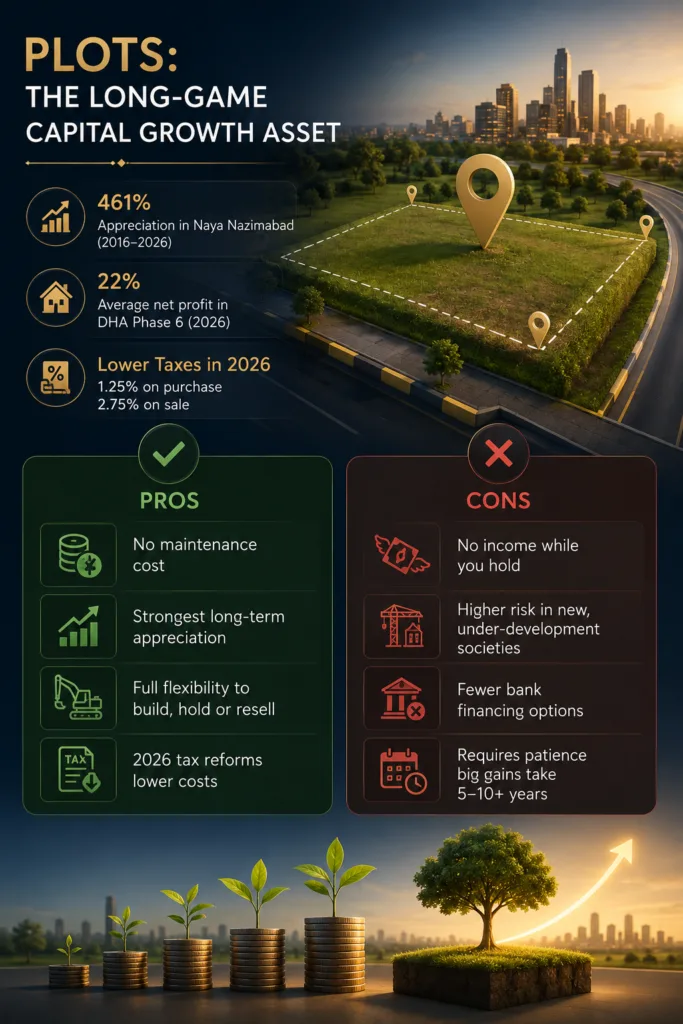
Plots: The Long-Game Capital Growth Asset

Plots remain the most trusted store of long-term value in Pakistani real estate land doesn’t age, doesn’t need maintenance, and historically doesn’t depreciate.

What the data says in 2026:

  • Naya Nazimabad in Karachi recorded cumulative capital appreciation of 461% between January 2016 and June 202 one of the clearest long-term case studies for plot appreciation in the country (IQI Global).
  • DHA Phase 6 recorded an average net profit of 22% on buy-renovate-resell strategies in 2026 alone (IQI Global).
  • The FY2026–27 federal budget abolished the Section 7E deemed-income tax on undeveloped land entirely and cut the combined withholding tax for active filers to a flat 1.25% on purchase and 2.75% on sale on a PKR 100 million transaction, that’s a meaningful direct saving, lowering both the cost of holding and exiting plots (Chakor Ventures).

Pros:

  • No maintenance cost land requires nothing to hold onto
  • Historically the strongest long-term appreciation of the three categories
  • Full flexibility to build, hold, or resell on your own timeline
  • 2026 tax reforms specifically reduced the cost of investing in and exiting land

Cons:

  • Generates zero income while you hold it no rent, no cash flow
  • Plots in new, under-development housing societies carry real risk, since services, possession, and full development take years
  • Fewer bank financing options compared to houses and apartments
  • Requires patience the biggest gains are typically realized over 5–10+ years, not months

Side-by-Side Comparison

Factor Apartment House Plot
Entry cost Moderate Highest Lowest to moderate
Monthly income Yes (6–8% yield) Only if rented out No
Capital appreciation Moderate Moderate Highest (long-term)
Liquidity (ease of resale) Moderate Slower Fastest
Maintenance responsibility Low (managed) High (owner) None
Bank financing availability Good Best Limited
Best time horizon 3–7 years 5–10+ years (or lifetime use) 5–10+ years
2026 regulatory tailwind Rate cuts improving affordability Cheaper mortgages Section 7E abolition + lower transaction tax

City-by-City Reality Check: Societies, Authorities & Case Histories

The comparison above holds true in general, but “apartment vs house vs plot” plays out very differently depending on which city you’re buying in and which income class of society you’re looking at. Here’s the breakdown for Pakistan’s three biggest property markets, including the regulatory bodies you need to verify against and real case histories worth knowing before you commit.

Islamabad — Regulated by the CDA

Every housing society in Islamabad needs an NOC (No Objection Certificate) from the Capital Development Authority (CDA) before it can legally sell plots, houses, or apartments (Sky Marketing). Always check a society’s live CDA approval status before booking anything here.

  • Elite / upper class: DHA Islamabad and Bahria Town Islamabad (Phases 7, 8, and Bahria Enclave) sit at the top. Bahria Town is known for 24/7 electricity, theme parks, and its own hospitals, while DHA is built around military-grade security and structured sector planning (4Dewaari, Sapphire Properties) both are the natural fit for buyers who want houses and plots in a fully self-contained, high-security lifestyle.
  • Upper-middle class: Naval Anchorage (developed by the Pakistan Navy, with its CDA-approved design dated 21 July 2005) is a strong fit for buyers who want CDA backing and a quieter, established environment without Bahria/DHA pricing (Mr. Property Marketing).
  • Middle class: B-17 (Multi Gardens) is the go-to for middle-class families wanting CDA-approved plots with Margalla Hills views it’s widely cited as the best “value for money” option in Islamabad West, especially now that Margalla Avenue links it directly to the F and E sectors (4Dewaari).

Apartment case history — The Centaurus (Sector F-8): This is Islamabad’s most recognizable vertical development and the best real-world example of how apartment projects actually unfold over time. The complex is owned by the Centaurus Group of Companies, chaired by Sardar Muhammad Ilyas Khan, with Sardar Rashid Ilyas Khan as President and Sardar Yasir Ilyas as CEO, and was developed by Pak Gulf Construction together with Al Tamimi Group (Saudi Arabia) and Sardar Builders (Wikipedia). Construction began in 2006 on a CDA-leased plot of 32,040 square yards, with the original approved plan calling for four towers — two residential (Towers A & B), one office (Tower C), and one 42-storey hotel (Tower D). The mall opened in 2013, and the residential apartment towers were completed and sold, but the project ran into a public dispute with the CDA in 2017 when Centaurus management tried to convert the office tower into a hotel tower instead of building the originally approved Tower D partly because the shopping mall had not yet secured its own completion certificate (Dawn). The Movenpick-branded hotel component didn’t actually open until early 2025 nearly two decades after construction started (Wikipedia). The lesson for apartment buyers: even a landmark, high-profile, CDA-leased project from a well-known ownership group can take years longer than promised and go through design and approval disputes mid-way. Verify a project’s current approval status and completion certificates not just its reputation or its owners’ name recognition before buying on installments.

Lahore — Regulated by the LDA (and RUDA for Ravi-side projects)

The Lahore Development Authority (LDA) issues NOCs for housing societies across the city; as of late 2025 there were roughly 320 LDA-approved societies in Lahore, ranging from decades-old schemes to projects approved as recently as 2024 (ABS Developers). Newer riverfront developments near Ravi also fall under the Ravi Urban Development Authority (RUDA).

  • Elite / upper class: DHA Lahore and Gulberg remain Lahore’s most prestigious addresses, offering houses, plots, and increasingly apartments in high-rise towers along MM Alam Road and Gulberg’s commercial belt, where units now command premium per-square-foot rates (Wall.pk). This is also where apartment rental yields are strongest in the whole city 7–8% net, as noted above.
  • Upper-middle class: Bahria Town Lahore, on Canal Road, spans multiple themed sectors (including Parisian-style blocks) and offers a full “lifestyle in one place” package with mosques, amusement parks, and hospitals popular with families who want DHA-level amenities at a lower entry price (Sapphire Properties, ABS Developers).
  • Middle class: Wapda Town and Johar Town are older, well-developed, LDA-approved schemes known for affordability alongside functioning infrastructure banks, branded shops, and established parks on the main boulevard (Union Developers).
  • Budget-conscious / first-time buyers: Naz Town and parts of Wapda Town offer some of the most affordable LDA-approved plots in the city, in the PKR 2–5 lac per Marla range as of late 2025 (ABS Developers).

Karachi — Regulated by the SBCA and KDA

In Karachi, the Sindh Building Control Authority (SBCA) approves and regulates housing society development and planning, while legacy schemes and land records often still reference the older Karachi Development Authority (KDA) framework (e.g., “KDA Scheme 33”) (Plotistan, ZameenLocator). Always confirm live SBCA approval status directly — Karachi has historically had more disputed and informally-developed schemes than Lahore or Islamabad.

  • Elite / upper class: DHA Karachi and Clifton are the city’s most expensive addresses, prized for coastal proximity, wide roads, and access to Clifton Beach, Dolmen Mall, and top private hospitals (Estate Safe Marketing).
  • Upper-middle class: Bahria Town Karachi, on the Karachi-Hyderabad Super Highway, is marketed as a self-contained “city within a city” with its own power, water, and security systems, and became especially popular during 2020 as families sought open space away from cramped city apartments (Property Pole). It comes with a significant legal case history every serious buyer should know (below).
  • Middle class: Naya Nazimabad, developed by Javedan Corporation (part of the Arif Habib Group), was launched in November 2011 near Sakhi Hasan as one of Karachi’s largest private-sector planned developments, aimed specifically at middle-income buyers with installment options (Wikipedia, Zameen). It’s a strong real-world case study for this income tier: plots here have appreciated a cumulative 461% between January 2016 and June 2026 (IQI Global), and the project now has multiple SBCA-approved NOCs covering both open plots and high-rise apartment blocks like Globe Residency (Manahil Estate) making it one of the few Karachi societies genuinely offering all three asset types (plots, houses, and apartments) to the same middle-class buyer.
  • Affordable / budget-conscious: Gulistan-e-Jauhar, Gulshan-e-Iqbal, and Scheme 33 (formerly co-managed by the KDA and the Board of Revenue) are the city’s established, budget-friendly options, popular for their proximity to universities, Safari Park, and major hospitals (Marina Builders, ZameenLocator).

Case history Bahria Town Karachi’s land dispute: This is the single most important cautionary case history in Pakistani real estate, and every Karachi buyer should understand it. In March 2019, Pakistan’s Supreme Court ruled that Bahria Town Karachi had illegally acquired roughly 16,896 acres of land in Malir district and ordered the developer to pay a Rs 460 billion settlement over seven years to legalize its holdings (Dawn). By late 2023, only about Rs 60.72 billion of that amount had actually been paid, and the Supreme Court issued fresh notices over the shortfall (Business Recorder). Because of this unresolved land status, mortgage financing for Bahria Town Karachi properties has remained largely unavailable, limiting the buyer pool mostly to cash buyers (Property Pole) a real, practical difference from DHA Karachi, where bank financing is routine. This doesn’t mean BTK is a scam development has continued, and the society remains genuinely popular, especially for houses and plots in developed precincts. But it’s a clear, real-world example of why “well-known and popular” is not the same as “fully clean on paper,” and why checking a society’s live legal and regulatory status matters even for the biggest names in the market.

What Changed in 2026 That Nobody’s Talking About

Most “apartment vs plot” content online is 2–3 years old and doesn’t reflect the current environment. Here’s what actually shifted this year:

  • Interest rates fell sharply. The SBP’s policy rate dropped from a 22% peak in 2023 to around 10.5–11.5% by mid-2026, making financing for houses and apartments significantly more accessible.
  • Land taxation got lighter a lot lighter. Section 7E, the deemed-income tax on undeveloped land, has been fully abolished under the FY2026–27 Finance Bill, after Pakistan’s Federal Constitutional Court declared it unconstitutional in May 2026. Advance tax on property sales for filers also dropped to a flat 2.75%, and purchase-side tax to 1.25% (Chakor Ventures). This directly improves the economics of holding and exiting plots specifically.
  • RERA introduced formal investor protection. For the first time, Pakistan has a regulatory framework offering real estate investors a layer of formal protection a meaningful shift for anyone nervous about developer reliability, especially in the apartment segment where builder attrition has historically been high (see the Centaurus and 1,000-builder examples above).
  • Inflation has cooled but remains a factor. Real estate continues to function as one of the few assets that generates income and grows in value simultaneously, even as broader price pressures ease.

Which One Fits Your Investor Profile?

  • You want passive monthly income and don’t want to deal with construction: Apartment, in an established, well-managed building with a verified delivery track record ideally in a high-yield pocket like DHA/Gulberg Lahore or Karachi’s stronger residential zones.
  • You’re buying for your family to live in, with investment as a secondary goal: House, ideally in a developed, LDA/CDA/SBCA-approved area with confirmed bank financing availability.
  • You have a 7–10 year horizon and want maximum capital growth, with no need for income along the way: Plot, preferably in a developed section of a reputable, currently-approved housing society (Naya Nazimabad and DHA Phase 6 are useful reference points for what strong long-term plot appreciation actually looks like).
  • You’re an overseas Pakistani looking for a hands-off asset: A completed apartment with existing tenants, or a developed plot in an established society both reduce the on-ground management burden compared to an under-construction house.

The Mistake Most Investors Make

They pick a category before picking a developer. The single biggest driver of returns or losses in all three categories isn’t apartment vs house vs plot. It’s who you’re buying from, and which authority has actually approved the project. A NOC-approved project from a developer with a verified delivery track record will consistently outperform an unapproved, cheaper alternative in any category and, as the Centaurus and Bahria Town Karachi case histories above show, even big, recognizable names can carry real regulatory and delivery risk. Before committing capital, verify the project’s live CDA/LDA/SBCA approvals, the developer’s completed project history, and whether the builder is still active and delivering in the current market.

Final Word

There’s no universally “best” investment among apartments, houses, and plots only the one that matches your capital, your timeline, your need for income versus growth, and the specific city and society you’re buying into. What 2026 has changed is the cost of getting there: cheaper financing, the abolition of Section 7E, and a regulatory framework that finally gives investors some protection.

At ISMMART Group of Industries, we help investors evaluate decisions like this the same way we approach every investment across our subsidiaries with transparency and a long-term view rather than sales pressure. For more details on our real estate portfolio, visit ismmartindustries.com

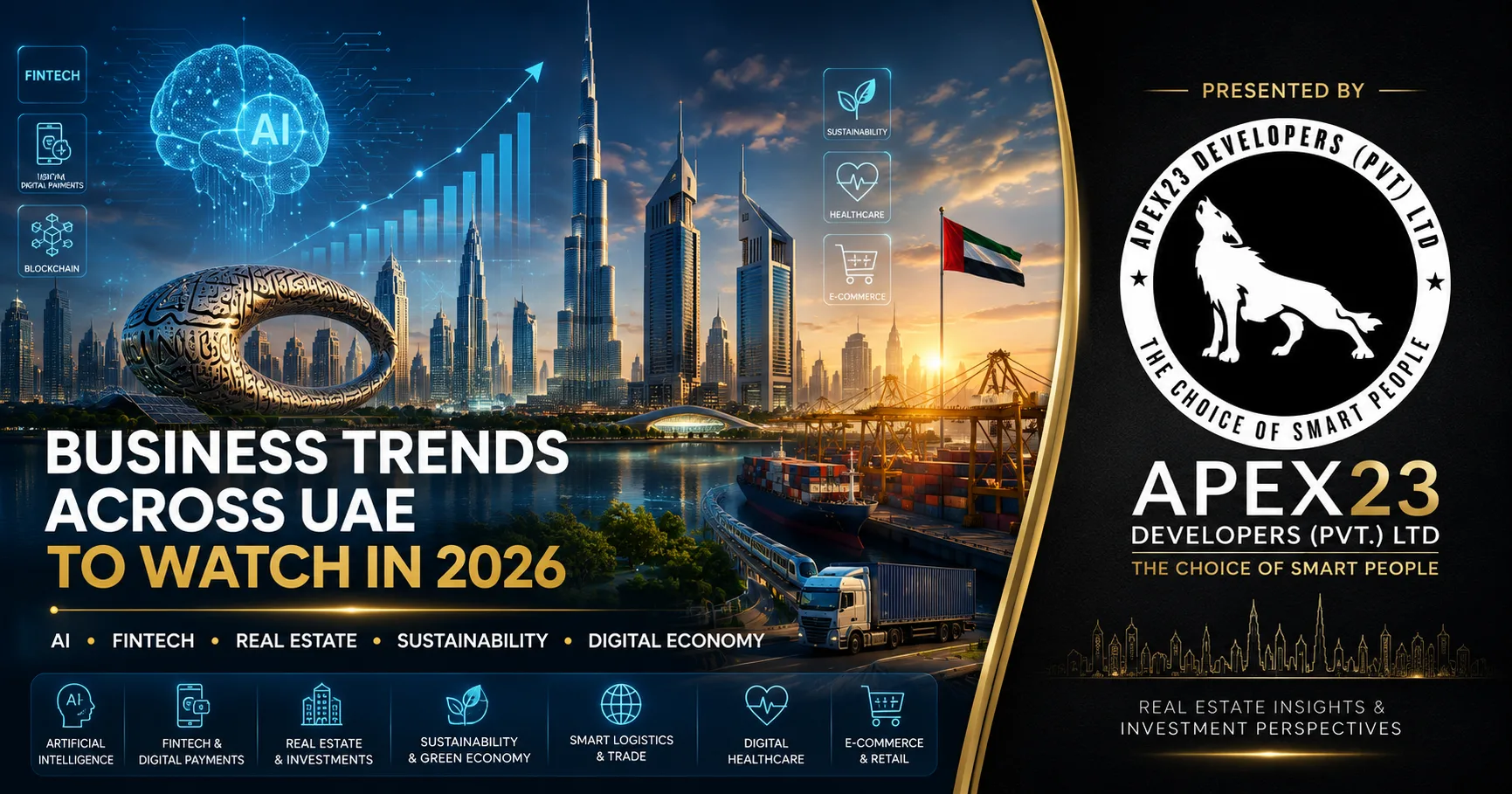
Top Business Trends Across the UAE to Watch in 2026

The United Arab Emirates (UAE) continues to strengthen its position as one of the world’s most attractive business destinations. With government-led innovation, strategic investments, and a pro-business regulatory environment overseen by the UAE Ministry of Economy, the country is rapidly evolving into a global hub for technology, finance, logistics, and entrepreneurship.

As businesses prepare for 2026, understanding emerging market trends is essential for staying competitive. Whether you’re an entrepreneur, investor, or business owner, keeping pace with these developments can help you identify new opportunities and make informed decisions.

1. Artificial Intelligence (AI) Becomes a Business Necessity

Artificial Intelligence is no longer limited to large technology companies. Businesses across the UAE are increasingly adopting AI to improve customer service, automate operations, analyze data, and boost productivity.

The UAE’s long-term AI strategy aims to position the country as a global leader in artificial intelligence by integrating AI across sectors such as healthcare, finance, education, transportation, and government services.

Businesses investing in AI-powered tools today are expected to gain a significant competitive advantage in the coming years, a pattern consistent with broader corporate strategy insights from McKinsey & Company.

Artificial Intelligence (AI) Becomes a business necessity. UAE's Long-Term AI Strategy

2. FinTech Continues to Transform Financial Services

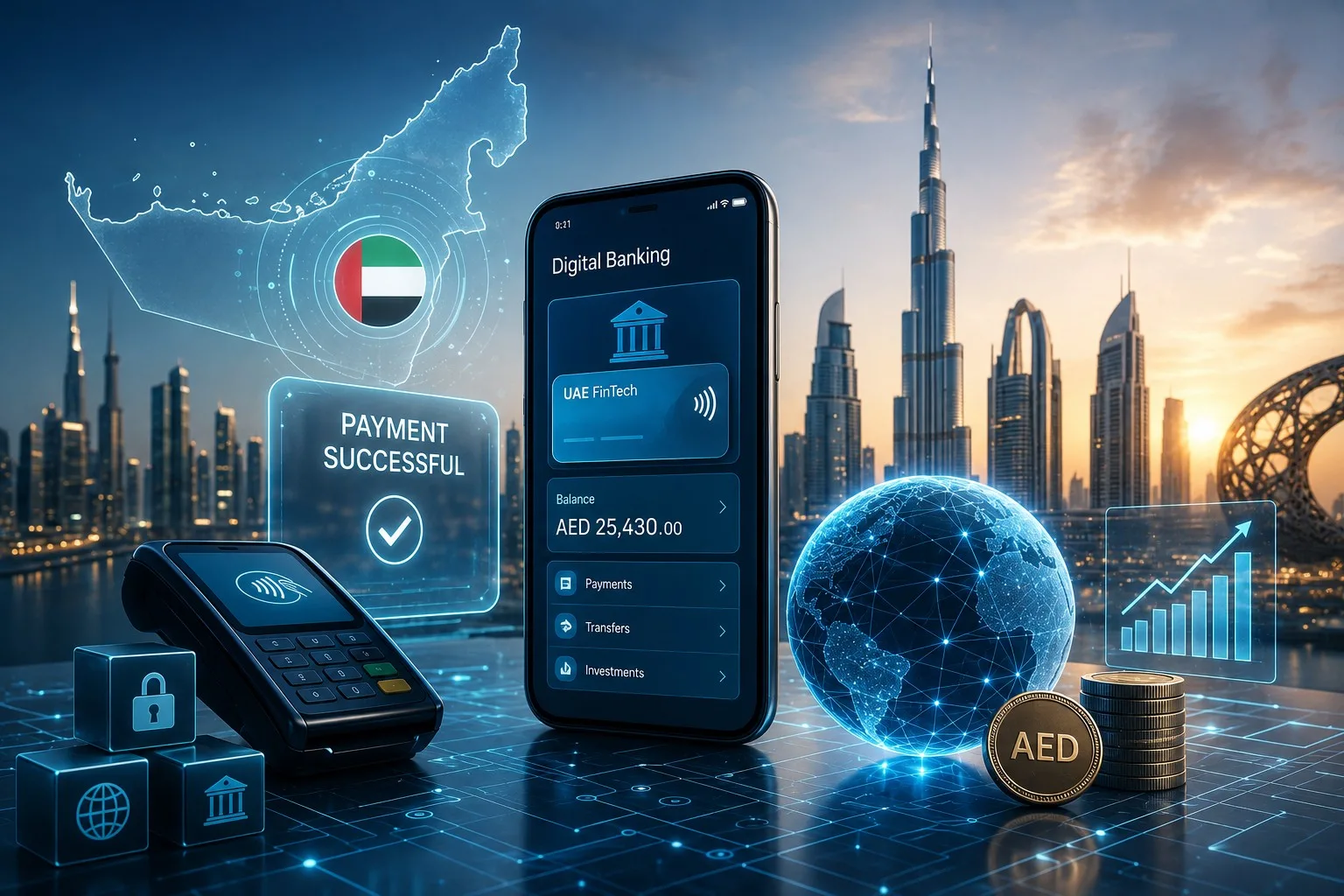
The UAE remains one of the Middle East’s leading fintech markets. Digital banking, mobile payments, blockchain solutions, and embedded finance are reshaping how consumers and businesses manage money.

According to industry forecasts, the UAE fintech market was valued at approximately USD 1.3 billion in 2025 and is expected to grow significantly over the next decade, driven by digital innovation and supportive regulations.

This growth presents opportunities for startups, investors, and established financial institutions alike.

Digital Banking trends

3. Startup and Free Zone Growth

Entrepreneurship continues to flourish across the UAE, supported by modern free zones, simplified company registration, and investor-friendly policies.

Free zones such as those in Dubai, Abu Dhabi, and other emirates provide benefits including:

  • 100% foreign ownership
  • Streamlined licensing processes
  • Industry-specific business clusters
  • Tax-friendly business environments

These initiatives continue to attract entrepreneurs and multinational companies looking to establish a regional presence.

4. Sustainability Drives Business Strategy

Sustainability has become more than a corporate responsibility, it’s a strategic priority. Businesses are increasingly investing in renewable energy, green construction, sustainable supply chains, and ESG (Environmental, Social, and Governance) initiatives.

Companies that integrate sustainability into their operations are likely to strengthen their brand reputation, attract investors, and meet evolving customer expectations.

Key Takeaway

Businesses that embrace AI, fintech innovation, entrepreneurship, and sustainability will be better positioned to thrive in the UAE’s rapidly evolving economy. These trends are shaping the country’s future and creating exciting opportunities across industries.

5. E-Commerce and Digital Retail Continue to Expand

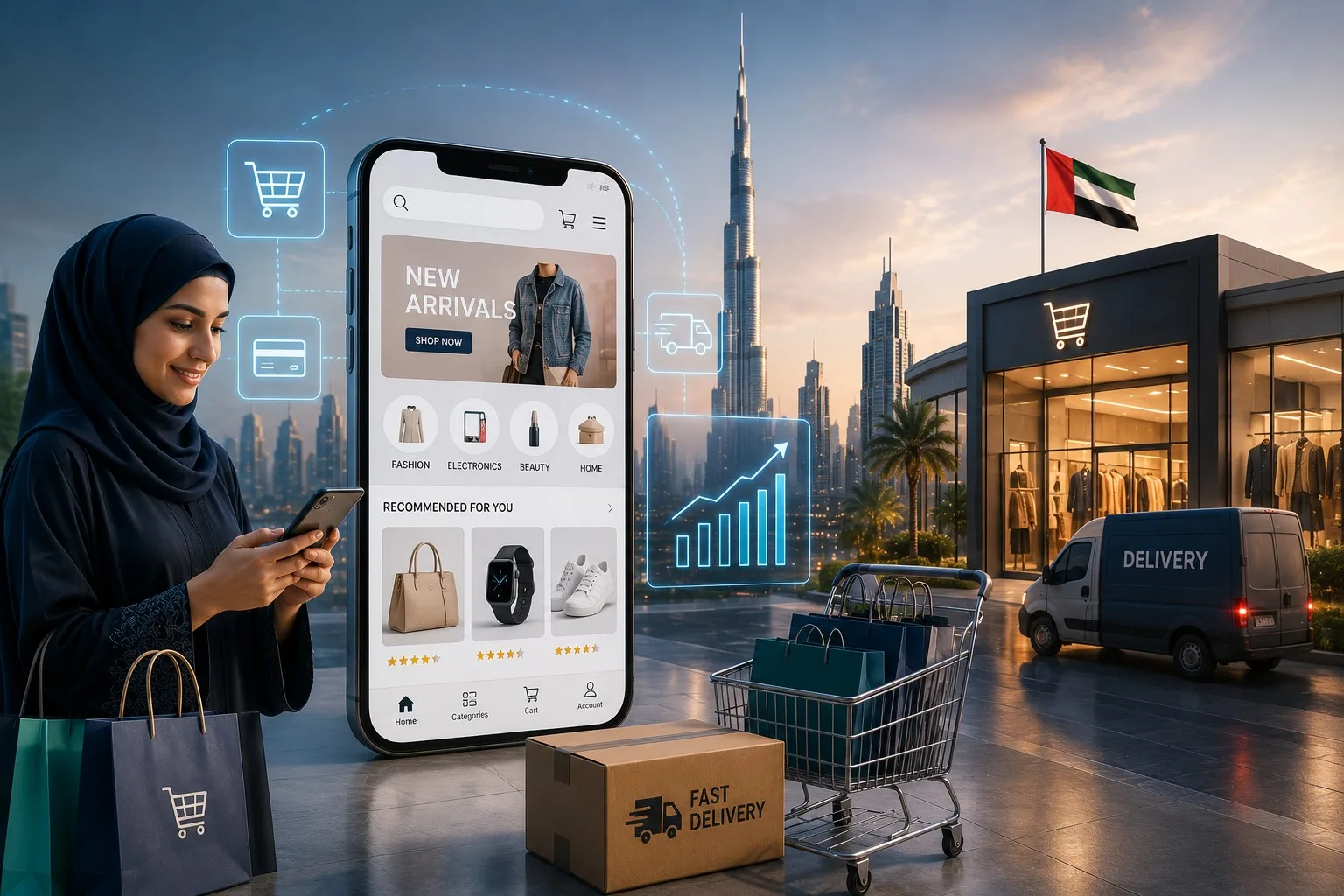
The UAE has one of the highest internet and smartphone penetration rates in the Middle East, making it an ideal market for e-commerce. Consumers increasingly prefer online shopping, digital payments, and fast delivery services.

Businesses are investing in AI-powered product recommendations, personalized shopping experiences, and omnichannel retail strategies to meet customer expectations. According to Statista’s UAE e-commerce market outlook, retail e-commerce revenue in the UAE is expected to continue growing through 2026 as more consumers embrace digital purchasing habits.

Companies that combine physical stores with strong online platforms will likely maintain a competitive advantage.
New Arrivals Trends with fast delivery

6. Smart Logistics and Supply Chain Innovation

The UAE’s strategic location between Europe, Asia, and Africa makes it a global logistics hub. Ports, airports, and free zones continue to benefit from investments in automation, artificial intelligence, and smart warehousing.

Technologies such as:

  • Warehouse automation
  • Internet of Things (IoT)
  • Blockchain tracking
  • Predictive analytics

are helping businesses improve delivery speed, reduce operational costs, and enhance supply chain visibility.

Government initiatives such as the Dubai Economic Agenda (D33) aim to further strengthen Dubai’s position as one of the world’s leading trade and logistics centers.

7. Digital Healthcare is Transforming Patient Care

Healthcare is rapidly becoming one of the UAE’s fastest-growing sectors. Hospitals and healthcare providers are adopting telemedicine, electronic health records, wearable health devices, and AI-assisted diagnostics.

The government’s continued investment in healthcare infrastructure and medical innovation is creating opportunities for technology providers, pharmaceutical companies, and healthcare startups.

As the population grows and demand for quality healthcare increases, digital health solutions are expected to remain a key business trend throughout 2026.

8. Tourism and Hospitality Remain Strong Growth Drivers

Tourism continues to play a significant role in the UAE economy. Major events, luxury hospitality, cultural attractions, and world-class infrastructure continue to attract millions of international visitors every year.

Businesses in hospitality are increasingly using:

  • AI-powered customer service
  • Smart hotel technologies
  • Contactless check-in systems
  • Personalized travel experiences

These innovations improve customer satisfaction while increasing operational efficiency.

Luxury hospitality with smart check in for comfort

9. Real Estate Evolves Through Technology

The UAE’s property market continues to attract both local and international investors. Developers are increasingly focusing on smart buildings, sustainable communities, and digital property transactions.

Technology such as virtual property tours, AI-powered property management, and blockchain-based documentation is improving transparency and making real estate transactions more efficient.

The combination of population growth, foreign investment, and infrastructure development — trends also reflected in the World Bank’s overview of the United Arab Emirates — is expected to support continued activity in the real estate sector.

Key Takeaway

The UAE’s growth in e-commerce, logistics, healthcare, tourism, and real estate reflects its commitment to innovation and economic diversification. Businesses that leverage technology
and prioritize customer experience will be well-positioned to capitalize on these expanding markets.

Big News: ISMMART Is Bringing Its Real Estate Expertise to the UAE!

As this list makes clear, real estate remains one of the UAE’s strongest growth stories and we are thrilled to announce that ISMMART is stepping into this dynamic market. Building on the success of Tower 17 and Apex23 Developers in Pakistan, ISMMART is expanding its trusted real estate portfolio into the UAE, bringing the same commitment to premium development, transparent investment planning, and long term value creation to one of the world’s most sought after property markets.

This move reflects our belief in the UAE’s continued rise as a global hub for smart, sustainable, and investor friendly real estate and our ambition to grow alongside it.

Stay tuned — more details on ISMMART’s upcoming UAE real estate projects are coming soon

Apex23 developers are bringing the real estate expertise to the UAE

10. Cybersecurity Becomes a Top Business Priority

As businesses continue to digitize their operations, cybersecurity is no longer optional—it’s essential. Organizations across the UAE are increasing investments in cloud security, data protection, identity management, and cyber resilience to safeguard customer information and business operations.

According to IBM’s Cost of a Data Breach Report, organizations with strong cybersecurity measures can significantly reduce the financial impact of data breaches. For businesses operating in the UAE’s rapidly growing digital economy, investing in cybersecurity is becoming a strategic necessity rather than just an IT function.

Cloud Security, Cyber Resilience, Threat Detection, Data Protection, identity Management, Threat Detection, Risk Management all protected all comes under one umbrella

11. The Green Economy Creates New Opportunities

The UAE continues to strengthen its commitment to sustainable economic growth through investments in renewable energy, clean technologies, and green infrastructure. Projects in solar energy, hydrogen, electric mobility, and sustainable construction are creating new opportunities for businesses and investors.

Companies that adopt environmentally responsible practices are increasingly attracting customers, investors, and international partners while improving long-term competitiveness.

12. Upskilling and the Future Workforce

Technology is transforming workplace requirements across every industry. Businesses are investing in employee training, digital skills, artificial intelligence literacy, and leadership development to remain competitive.

Skills expected to remain in high demand include:

  • Artificial Intelligence
  • Data Analytics
  • Cybersecurity
  • Cloud Computing
  • Digital Marketing
  • Project Management

Organizations that continuously invest in workforce development will be better prepared for future market changes.

Investment Outlook for 2026

The UAE’s business-friendly regulations, strategic location, modern infrastructure, and commitment to innovation continue to attract entrepreneurs and international investors, a theme echoed in PwC Middle East’s regional business analysis.

Industries expected to present strong opportunities include:

  • Artificial Intelligence
  • Financial Technology (FinTech)
  • Renewable Energy
  • Healthcare Technology
  • Logistics and Supply Chain
  • E-commerce
  • Tourism and Hospitality
  • Advanced Manufacturing

While every investment carries risk, businesses that align with these long-term growth sectors are likely to benefit from the UAE’s continued economic transformation.

Conclusion

The UAE is entering 2026 with strong economic momentum driven by innovation, digital transformation, sustainability, and strategic government initiatives. Artificial intelligence, fintech, e-commerce, healthcare, logistics, tourism, and green technologies are not simply emerging trends they are becoming the foundation of the country’s future economy.

For entrepreneurs, investors, and business leaders, success will depend on embracing technological innovation, prioritizing customer experience, investing in talent, and remaining adaptable in an increasingly competitive marketplace.

Businesses that recognize these trends early and develop forward-looking strategies will be better positioned to achieve sustainable growth and long-term success in one of the world’s most dynamic economies.

Frequently Asked Questions (FAQs)

Q1. Which industries are expected to grow the fastest in the UAE in 2026? Artificial Intelligence, FinTech, renewable energy, healthcare technology, logistics, tourism, and e-commerce are expected to experience significant growth.

Q2. Why is the UAE attractive for businesses? The UAE offers a strategic geographic location, world-class infrastructure, business-friendly regulations, tax advantages in many free zones, and strong government support for innovation.

Q3. How is AI influencing businesses in the UAE? AI is helping businesses automate operations, improve customer service, analyze data, optimize supply chains, and increase overall productivity across multiple industries.

Final Thoughts

The future of business in the UAE is being shaped by innovation, resilience, and sustainability. Organizations that invest in digital transformation, cybersecurity, workforce development, and environmentally responsible practices today will be well-equipped to thrive in 2026 and beyond. Staying informed about these evolving trends will enable businesses to seize new opportunities and maintain a competitive edge in the global marketplace.


Why Location Matters More Than Price in Real Estate

Introduction

Every property buyer in Pakistan has heard the same advice from an uncle, a broker, or a well-meaning friend: “Yeh sasta mil raha hai, le lo” this one’s cheap, just take it. And on paper, it looks like a win. Lower price, smaller installment, an easy “yes.” But ask anyone who’s owned property for ten years, and they’ll tell you the same thing: the plot that seemed like a bargain in a quiet, disconnected area often stayed exactly where it was priced, while the slightly pricier one near a new road, a growing business district, or a gated community quietly doubled in value. Price is what you negotiate today. Location is what actually pays you back tomorrow. This blog breaks down exactly why, using real numbers from Pakistan’s own market.

Table of Contents

  1. What Really Determines Property Value
  2. Why Price Feels Like the Obvious Factor but Isn’t
  3. Economic Activity and Employment Hubs
  4. How Location Drives Long-Term Value: The Role of Infrastructure
  5. Location vs Price: A Side-by-Side Comparison
  6. Accessibility to Urban Amenities
  7. Rental Income, Yield, and Stability
  8. How to Choose the Ideal Location: What to Actually Look For
  9. How Location Affects Commercial vs Residential Property Differently
  10. Surrounding Communities and Neighborhood Quality
  11. Safety, Security, and Gated Living
  12. A Real-Life Case: Two Buyers, Two Choices
  13. Conclusion

1. What Really Determines Property Value

A property’s price tag is only ever a snapshot of today. Its real, long-term value is shaped by things that don’t change overnight: how close it is to jobs, how safe the area is, whether the roads and utilities work, and whether the neighborhood is actually growing or standing still. Experts consistently point to proximity to business districts, schools, hospitals, and transportation hubs as the biggest factors in how quickly and how much a property appreciates. In other words, the property itself is only half the story where it sits is the other half, and often the bigger one.
 

2. Why Price Feels Like the Obvious Factor But Isn’t

Price feels safe because it’s a number you can compare instantly. Location feels harder to judge, because its real value shows up slowly, over years, not on the booking form. This is exactly why so many buyers default to the cheaper option it’s the easier decision to make at the moment. But a lower price in a weak location often means paying less now and earning less later: slower appreciation, harder resale, and rental income that struggles to find tenants. A slightly higher price in a strong location, on the other hand, tends to reward patience — which is why real estate experts describe genuinely well-located properties as commanding higher prices precisely because buyers already sense, even instinctively, that location protects value better than a discount ever could.

3. Economic Activity and Employment Hubs

Property values follow jobs. Areas near growing business hubs, IT parks, and commercial centers see consistently stronger demand, because people want to live close to where they work. Islamabad is a clear example: its stable economy and thriving IT sector have made it one of the country’s most attractive investment hubs, with high demand for both residential and commercial property that consistently outstrips supply. The same pattern shows up in Faisalabad, where the city’s industrial strength drives steady demand for property nearby, and in Gwadar, where major port and CPEC-linked development has turned a once-quiet coastal town into a serious long-term investment location

4. How Location Drives Long-Term Value: The Role of Infrastructure

Nothing moves property values quite like a new road, metro line, or interchange. Infrastructure projects highways, metro systems, airport expansions reliably increase demand, and therefore prices, in the areas around them, while areas with poor infrastructure or frequent utility problems tend to lag behind.

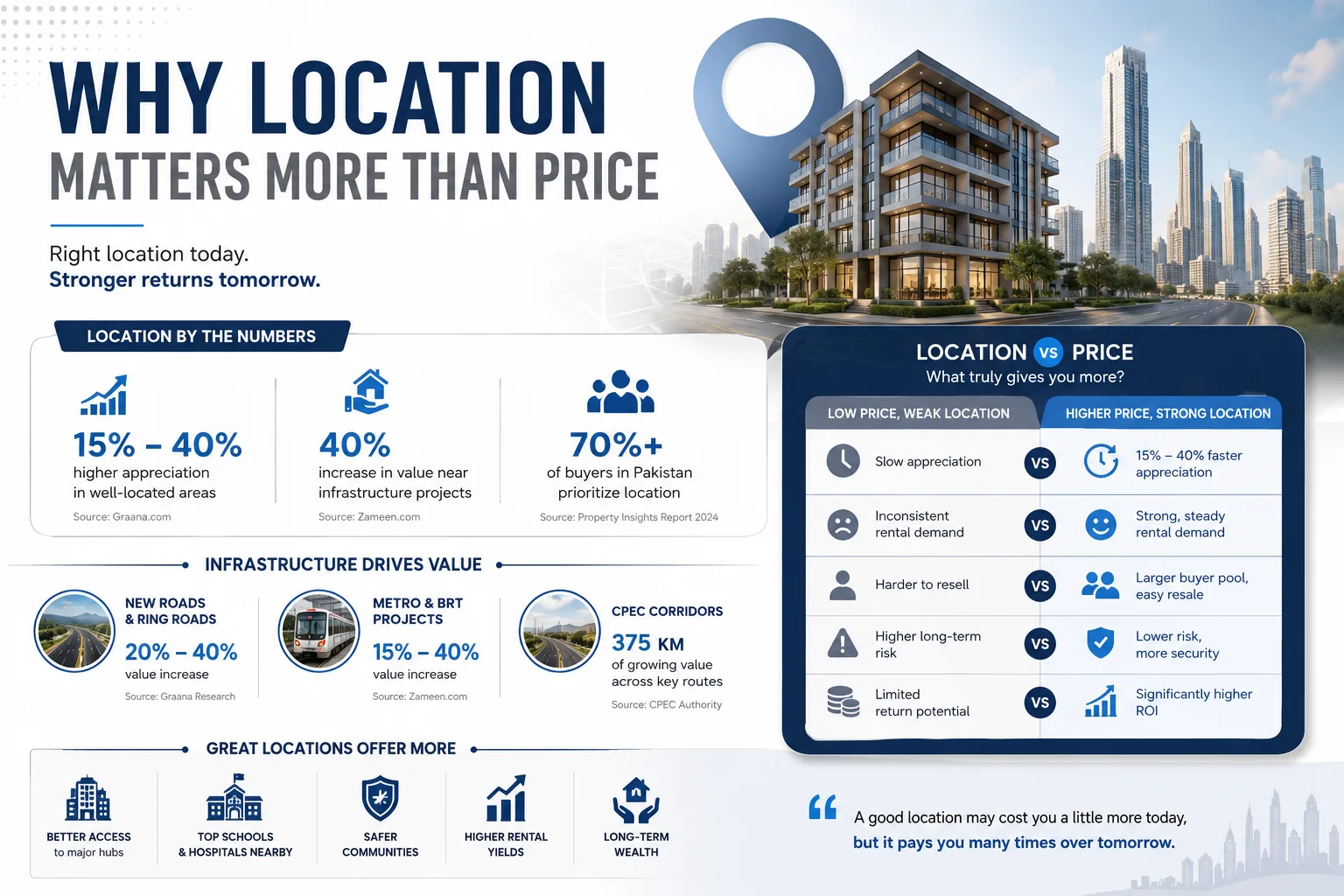
The numbers back this up clearly. Land along the Rawalpindi Ring Road corridor and DHA Phase 5 Islamabad appreciated 20 to 40% in a single year. In Karachi, catchment areas around the Green Line BRT and the revived Karachi Circular Railway have seen 15 to 40% appreciation, as improved connectivity turns previously overlooked neighborhoods into serious investment zones.  Along the Islamabad Lahore Motorway corridor, the ongoing China-Pakistan Economic Corridor (CPEC) has quietly reshaped an entire 375-kilometer stretch of land values, as industrial activity and population growth follow the new road network outward from both cities.

The lesson here is simple: wherever infrastructure goes, property values follow and it’s far more predictable than most people realize.

5. Location vs Price: A Side-by-Side Comparison

Factor Cheaper, Weaker Location Slightly Higher Price, Strong Location
Appreciation speed Slow, often flat for years 15–40% in strong infrastructure corridors
Rental demand Inconsistent, longer vacancies Strong, steady tenant demand
Resale ease Harder to find a buyer Larger, more active buyer pool
Long-term risk Higher depends on future development that may never arrive Lower value is already supported by existing activity
Best for Very short-term speculation only Long-term wealth building

6. Accessibility to Urban Amenities

Beyond jobs and roads, people simply want to live near the things daily life depends on schools, hospitals, markets, and recreational spaces. Properties close to these essentials consistently sell faster and hold their value better than those far from them. Developments that include amenities like parks, gyms, and swimming pools within the community itself are increasingly valued higher than similar properties without them, because buyers are no longer just purchasing a home, they’re purchasing a lifestyle they don’t have to drive far to reach. (Source)

7. Rental Income, Yield, and Stability

Location doesn’t just affect what a property is worth, it directly affects what it earns you every month. As a general Pakistani benchmark, a gross rental yield above 6% for residential property, and above 10% for commercial property, is considered strong. Karachi illustrates this well: standard residential areas average 6 to 7% rental yield, while high-demand commercial zones can reach 10 to 15%

Location also determines how stable that income is. In strong, well-connected areas like DHA and Bahria Town Islamabad, vacancy periods between tenants typically run just 2 to 6 weeks. In areas with poor access or an oversupply of similar units, that same gap can stretch to 3 to 6 months of lost income, a difference that adds up fast over a year. A slightly higher purchase price in the right location often pays for itself many times over simply through fewer empty months.

8. How to Choose the Ideal Location: What to Actually Look For

Before falling for a low price, run any property through these checks:

  1. Proximity to jobs and business hubs is the area near where people actually work, or growing toward it?
  2. Infrastructure signals: is there a new road, interchange, or metro line planned or already under construction nearby? These are the earliest, most reliable signs of future appreciation.
  3. Access to essentials schools, hospitals, markets, and mosques within easy reach.
  4. Rental demand history checks how quickly similar properties in the area get rented, not just what they rent for.
  5. Security and community structure gated access, 24/7 surveillance, and a managed community consistently support stronger long-term value.
  6. 3–5 year price trend, not just today’s asking price a property’s recent trajectory tells you far more than a single snapshot.

9. How Location Affects Commercial vs Residential Property Differently

Location works differently depending on what you’re buying. For commercial property, location is almost entirely about footfall and business activity. A shop or office on a busy boulevard earns far more than an identical unit on a quiet street, because its income depends on the people walking past it every day. For residential property, location is about livability safety, schools, and community matter more than raw foot traffic. Interestingly, areas like Blue Area in Islamabad show investors willingly accepting a lower immediate rental yield in exchange for exceptional long-term capital appreciation proof that in prime commercial locations, buyers are consciously paying for location itself, not just current income.

10. Surrounding Communities and Neighborhood Quality

A property doesn’t exist in isolation its neighbors matter. A well-maintained, actively growing community, with responsible management and a consistent standard of upkeep, protects and grows property values over time. A neighborhood in decline, even with a beautiful individual house inside it, will struggle to hold its value against outside market pressure. This is one of the most overlooked parts of location — you’re not just buying a plot, you’re buying into everything being built and maintained around it.

11. Safety, Security, and Gated Living

Security has become one of the strongest value drivers in Pakistani real estate. Areas with lower crime rates and visible security measures, gated entry points, boundary walls, 24/7 surveillance are consistently more desirable, and properties in these areas tend to appreciate faster than those in less secure regions. This is exactly why gated communities have become such a dominant force in the market; some reports now describe gated developments as making up the large majority of premium real estate investment in cities like Karachi. Beyond crime, safety also includes resilience properties in areas prone to flooding or other natural risks that tend to see depressed values compared to those in more stable, secure zones.

12. A Real-Life Case: Two Buyers, Two Choices

Picture two cousins, each with the same budget, buying property in the same year. One buys a plot in a far-out, undeveloped area purely because it was the cheapest option available, no nearby roads, no clear development plan, no real community around it. The other buys a smaller unit, at a slightly higher price, inside a gated community close to a growing commercial corridor with a new interchange under construction nearby.

Five years later, the first cousin’s plot has barely moved in value there’s still no real infrastructure around it, and finding a buyer takes months of waiting. The second cousin’s property has appreciated well above the original price, rents out within weeks whenever a tenant leaves, and could be sold quickly if needed. Neither cousin made an emotional mistake — both were simply following the advice they trusted at the time. But one paid for a lower price. The other paid for a better location. Only one of them actually built wealth.

This is the story that plays out, in different forms, across Pakistan every single year and it’s exactly why understanding location isn’t optional homework. It’s the difference between a property that just sits there, and one that actually works for you.

13. Conclusion

Price is a number you agree on for a single day. Location is a decision that keeps working or keeps struggling for every day after that. The infrastructure, jobs, safety, and community around a property are what actually determine whether it becomes a real asset or a quiet disappointment. The smartest move isn’t chasing the lowest price, it’s understanding that a well-located property, even at a slightly higher cost, is very often the cheaper decision in the long run.

Why Trust and Transparency Matter More Than Price in Business Partnerships

Trust and Transparency over Price

Every business owner eventually faces the same temptation: win the deal by cutting the price. It works, sometimes. But it rarely builds anything that lasts. The partnerships that survive years, the ones that grow instead of just close, are almost never the ones built on the lowest number they’re built on two things that don’t show up on an invoice: trust and transparency. When a client trusts you and understands exactly what they’re paying for, price stops being the deciding factor. This blog breaks down what trust and transparency actually mean in business, why they consistently outperform price as a deciding factor, and what it looks like when a business genuinely builds a partnership around trust and transparency instead of a discount.

Table of Contents

  1. Defining Trust and Transparency in Business
  2. The Benefits of Trust and Transparency
  3. How Trust Leads to More Effective Decision-Making
  4. How Transparency Reduces Risk
  5. How Trust and Transparency Turn Deals into Real Partnerships
    • Aligning Goals
    • Building Open Communication Channels
    • Creating Ownership and Responsibility
    • Establishing Long-Term Trust
  6. A Real-World Example
  7. FAQs
  8. Conclusion

1. Defining Trust and Transparency in Business

Trust is the belief that the other side in a business relationship will do what they say, treat you fairly, and act in good faith even when no one is checking. It’s not something a contract can force; it’s something built up through consistent, honest behavior over time.

Transparency is what makes trust possible in the first place. It means openly sharing information pricing, timelines, risks, mistakes instead of hiding it until someone asks, or until it becomes impossible to hide. Where trust is the feeling, transparency is the action that earns it.

Together, they answer the one question every business partner is really asking whether they say it out loud or not: “Can I actually rely on you?”

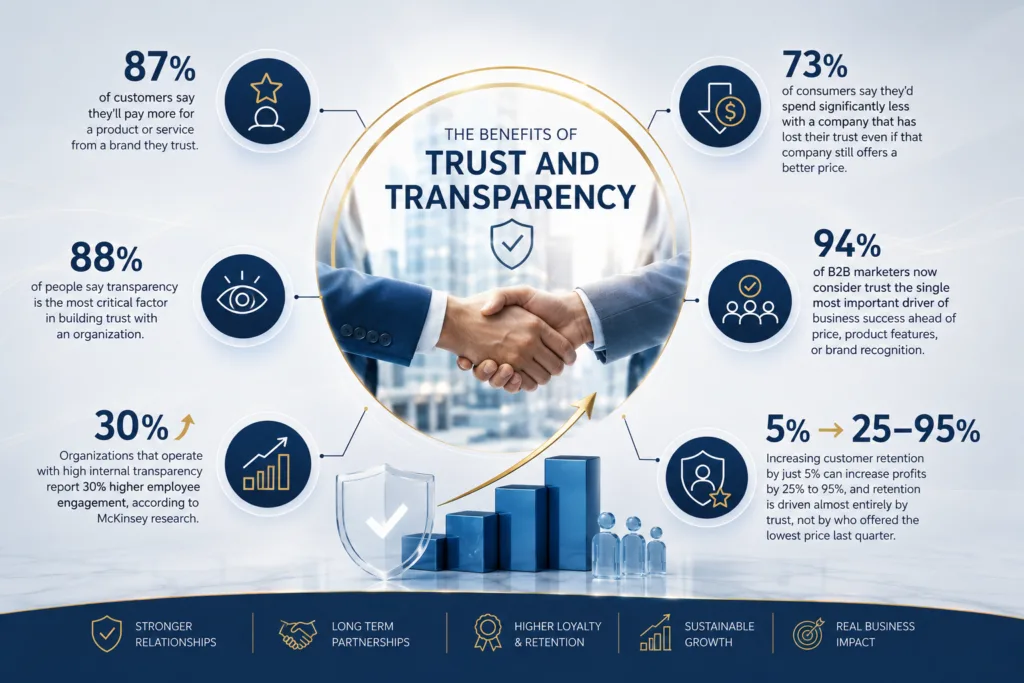
2. The Benefits of Trust and Transparency
The Benefits of Trust and Transparency

The data on this is remarkably consistent across studies:

  • 87% of customers say they’ll pay more for a product or service from a brand they trust.
  • 73% of consumers say they’d spend significantly less with a company that has lost their trust even if that company still offers a better price. (Source)
  • According to the Edelman Trust Barometer, 88% of people say transparency is the most critical factor in building trust with an organization. (Source)
  • A 2025 LinkedIn/Ipsos study found that 94% of B2B marketers now consider trust the single most important driver of business success ahead of price, product features, or brand recognition. (Source)
  • Organizations that operate with high internal transparency report 30% higher employee engagement, according to McKinsey research meaning transparency doesn’t just help external partnerships, it strengthens the team behind them too. (Source)

The benefit isn’t abstract it shows up directly in retention and revenue. Research from Bain & Company found that increasing customer retention by just 5% can increase profits by 25% to 95%, and retention is driven almost entirely by trust, not by who offered the lowest price last quarter. (Source)

3. How Trust Leads to More Effective Decision-Making

When two sides of a partnership trust each other, decisions get made faster and better. Here’s why: without trust, every decision gets filtered through suspicion “are they telling me the full picture?” which slows everything down and often leads to defensive, overly cautious choices on both sides.

With trust in place, partners can share real information, including bad news, without fear of it being used against them. That means problems get raised earlier, solutions get found faster, and decisions get made based on facts instead of guesswork or hidden agendas. This is exactly why 82% of consumers say trust in a company is very important when deciding who to do business with trust removes the need to second-guess every decision the other party makes.

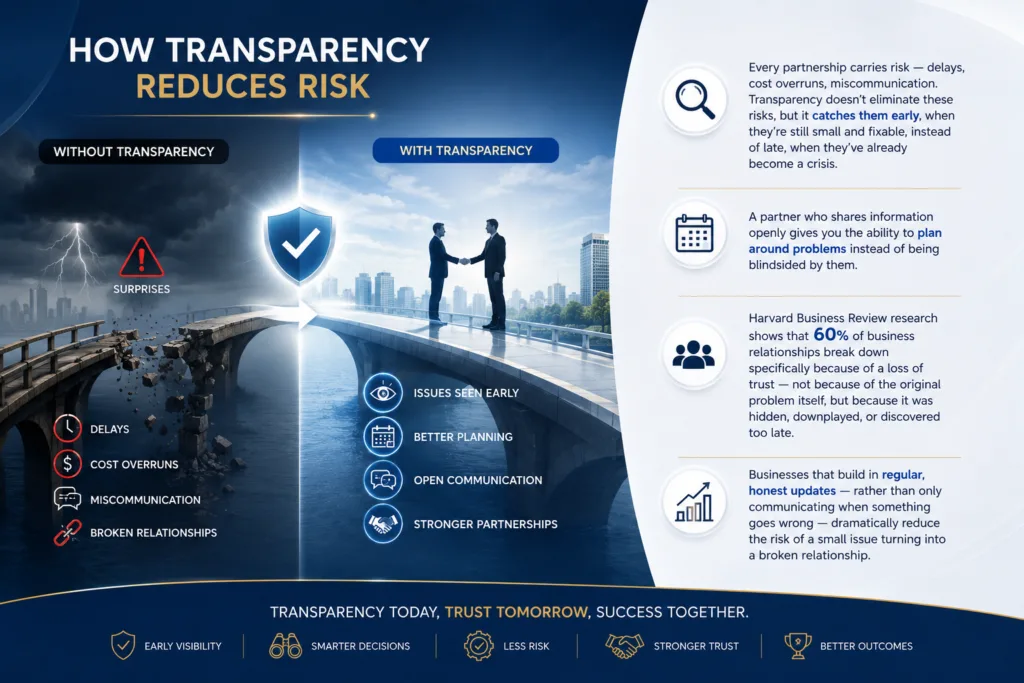
4. How Transparency Reduces Risk
How Transparency Reduces Risk

Every business partnership carries risk delays, cost overruns, miscommunication. Transparency doesn’t eliminate these risks, but it catches them early, when they’re still small and fixable, instead of late, when they’ve already become a crisis.

A partner who shares information openly gives you the ability to plan around problems instead of being blindsided by them. This is also why research from Harvard Business Review found that 60% of business relationships break down specifically because of a loss of trust not because of the original problem itself, but because it was hidden, downplayed, or discovered too late. (Source) Businesses that build in regular, honest updates — rather than only communicating when something goes wrong dramatically reduce the risk of a small issue turning into a broken relationship.

5. How Trust and Transparency Turn Deals Into Real Partnerships

A one-time deal and a real, lasting partnership are built differently. Here’s what actually moves a business relationship from “just a transaction” to a genuine partnership.

Aligning Goals

Every strong partnership starts with both sides being honest about what they actually want out of the relationship not just what sounds good in a meeting. When goals are stated openly instead of assumed, both sides can plan around the same outcome instead of quietly working toward different ones, which is one of the most common, and most avoidable, reasons partnerships quietly fall apart.

Building Open Communication Channels

Trust needs a channel to travel through. That means regular check-ins, clear points of contact, and a habit of sharing updates good and bad before they’re asked for. Partnerships that only communicate when there’s a problem tend to associate every conversation with bad news, which slowly erodes trust even when the underlying relationship is fine.

Creating Ownership and Responsibility

A transparent partnership is one where both sides are willing to say “that was on us” when something goes wrong, instead of deflecting or staying quiet. This kind of accountability is what separates a partner you can rely on from one you have to constantly double-check and it’s very hard to fake over time.

Establishing Long-Term Trust

Trust isn’t built in one meeting it’s built transaction by transaction, promise by promise. Every time a business does what it said it would do, it adds to a track record. Over enough time, that track record becomes the actual reason a partner stays loyal, far more than any single price point ever could.

6. A Real-World Example

Buffer, a social media management platform, built its reputation almost entirely around radical transparency publicly sharing its revenue, its financial metrics, and even the exact formula it uses to calculate every employee’s salary. Instead of damaging the company, this openness built a loyal customer base that appreciated being let into the company’s real journey, including its setbacks, resulting in strong media coverage and long-term customer loyalty. (Source)

Patagonia offers another clear example. The outdoor apparel company built its brand around openly sharing its supply chain practices and the environmental impact of its products including admitting when a popular product had a larger environmental footprint than expected. Rather than hurting the brand, this transparency deepened customer loyalty, and the company’s sales grew to nearly a billion dollars in 2019. (Source)

Perhaps the most well-known case is Johnson & Johnson’s response to the 1980s Tylenol crisis, still taught in business schools today. When the company faced a serious product safety crisis, it responded with immediate transparency taking responsibility publicly and communicating openly with customers throughout, rather than minimizing the issue. That transparent response is widely credited with rebuilding public trust and positioning the company as a long-term leader in ethical business practice. (Source)

The common thread in all three: none of these companies were the cheapest option in their industry. What made customers and partners stay was the confidence that these businesses would tell the truth, even when the truth wasn’t flattering.

7. FAQs

Why does trust matter more than price in a business partnership? Because price is a one-time decision, but trust determines whether the relationship survives problems, delays, and unexpected changes which every long-term partnership eventually faces.

Can transparency actually hurt a business? It can invite more scrutiny, since sharing more information means more can be questioned but studies consistently show the trust it builds outweighs that risk, especially over the long term.

How do you build trust with a new business partner quickly? Start by being transparent early share pricing clearly, communicate realistic timelines, and follow through on small commitments before asking for larger ones. Trust builds fastest through consistency, not promises.

What’s the difference between trust and transparency? Transparency is the action openly sharing information. Trust is the result the confidence that builds up in the other person because of that openness over time.

8. Conclusion

Price will always be part of any business decision, but it’s rarely the reason a partnership actually lasts. The businesses and partnerships that survive through delays, mistakes, and market changes are the ones built on trust that was earned honestly, through transparency that didn’t wait to be asked for. In the long run, a partner you can rely on is worth more than a partner who was simply cheaper.


Read Also: Real Estate vs Pharma vs Hospitality: Which Is the Best Investment in Pakistan 2026?

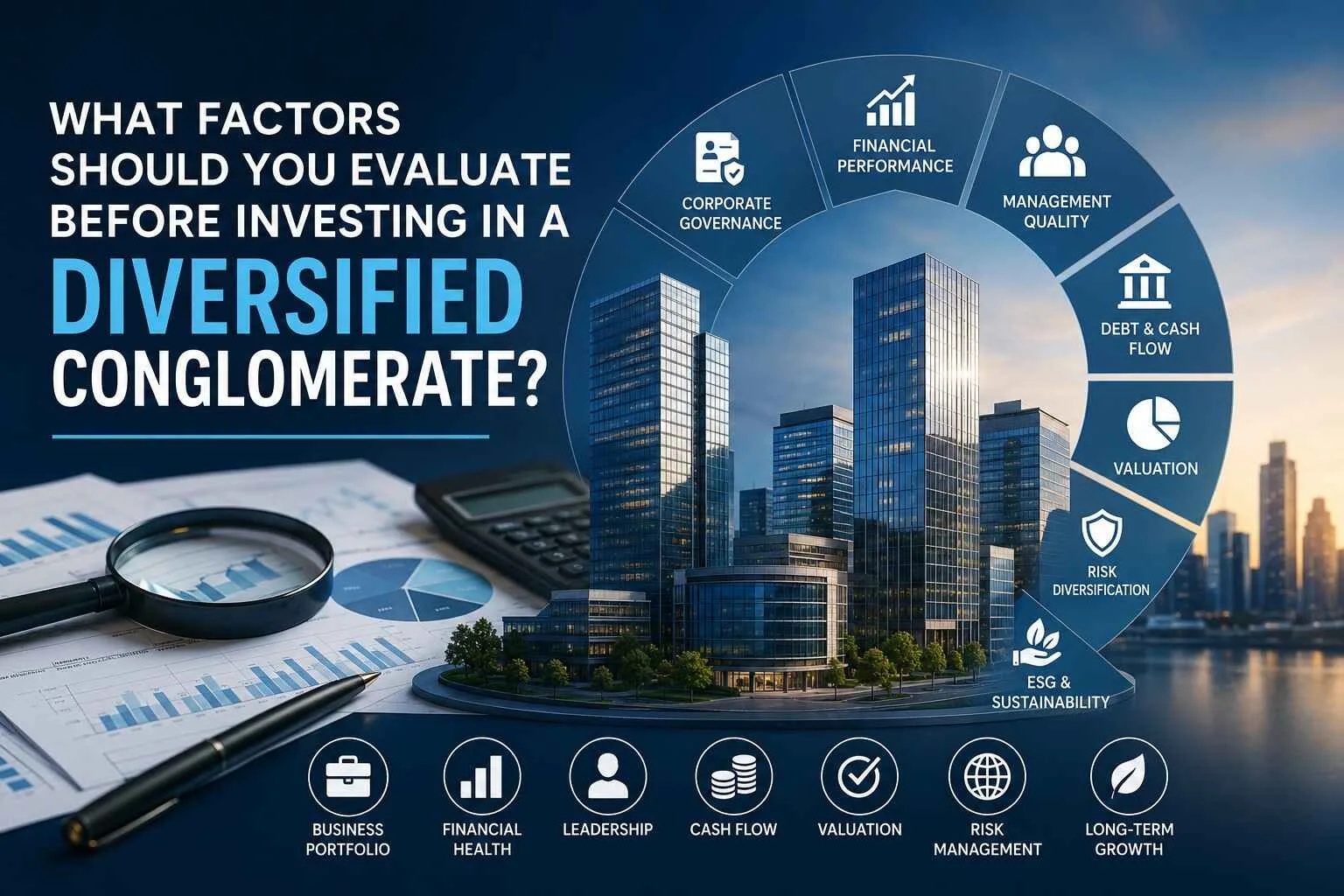
What Factors Should You Evaluate Before Investing in a Diversified Conglomerate?

Introduction

Investing in a diversified conglomerate can be an excellent strategy for investors seeking long-term growth, portfolio stability, and reduced business risk. A diversified conglomerate operates across multiple industries, allowing it to generate revenue from different business segments rather than relying on a single market. Well-known examples include Berkshire Hathaway, Tata Group, Reliance Industries, and Samsung Group.

However, diversification alone does not guarantee success. Investors should carefully analyze a conglomerate’s financial performance, management strategy, and portfolio quality before making an investment decision.

According to a McKinsey & Company analysis of diversification strategy, diversified companies create long-term value only when they allocate capital effectively and actively manage their business portfolio rather than simply owning multiple businesses. Likewise, S&P Global Market Intelligence reports that strong governance and disciplined investment decisions are key characteristics of high-performing conglomerates.

1. Understand the Diversified Conglomerate’s Business Portfolio

The first step is identifying the industries in which the company operates.

Ask yourself:

  • Are the businesses related or completely different?
  • Which divisions generate the highest revenue?
  • Which business contributes the most profit?
  • Are any segments consistently underperforming?

A balanced portfolio with profitable businesses across different sectors generally provides better resilience during market fluctuations.

2. Evaluate the Financial Performance of a Diversified Conglomerate

Financial statements provide valuable insight into the company’s health.

Some important indicators include:

  • Revenue Growth: Consistent growth suggests expanding operations.
  • Net Profit Margin: Higher margins indicate efficient cost management.
  • Return on Equity (ROE): Shows how effectively management uses shareholders’ investments.
  • Earnings Per Share (EPS): Increasing EPS often reflects sustainable business growth.

Investors should compare these metrics over at least the past five years instead of relying on a single year’s performance.

3. Assess the Management Quality of a Diversified Conglomerate

Even a strong portfolio can underperform if management makes poor decisions.

Evaluate whether leadership has:

  • A proven long-term strategy.
  • Transparent communication with shareholders.
  • A successful acquisition history.
  • Effective capital allocation practices.

Companies led by experienced management teams often make better investment decisions and create greater shareholder value over time.

Key Takeaway

Before investing in a diversified conglomerate, understand what the company owns, how it earns money, and whether management has consistently delivered strong financial results. These factors form the foundation of a sound investment decision.

4. Analyze Debt and Cash Flow

Debt can help companies grow, but excessive borrowing may become a financial burden during economic slowdowns. Investors should assess whether the company generates enough cash to comfortably repay its obligations.

Key metrics to review include:

  • Debt-to-Equity (D/E) Ratio: Indicates how much debt is used to finance the business compared to shareholders’ equity.
  • Interest Coverage Ratio: Measures the company’s ability to pay interest on its debt.
  • Free Cash Flow (FCF): Shows the cash remaining after capital expenditures and is an important indicator of financial flexibility.

A company with strong cash flow is generally better positioned to invest in new opportunities, pay dividends, reduce debt, and withstand market volatility.

5. Determine Whether the Diversified Conglomerate Is Fairly Valued

Even an excellent company can be a poor investment if its stock price is too high. Investors should compare the company’s valuation with competitors using common financial ratios.

Some of the most useful valuation metrics include:

Rather than relying on a single ratio, compare these metrics with industry averages and the company’s historical valuation.

6. Watch for the “Conglomerate Discount”

Many diversified companies trade below the combined value of their individual businesses — a phenomenon known as the conglomerate discount.

This discount may occur because:

  • Complex business structures are harder for investors to understand.
  • Poor-performing divisions reduce the value of stronger businesses.
  • Investors may prefer focused companies over diversified ones.

However, a discount isn’t always a warning sign. If management allocates capital efficiently and maintains transparency, it can represent a buying opportunity.
Diversified Conglomerate

7. Evaluate Risk Diversification

One of the biggest advantages of conglomerates is risk reduction through diversification. However, not all diversification is equally effective.

Ask these questions:

  • Are businesses exposed to different economic cycles?
  • Does the company operate in multiple countries?
  • Is revenue generated from various industries rather than one dominant segment?

A diversified revenue base can help stabilize earnings during market downturns and reduce dependence on any single industry.

Key Takeaway

Strong financial health, manageable debt, healthy cash flow, and reasonable valuation are essential indicators of a quality conglomerate. Investors should also determine whether a lower market valuation reflects genuine business weaknesses or simply an undervalued opportunity.

8. Review Corporate Governance of the Diversified Conglomerate

Strong corporate governance helps build investor confidence. Look for companies with an experienced board of directors, transparent financial reporting, ethical business practices, and a clear commitment to protecting shareholder interests.

Investors should also review annual reports — such as Berkshire Hathaway’s annual shareholder letters or Tata Group’s investor disclosures — to understand executive compensation, board independence, and the company’s approach to managing risks.

9. Consider the Dividend History of the Diversified Conglomerate

For income-focused investors, a stable or growing dividend is often a positive indicator of financial strength. While not every successful conglomerate pays high dividends, companies with a consistent dividend history usually demonstrate healthy cash flow and disciplined capital management.

However, dividend payments should be supported by sustainable earnings rather than excessive borrowing.

10. Evaluate ESG and Long-Term Sustainability

Environmental, Social, and Governance (ESG) factors are becoming increasingly important in investment decisions. Companies with strong ESG practices often experience better risk management, improved corporate reputation, and greater investor confidence.

Review the company’s sustainability reports to understand its environmental initiatives, employee welfare, governance standards, and long-term strategic goals.

Final Investment Checklist

Before investing in a diversified conglomerate, ask yourself:

  • ✔ Does the company have a diversified and profitable business portfolio?
  • ✔ Are revenue and earnings growing consistently?
  • ✔ Is debt at a manageable level?
  • ✔ Does the company generate strong free cash flow?
  • ✔ Is the stock reasonably valued?
  • ✔ Does management have a strong track record?
  • ✔ Are corporate governance and ESG practices transparent?
  • ✔ Does the investment align with your financial goals and risk tolerance?

If most of these questions can be answered positively, the company may be worth further consideration.

Conclusion

Diversified conglomerates can offer investors stability, reduced business risk, and long-term growth opportunities. However, successful investing requires more than simply choosing a well-known name. Investors should carefully examine the company’s financial performance, business diversification, debt management, leadership quality, valuation, governance, and sustainability practices before making any investment decision.

No investment is entirely risk-free, but thorough research and disciplined analysis can significantly improve your chances of making informed decisions. By focusing on both quantitative metrics and qualitative factors, investors can better identify conglomerates that are positioned to create long-term shareholder value.

Commercial vs Residential Property: Which Is the Better Investment in Pakistan?

Every property investor in Pakistan eventually asks the same question: shop or house? Office or apartment? Both are real, both are proven, and both can make you money  but they work in completely different ways, and mixing them up is exactly how a lot of investors end up disappointed with returns they didn’t fully understand going in. This guide breaks down commercial and residential property side by side, using real Pakistani numbers, so you can see clearly which one actually fits your goals whether that’s steady, passive growth, or faster, active income.

Table of Contents

  1. What Is Commercial Property?
  2. What Is Residential Property?
  3. Tax on Commercial vs Residential Property
  4. Risk and Reward
  5. Market Research & Location: How It Affects Value
  6. Which One Should You Choose?
  7. Capital Appreciation and Exit Strategy
  8. The Role of Planned Communities
  9. A Quick Word on ISMMART Group of Industries
  10. Tips Before You Choose
  11. FAQs
  12. Conclusion

1. What Is Commercial Property?


Commercial property is built for business use shops, offices, plazas, retail units, warehouses. Its value depends on footfall, business activity, and how many companies want to operate from that location. In Pakistan, commercial property typically delivers 10–12% ROI, almost double residential returns in the same city. (Source) The sector has also been expanding fast commercial real estate grew by 34.2% in 2022 alone, outpacing the overall real estate sector’s growth of 25.5% that same year, driven largely by rising demand from software companies, financial firms, and retail brands looking for proper office and shop space. (Source) In 2022 alone, commercial real estate expanded by 34.2%, well ahead of the overall property sector’s growth of 25.5% that same year a sign of just how fast investor interest in this category has been growing. (Source)

Pros Cons
Higher rental yield (8–12%) Higher entry cost
Fixed, annually increasing rent contracts Longer vacancy periods possible
Strong demand from businesses, offices, retail brands Needs active management
Faster monthly cash flow More sensitive to economic slowdowns

2. What Is Residential Property?

Residential property is built for people to live in houses, apartments, plots for homes. Its value depends on livability: location, security, schools, and connectivity. Residential property in Pakistan typically delivers 5–7% annual returns, with rental yields often closer to 3–4%. (Source) Demand stays strong regardless of economic conditions, mainly because Pakistan’s population is heading toward 250 million by 2030 while the country is already short close to 10 million housing units a gap that keeps residential property in steady, long-term demand no matter what the wider economy is doing. (Source) Even so, it remains the sector most Pakistanis actually invest in first, largely because Pakistan’s housing shortage of nearly 10 million units keeps genuine, long-term demand behind every residential purchase.

Pros Cons
Lower entry cost, easier installment plans Lower rental yield
Easier to get a loan or mortgage for Rent often stays flat for years
Lower risk, steady demand Slower cash flow — mostly appreciation-based
Can be used personally, not just rented Selling takes longer

3. Tax on Commercial vs Residential Property

Both property types are taxed by the FBR, but not identically:

  • Capital Gains Tax (CGT): a flat 15% for filers on properties bought after July 2024 applies equally to commercial and residential. (Source)
  • Capital Value Tax (CVT): 2% of property value, paid by the buyer, on both types. (Source)
  • Federal Excise Duty (FED): 5%, but here’s the difference it applies to every commercial property purchase, while for residential property it only applies to the first owner at booking. (Source)
  • Rental income tax: for commercial property, the FBR assumes a minimum fair rent of 4% of the property’s assessed value for tax purposes meaning commercial rental income is taxed on a higher assumed baseline than residential. (Source)

In short: commercial property carries a slightly heavier, more consistent tax load, while residential property is lighter on tax for repeat owners but both are simple to plan for once you know the numbers upfront.

4. Risk and Reward

Commercial Residential
Reward potential Higher (10–12% ROI) Moderate (5–7% ROI)
Income speed Fast — rent starts quickly Slow — appreciation-driven
Risk level Higher — vacancy hits income directly Lower — always in demand
Financing ease Harder — banks lend more cautiously Easier — mortgages and installment plans are widely available
Best suited for Investors chasing active income Investors wanting stability

5. Market Research & Location: How It Affects Value

Location changes everything, but it changes each property type differently.

For commercial property, location is about footfall and business activity. A shop on a busy Islamabad boulevard or a Lahore commercial hub earns far more than an identical shop on a quiet side street because its value comes from the customers walking past it every day. Areas like Blue Area in Islamabad, DHA and Gulberg in Lahore, and Clifton and Saddar in Karachi consistently command the highest commercial rents in the country, precisely because of the sheer volume of daily business activity around them.

For residential property, location is about livability. Proximity to schools, security, mosques, and clean infrastructure drives value which is why gated, planned communities in Islamabad and Lahore have consistently outperformed older, unplanned residential areas in recent years.

Feature Commercial Property Residential Property
Value driver Footfall & business activity Livability & safety
Best locations Main boulevards, business hubs Gated communities, planned schemes
Income type Active rental income Long-term appreciation
Tenant type Businesses, offices, shops Families, individuals

6. Which One Should You Choose?

  • Choose commercial if you have some capital already, want faster income, and can handle vacancy risk.
  • Choose residential if this is your first property, you want lower risk, and you prefer stability over speed.
  • Choose a mixed-use project if you want a bit of both without picking a side too early.

7. Capital Appreciation and Exit Strategy

Commercial property tends to appreciate faster in booming business areas but can also stall if the local business scene slows down exiting depends heavily on finding another investor, not a homebuyer, which can take longer in a weak market.

Residential property appreciates more steadily and is easier to exit, since the buyer pool is larger everyone from families to first-time buyers is a potential buyer, not just investors. This is why residential property is often seen as the “safer exit,” even if the upside is smaller.

8. The Role of Planned Communities

Planned communities gated housing schemes with proper roads, security, and utilities have become a major value driver for both property types. For residential buyers, they offer safety and a better quality of life. For commercial investors, a planned community with a growing residential population nearby guarantees a built-in customer base for shops and offices from day one. This is exactly why mixed-use developments residential towers with retail floors built in — have become one of the most in-demand formats in Pakistani real estate today.

9. A Quick Word on ISMMART Group of Industries

ISMMART Group of Industries offers both sides of this comparison under one roof. Its flagship project, Tower 17 in Faisal Hills, Islamabad, includes residential apartments starting from PKR 1,000,000, alongside three levels of retail and commercial space giving investors access to both residential stability and commercial-style income within the same development. Full details are on the Tower 17 project page.

10. Tips Before You Choose

  1. Match the property to your goal — income now, or growth later.
  2. Check the exact location’s footfall or livability, not just the general area.
  3. Factor in tax differences before comparing final returns.
  4. Verify documentation CDA/SECP approvals, ownership titles before paying anything.
  5. Consider a mixed-use project if you’re not ready to fully commit to one side.

11. FAQs

Which gives a higher return, commercial or residential? Commercial typically delivers higher ROI (10–12%) compared to residential (5–7%), but with more risk and a higher entry cost.

Which is easier to sell? Residential property, because the buyer pool is larger it includes families, not just investors.

Is tax higher on commercial property? Slightly, yes commercial property always pays the 5% Federal Excise Duty, while residential only pays it on the first purchase.

Can I invest in both? Yes, and many investors do often through mixed-use projects that include both residential and commercial space in one development.

Does location matter more for one type than the other? Yes commercial property is far more location-sensitive, since its value depends almost entirely on footfall. A residential property can still hold solid value in a quieter area, as long as it’s safe and well-connected.

12. Conclusion

There’s no universal winner between commercial and residential property in Pakistan — only the right fit for your budget, risk tolerance, and timeline. Commercial rewards patience with higher income; residential rewards patience with stability and easier resale. Understanding both, with real numbers instead of guesswork, is what actually leads to a smart investment decision.

Always verify documentation and current pricing directly with any developer, and consult a tax advisor for your specific situation. This article is for information purposes and is not financial advice.

How to Verify an Investment Management Company’s Credibility Before Doing Business

There’s a specific feeling everyone in Pakistan knows. You’ve found a company that looks perfect, the website is polished, the sales rep is friendly, the offer sounds almost too good. And right underneath the excitement, there’s a small, quiet voice asking: “But is this actually real?”

That question isn’t paranoia. It’s a good instinct. And the good news is, you don’t have to guess anymore. Pakistan actually has a clear, simple system for checking whether a company is genuine — you just need to know where to look. This guide walks you through it, step by step, in plain language, so the next time you’re about to sign a contract, book a property, or hand over your hard-earned savings, you can do it with real peace of mind instead of crossed fingers.

Why This Small Habit Matters So Much

Think about it from a human angle. When you trust a company with your money, you’re really trusting them with something bigger a plan, a dream, maybe your family’s future. Every year, people across Pakistan hand over savings to companies that looked convincing on the surface but had nothing solid behind them. It’s not that people are careless. It’s that most of us were never taught how to check. We rely on gut feeling, on what a friend said, on how nice the office looked.

Here’s the shift in mindset that changes everything: a genuinely good company wants you to verify it. A company with nothing to hide will happily point you to its registration number, its tax records, its approvals. It’s only the companies with something to hide that get uncomfortable when you ask questions. So verifying a company isn’t an act of distrust, it’s simply good practice, and any solid, established business will respect you more for doing it.

Step One: Check the Government Records (This Is Easier Than You Think)

Pakistan has real, working institutions built exactly for this purpose. Here’s how each one helps you, in order of how often you’ll actually use them.

SECP — Confirm the Company Legally Exists

The Securities and Exchange Commission of Pakistan (SECP) is the main body that registers companies in Pakistan. As of 2025, there are over 180,000 registered companies in the country. (Source) Every registered company gets a CUIN (Company Incorporation Number), and you can search any company’s name for free on the SECP eServices portal. Within seconds, you’ll see whether the company is legally incorporated, when it was formed, whether it’s active, and its registered office address. If a company can’t be found there and claims to be a private limited company, that’s your cue to ask more questions.

FBR — Confirm the Company Pays Its Taxes

The Federal Board of Revenue (FBR) issues every legitimate business an NTN (National Tax Number). You can check any company’s NTN and see whether they’re on the Active Taxpayer List (ATL) completely free, no login needed through the FBR’s online verification portal. A company that files its taxes regularly and appears on the ATL is telling you something important: it’s playing by the rules, in a system where doing so is completely visible and checkable by anyone. 

CDA — Confirm a Real Estate Project Is Actually Approved

If you’re specifically looking at property or a construction project in Islamabad, the Capital Development Authority (CDA) is your best friend. CDA approves housing and commercial schemes in two stages first the Layout Plan (LOP), then the No Objection Certificate (NOC) and only issues these once a project meets legal, safety, and infrastructure requirements. (Source) You can check any project’s exact approval status directly on CDA’s website before paying a single rupee in booking or token money. A project with a clear LOP and NOC gives you a real legal foundation to build your investment on.

NAB — A Quiet but Reassuring Check

The National Accountability Bureau (NAB) is Pakistan’s anti-corruption body, responsible for investigating financial fraud and corruption across public and private sectors. (Source) NAB doesn’t hand out “certificates” the way SECP or FBR do but a company (and its leadership) with no NAB inquiries or cases attached to their name is a genuinely reassuring sign. It simply means nothing has raised a red flag with Pakistan’s accountability system.

Put simply: if a company is verifiable through SECP, active with FBR, and where relevant properly approved by CDA, with a clean record and no accountability concerns, that’s about as solid a legal foundation as a business can have in Pakistan. At that point, anyone can comfortably do business with them.

Step Two: Look Beyond the Paperwork the Human Side of Trust

Government records tell you a company is legal. They don’t tell you whether a company is actually good to work with. For that, you need to look at the human story behind the business.

Background and history. How long has this company actually been operating? Do they have real, physical offices you can walk into, or just a phone number and a Facebook page? A company with a visible footprint offices, ongoing projects you can literally go and see has already put real skin in the game.

Customer reviews and word of mouth. This is honestly one of the most powerful signals there is. Search the company’s name along with words like “reviews” or “experience.” Look at what past customers say, not just on the company’s own page, but on independent platforms and social media. A pattern of happy, long-term customers speaks louder than any advertisement ever could.

How they treat their customers. Pay attention to how a company responds when something goes wrong. Do they respond to messages? Do they resolve complaints, or go quiet? A company that genuinely values its customers will have systems in place a proper support team, clear contact details, transparent policies because it knows that trust, once built, is worth protecting.

Customers’ past experience. If a company has delivered on past promises finished a project on time, followed through on what they said they would do that history becomes one of its biggest assets. It’s also exactly why established groups with a visible, ongoing track record tend to earn more social trust over time than newer, unproven names.

A Real Example: What This Looks Like in Practice

ISMMART Group of Industries is a good example of what this whole verification process looks like when you actually walk through it. According to the company’s own official LinkedIn page, ISMMART Group of Industries is described as a group of six companies registered under SECP. (Source) It operates with real, physical offices a Central HQ in Islamabad, a global office in Dubai’s Business Bay, and branches in Lahore and Karachi and it has ongoing, visible projects like Tower 17 that anyone can look up, visit, and follow the progress of, rather than a business that exists only online. It also lists direct contact details publicly (+92 337 330 9872, businesses@ismmartindustries.com), which is exactly the kind of transparency a trustworthy company should offer.

Here’s the most important part, and the same advice we’d give about any company: don’t just take this article’s word for it, or the company’s own word for it either. Search ISMMART’s name on the SECP portal yourself. Check the FBR taxpayer list. Look at customer reviews online. Ask about Tower 17’s approval status directly with their team. That’s not a lack of confidence in any one business that’s simply what smart, informed customers do everywhere, and any credible company will welcome the question rather than avoid it.

Your Quick Credibility Checklist

Next time you’re about to do business with any company in Pakistan, run through this in five minutes:

  1. Search the company on the SECP eServices portal confirm it’s legally registered and active.
  2. Check their NTN and ATL status on FBR’s portal confirm they’re a compliant taxpayer.
  3. For real estate specifically, check CDA’s approval status for the exact project and phase.
  4. Search their name plus “reviews” and read what real customers are saying.
  5. Visit their physical office if you can, or at least confirm it exists.
  6. Ask them directly for documentation registration certificates, NOCs, tax records. A confident, transparent company will hand these over without hesitation.

The Warm Truth About Trust

Verifying a company isn’t about being suspicious of the world it’s about giving your money, your time, and your trust to the businesses that have genuinely earned it. The best part? Once you know these few simple steps, you’ll never have to rely on gut feeling alone again. You’ll walk into every business decision with confidence, clarity, and the quiet peace of mind that comes from knowing exactly who you’re dealing with.

And honestly, that’s good for everyone for you, and for every company out there doing things the right way, who has nothing to hide and everything to show.