Why Location Matters More Than Price in Real Estate

Introduction

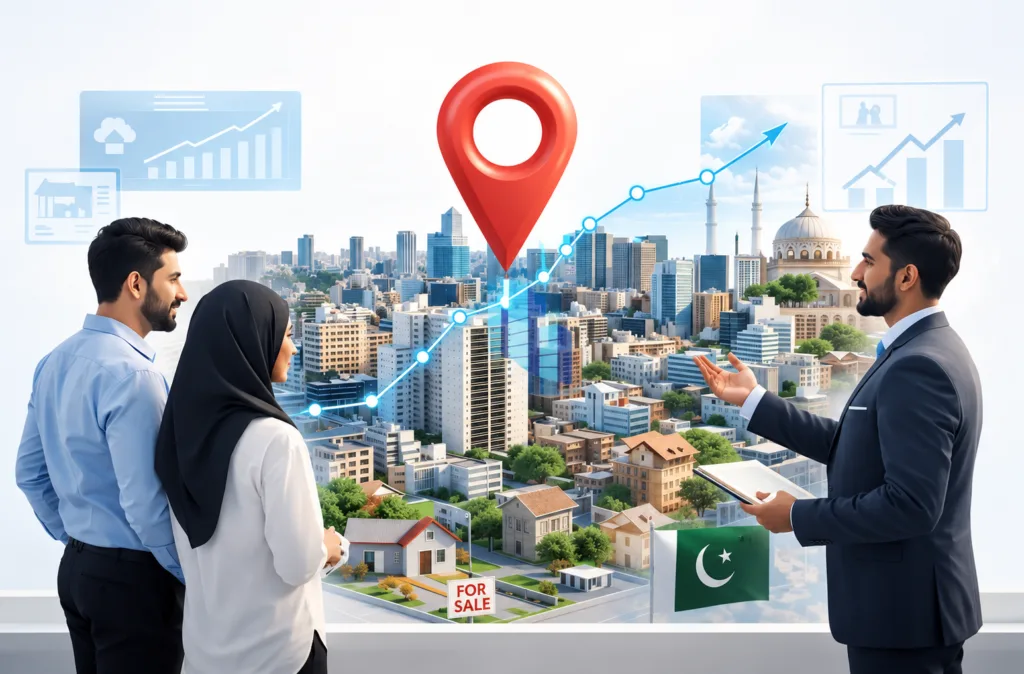
Every property buyer in Pakistan has heard the same advice from an uncle, a broker, or a well-meaning friend: “Yeh sasta mil raha hai, le lo” this one’s cheap, just take it. And on paper, it looks like a win. Lower price, smaller installment, an easy “yes.” But ask anyone who’s owned property for ten years, and they’ll tell you the same thing: the plot that seemed like a bargain in a quiet, disconnected area often stayed exactly where it was priced, while the slightly pricier one near a new road, a growing business district, or a gated community quietly doubled in value. Price is what you negotiate today. Location is what actually pays you back tomorrow. This blog breaks down exactly why, using real numbers from Pakistan’s own market.

Table of Contents

  1. What Really Determines Property Value
  2. Why Price Feels Like the Obvious Factor but Isn’t
  3. Economic Activity and Employment Hubs
  4. How Location Drives Long-Term Value: The Role of Infrastructure
  5. Location vs Price: A Side-by-Side Comparison
  6. Accessibility to Urban Amenities
  7. Rental Income, Yield, and Stability
  8. How to Choose the Ideal Location: What to Actually Look For
  9. How Location Affects Commercial vs Residential Property Differently
  10. Surrounding Communities and Neighborhood Quality
  11. Safety, Security, and Gated Living
  12. A Real-Life Case: Two Buyers, Two Choices
  13. Conclusion

1. What Really Determines Property Value

A property’s price tag is only ever a snapshot of today. Its real, long-term value is shaped by things that don’t change overnight: how close it is to jobs, how safe the area is, whether the roads and utilities work, and whether the neighborhood is actually growing or standing still. Experts consistently point to proximity to business districts, schools, hospitals, and transportation hubs as the biggest factors in how quickly and how much a property appreciates. In other words, the property itself is only half the story where it sits is the other half, and often the bigger one.
 

2. Why Price Feels Like the Obvious Factor But Isn’t

Price feels safe because it’s a number you can compare instantly. Location feels harder to judge, because its real value shows up slowly, over years, not on the booking form. This is exactly why so many buyers default to the cheaper option it’s the easier decision to make at the moment. But a lower price in a weak location often means paying less now and earning less later: slower appreciation, harder resale, and rental income that struggles to find tenants. A slightly higher price in a strong location, on the other hand, tends to reward patience — which is why real estate experts describe genuinely well-located properties as commanding higher prices precisely because buyers already sense, even instinctively, that location protects value better than a discount ever could.

3. Economic Activity and Employment Hubs

Property values follow jobs. Areas near growing business hubs, IT parks, and commercial centers see consistently stronger demand, because people want to live close to where they work. Islamabad is a clear example: its stable economy and thriving IT sector have made it one of the country’s most attractive investment hubs, with high demand for both residential and commercial property that consistently outstrips supply. The same pattern shows up in Faisalabad, where the city’s industrial strength drives steady demand for property nearby, and in Gwadar, where major port and CPEC-linked development has turned a once-quiet coastal town into a serious long-term investment location

4. How Location Drives Long-Term Value: The Role of Infrastructure

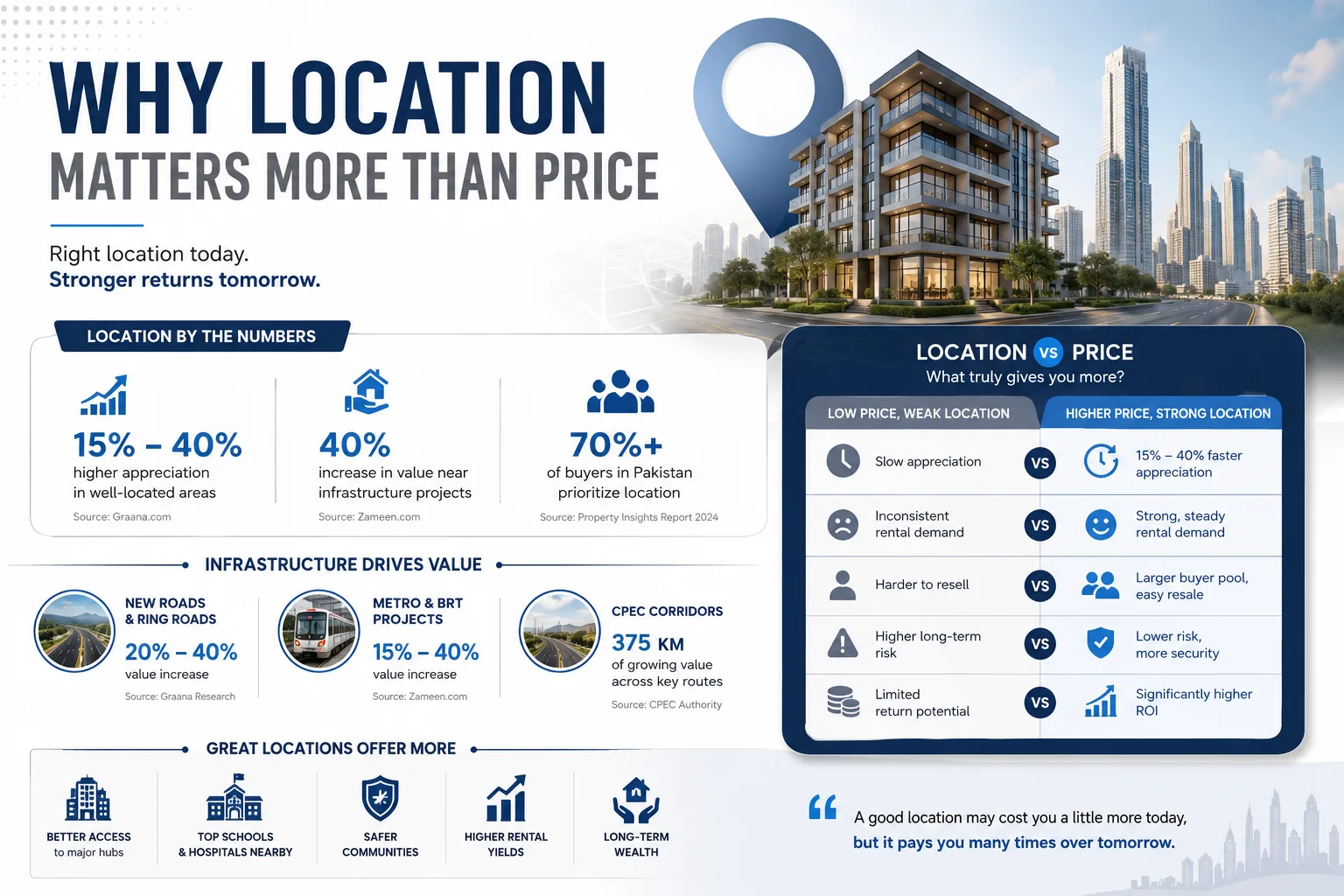
Nothing moves property values quite like a new road, metro line, or interchange. Infrastructure projects highways, metro systems, airport expansions reliably increase demand, and therefore prices, in the areas around them, while areas with poor infrastructure or frequent utility problems tend to lag behind.

The numbers back this up clearly. Land along the Rawalpindi Ring Road corridor and DHA Phase 5 Islamabad appreciated 20 to 40% in a single year. In Karachi, catchment areas around the Green Line BRT and the revived Karachi Circular Railway have seen 15 to 40% appreciation, as improved connectivity turns previously overlooked neighborhoods into serious investment zones.  Along the Islamabad Lahore Motorway corridor, the ongoing China-Pakistan Economic Corridor (CPEC) has quietly reshaped an entire 375-kilometer stretch of land values, as industrial activity and population growth follow the new road network outward from both cities.

The lesson here is simple: wherever infrastructure goes, property values follow and it’s far more predictable than most people realize.

5. Location vs Price: A Side-by-Side Comparison

Factor Cheaper, Weaker Location Slightly Higher Price, Strong Location
Appreciation speed Slow, often flat for years 15–40% in strong infrastructure corridors
Rental demand Inconsistent, longer vacancies Strong, steady tenant demand
Resale ease Harder to find a buyer Larger, more active buyer pool
Long-term risk Higher depends on future development that may never arrive Lower value is already supported by existing activity
Best for Very short-term speculation only Long-term wealth building

6. Accessibility to Urban Amenities

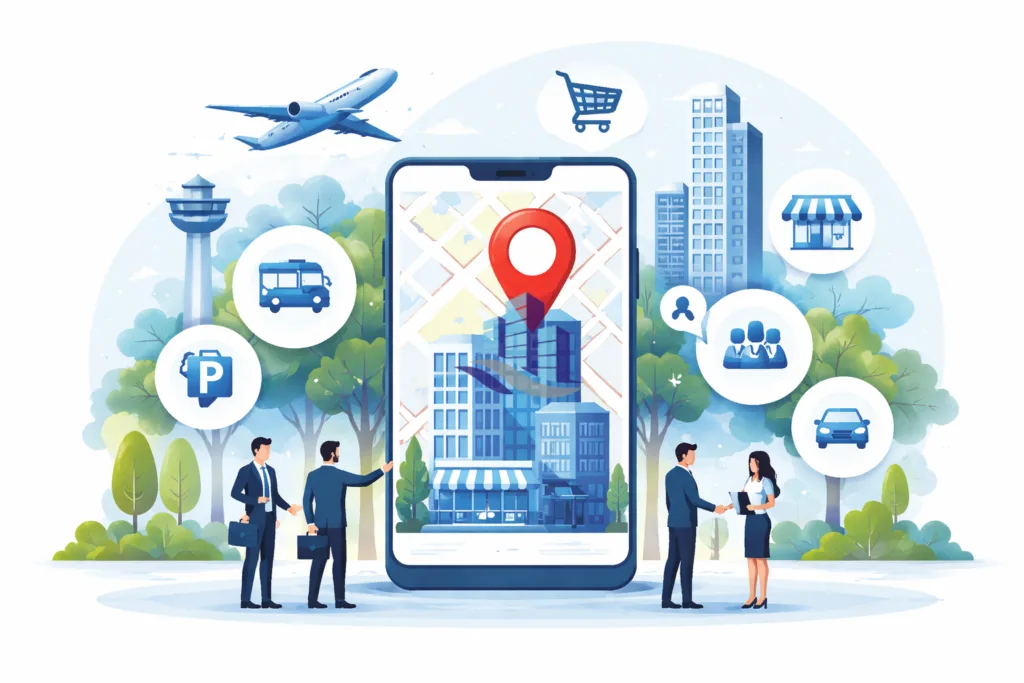
Beyond jobs and roads, people simply want to live near the things daily life depends on schools, hospitals, markets, and recreational spaces. Properties close to these essentials consistently sell faster and hold their value better than those far from them. Developments that include amenities like parks, gyms, and swimming pools within the community itself are increasingly valued higher than similar properties without them, because buyers are no longer just purchasing a home, they’re purchasing a lifestyle they don’t have to drive far to reach. (Source)

7. Rental Income, Yield, and Stability

Location doesn’t just affect what a property is worth, it directly affects what it earns you every month. As a general Pakistani benchmark, a gross rental yield above 6% for residential property, and above 10% for commercial property, is considered strong. Karachi illustrates this well: standard residential areas average 6 to 7% rental yield, while high-demand commercial zones can reach 10 to 15%

Location also determines how stable that income is. In strong, well-connected areas like DHA and Bahria Town Islamabad, vacancy periods between tenants typically run just 2 to 6 weeks. In areas with poor access or an oversupply of similar units, that same gap can stretch to 3 to 6 months of lost income, a difference that adds up fast over a year. A slightly higher purchase price in the right location often pays for itself many times over simply through fewer empty months.

8. How to Choose the Ideal Location: What to Actually Look For

Before falling for a low price, run any property through these checks:

  1. Proximity to jobs and business hubs is the area near where people actually work, or growing toward it?
  2. Infrastructure signals: is there a new road, interchange, or metro line planned or already under construction nearby? These are the earliest, most reliable signs of future appreciation.
  3. Access to essentials schools, hospitals, markets, and mosques within easy reach.
  4. Rental demand history checks how quickly similar properties in the area get rented, not just what they rent for.
  5. Security and community structure gated access, 24/7 surveillance, and a managed community consistently support stronger long-term value.
  6. 3–5 year price trend, not just today’s asking price a property’s recent trajectory tells you far more than a single snapshot.

9. How Location Affects Commercial vs Residential Property Differently

Location works differently depending on what you’re buying. For commercial property, location is almost entirely about footfall and business activity. A shop or office on a busy boulevard earns far more than an identical unit on a quiet street, because its income depends on the people walking past it every day. For residential property, location is about livability safety, schools, and community matter more than raw foot traffic. Interestingly, areas like Blue Area in Islamabad show investors willingly accepting a lower immediate rental yield in exchange for exceptional long-term capital appreciation proof that in prime commercial locations, buyers are consciously paying for location itself, not just current income.

10. Surrounding Communities and Neighborhood Quality

A property doesn’t exist in isolation its neighbors matter. A well-maintained, actively growing community, with responsible management and a consistent standard of upkeep, protects and grows property values over time. A neighborhood in decline, even with a beautiful individual house inside it, will struggle to hold its value against outside market pressure. This is one of the most overlooked parts of location — you’re not just buying a plot, you’re buying into everything being built and maintained around it.

11. Safety, Security, and Gated Living

Security has become one of the strongest value drivers in Pakistani real estate. Areas with lower crime rates and visible security measures, gated entry points, boundary walls, 24/7 surveillance are consistently more desirable, and properties in these areas tend to appreciate faster than those in less secure regions. This is exactly why gated communities have become such a dominant force in the market; some reports now describe gated developments as making up the large majority of premium real estate investment in cities like Karachi. Beyond crime, safety also includes resilience properties in areas prone to flooding or other natural risks that tend to see depressed values compared to those in more stable, secure zones.

12. A Real-Life Case: Two Buyers, Two Choices

Picture two cousins, each with the same budget, buying property in the same year. One buys a plot in a far-out, undeveloped area purely because it was the cheapest option available, no nearby roads, no clear development plan, no real community around it. The other buys a smaller unit, at a slightly higher price, inside a gated community close to a growing commercial corridor with a new interchange under construction nearby.

Five years later, the first cousin’s plot has barely moved in value there’s still no real infrastructure around it, and finding a buyer takes months of waiting. The second cousin’s property has appreciated well above the original price, rents out within weeks whenever a tenant leaves, and could be sold quickly if needed. Neither cousin made an emotional mistake — both were simply following the advice they trusted at the time. But one paid for a lower price. The other paid for a better location. Only one of them actually built wealth.

This is the story that plays out, in different forms, across Pakistan every single year and it’s exactly why understanding location isn’t optional homework. It’s the difference between a property that just sits there, and one that actually works for you.

13. Conclusion

Price is a number you agree on for a single day. Location is a decision that keeps working or keeps struggling for every day after that. The infrastructure, jobs, safety, and community around a property are what actually determine whether it becomes a real asset or a quiet disappointment. The smartest move isn’t chasing the lowest price, it’s understanding that a well-located property, even at a slightly higher cost, is very often the cheaper decision in the long run.

Why Trust and Transparency Matter More Than Price in Business Partnerships

Trust and Transparency over Price

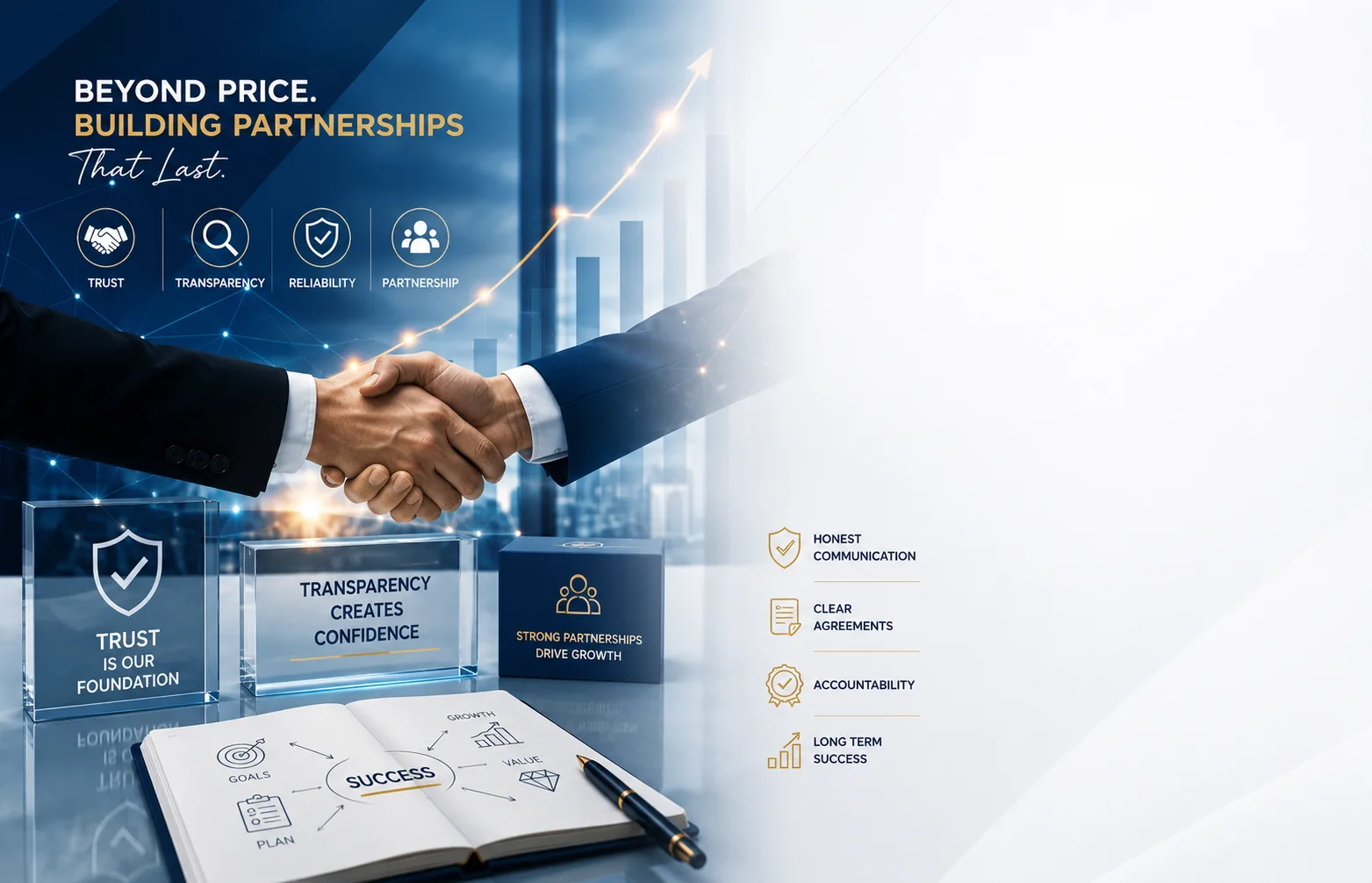
Every business owner eventually faces the same temptation: win the deal by cutting the price. It works, sometimes. But it rarely builds anything that lasts. The partnerships that survive years, the ones that grow instead of just close, are almost never the ones built on the lowest number they’re built on two things that don’t show up on an invoice: trust and transparency. When a client trusts you and understands exactly what they’re paying for, price stops being the deciding factor. This blog breaks down what trust and transparency actually mean in business, why they consistently outperform price as a deciding factor, and what it looks like when a business genuinely builds a partnership around trust and transparency instead of a discount.

Table of Contents

  1. Defining Trust and Transparency in Business
  2. The Benefits of Trust and Transparency
  3. How Trust Leads to More Effective Decision-Making
  4. How Transparency Reduces Risk
  5. How Trust and Transparency Turn Deals into Real Partnerships
    • Aligning Goals
    • Building Open Communication Channels
    • Creating Ownership and Responsibility
    • Establishing Long-Term Trust
  6. A Real-World Example
  7. FAQs
  8. Conclusion

1. Defining Trust and Transparency in Business

Trust is the belief that the other side in a business relationship will do what they say, treat you fairly, and act in good faith even when no one is checking. It’s not something a contract can force; it’s something built up through consistent, honest behavior over time.

Transparency is what makes trust possible in the first place. It means openly sharing information pricing, timelines, risks, mistakes instead of hiding it until someone asks, or until it becomes impossible to hide. Where trust is the feeling, transparency is the action that earns it.

Together, they answer the one question every business partner is really asking whether they say it out loud or not: “Can I actually rely on you?”

2. The Benefits of Trust and Transparency
The Benefits of Trust and Transparency

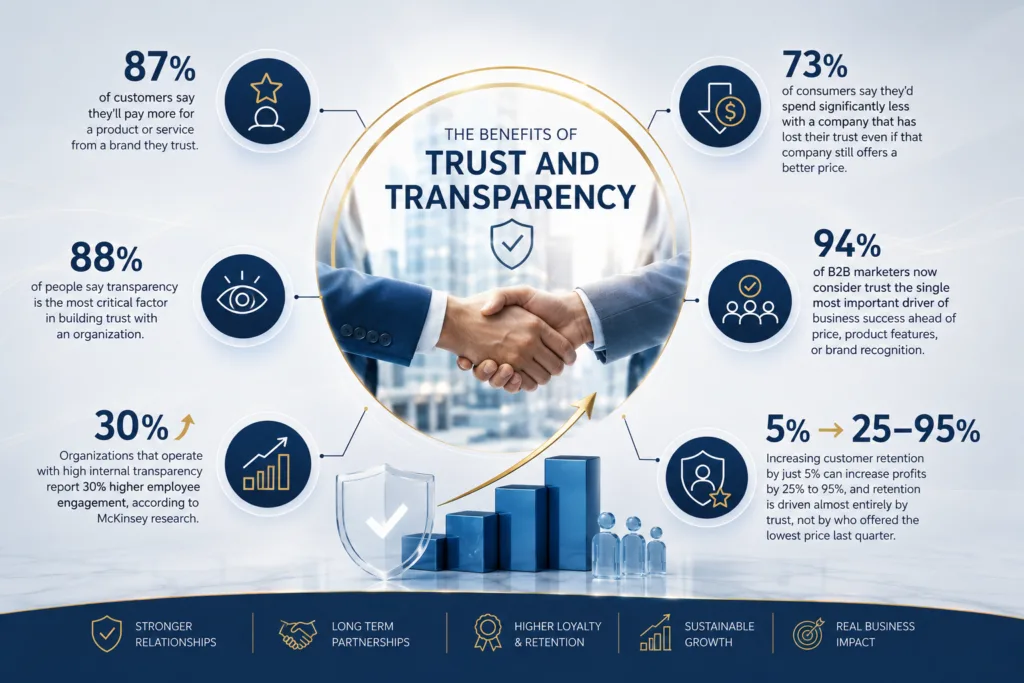
The data on this is remarkably consistent across studies:

  • 87% of customers say they’ll pay more for a product or service from a brand they trust.
  • 73% of consumers say they’d spend significantly less with a company that has lost their trust even if that company still offers a better price. (Source)
  • According to the Edelman Trust Barometer, 88% of people say transparency is the most critical factor in building trust with an organization. (Source)
  • A 2025 LinkedIn/Ipsos study found that 94% of B2B marketers now consider trust the single most important driver of business success ahead of price, product features, or brand recognition. (Source)
  • Organizations that operate with high internal transparency report 30% higher employee engagement, according to McKinsey research meaning transparency doesn’t just help external partnerships, it strengthens the team behind them too. (Source)

The benefit isn’t abstract it shows up directly in retention and revenue. Research from Bain & Company found that increasing customer retention by just 5% can increase profits by 25% to 95%, and retention is driven almost entirely by trust, not by who offered the lowest price last quarter. (Source)

3. How Trust Leads to More Effective Decision-Making

When two sides of a partnership trust each other, decisions get made faster and better. Here’s why: without trust, every decision gets filtered through suspicion “are they telling me the full picture?” which slows everything down and often leads to defensive, overly cautious choices on both sides.

With trust in place, partners can share real information, including bad news, without fear of it being used against them. That means problems get raised earlier, solutions get found faster, and decisions get made based on facts instead of guesswork or hidden agendas. This is exactly why 82% of consumers say trust in a company is very important when deciding who to do business with trust removes the need to second-guess every decision the other party makes.

4. How Transparency Reduces Risk
How Transparency Reduces Risk

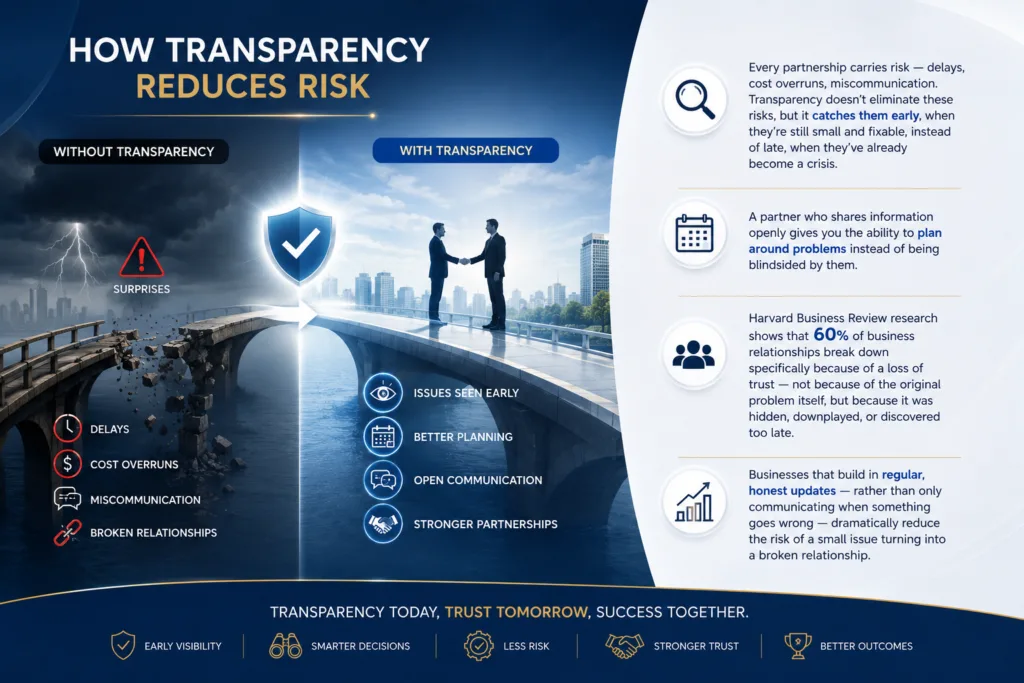
Every business partnership carries risk delays, cost overruns, miscommunication. Transparency doesn’t eliminate these risks, but it catches them early, when they’re still small and fixable, instead of late, when they’ve already become a crisis.

A partner who shares information openly gives you the ability to plan around problems instead of being blindsided by them. This is also why research from Harvard Business Review found that 60% of business relationships break down specifically because of a loss of trust not because of the original problem itself, but because it was hidden, downplayed, or discovered too late. (Source) Businesses that build in regular, honest updates — rather than only communicating when something goes wrong dramatically reduce the risk of a small issue turning into a broken relationship.

5. How Trust and Transparency Turn Deals Into Real Partnerships

A one-time deal and a real, lasting partnership are built differently. Here’s what actually moves a business relationship from “just a transaction” to a genuine partnership.

Aligning Goals

Every strong partnership starts with both sides being honest about what they actually want out of the relationship not just what sounds good in a meeting. When goals are stated openly instead of assumed, both sides can plan around the same outcome instead of quietly working toward different ones, which is one of the most common, and most avoidable, reasons partnerships quietly fall apart.

Building Open Communication Channels

Trust needs a channel to travel through. That means regular check-ins, clear points of contact, and a habit of sharing updates good and bad before they’re asked for. Partnerships that only communicate when there’s a problem tend to associate every conversation with bad news, which slowly erodes trust even when the underlying relationship is fine.

Creating Ownership and Responsibility

A transparent partnership is one where both sides are willing to say “that was on us” when something goes wrong, instead of deflecting or staying quiet. This kind of accountability is what separates a partner you can rely on from one you have to constantly double-check and it’s very hard to fake over time.

Establishing Long-Term Trust

Trust isn’t built in one meeting it’s built transaction by transaction, promise by promise. Every time a business does what it said it would do, it adds to a track record. Over enough time, that track record becomes the actual reason a partner stays loyal, far more than any single price point ever could.

6. A Real-World Example

Buffer, a social media management platform, built its reputation almost entirely around radical transparency publicly sharing its revenue, its financial metrics, and even the exact formula it uses to calculate every employee’s salary. Instead of damaging the company, this openness built a loyal customer base that appreciated being let into the company’s real journey, including its setbacks, resulting in strong media coverage and long-term customer loyalty. (Source)

Patagonia offers another clear example. The outdoor apparel company built its brand around openly sharing its supply chain practices and the environmental impact of its products including admitting when a popular product had a larger environmental footprint than expected. Rather than hurting the brand, this transparency deepened customer loyalty, and the company’s sales grew to nearly a billion dollars in 2019. (Source)

Perhaps the most well-known case is Johnson & Johnson’s response to the 1980s Tylenol crisis, still taught in business schools today. When the company faced a serious product safety crisis, it responded with immediate transparency taking responsibility publicly and communicating openly with customers throughout, rather than minimizing the issue. That transparent response is widely credited with rebuilding public trust and positioning the company as a long-term leader in ethical business practice. (Source)

The common thread in all three: none of these companies were the cheapest option in their industry. What made customers and partners stay was the confidence that these businesses would tell the truth, even when the truth wasn’t flattering.

7. FAQs

Why does trust matter more than price in a business partnership? Because price is a one-time decision, but trust determines whether the relationship survives problems, delays, and unexpected changes which every long-term partnership eventually faces.

Can transparency actually hurt a business? It can invite more scrutiny, since sharing more information means more can be questioned but studies consistently show the trust it builds outweighs that risk, especially over the long term.

How do you build trust with a new business partner quickly? Start by being transparent early share pricing clearly, communicate realistic timelines, and follow through on small commitments before asking for larger ones. Trust builds fastest through consistency, not promises.

What’s the difference between trust and transparency? Transparency is the action openly sharing information. Trust is the result the confidence that builds up in the other person because of that openness over time.

8. Conclusion

Price will always be part of any business decision, but it’s rarely the reason a partnership actually lasts. The businesses and partnerships that survive through delays, mistakes, and market changes are the ones built on trust that was earned honestly, through transparency that didn’t wait to be asked for. In the long run, a partner you can rely on is worth more than a partner who was simply cheaper.


Read Also: Real Estate vs Pharma vs Hospitality: Which Is the Best Investment in Pakistan 2026?

How to Verify an Investment Management Company’s Credibility Before Doing Business

There’s a specific feeling everyone in Pakistan knows. You’ve found a company that looks perfect, the website is polished, the sales rep is friendly, the offer sounds almost too good. And right underneath the excitement, there’s a small, quiet voice asking: “But is this actually real?”

That question isn’t paranoia. It’s a good instinct. And the good news is, you don’t have to guess anymore. Pakistan actually has a clear, simple system for checking whether a company is genuine — you just need to know where to look. This guide walks you through it, step by step, in plain language, so the next time you’re about to sign a contract, book a property, or hand over your hard-earned savings, you can do it with real peace of mind instead of crossed fingers.

Why This Small Habit Matters So Much

Think about it from a human angle. When you trust a company with your money, you’re really trusting them with something bigger a plan, a dream, maybe your family’s future. Every year, people across Pakistan hand over savings to companies that looked convincing on the surface but had nothing solid behind them. It’s not that people are careless. It’s that most of us were never taught how to check. We rely on gut feeling, on what a friend said, on how nice the office looked.

Here’s the shift in mindset that changes everything: a genuinely good company wants you to verify it. A company with nothing to hide will happily point you to its registration number, its tax records, its approvals. It’s only the companies with something to hide that get uncomfortable when you ask questions. So verifying a company isn’t an act of distrust, it’s simply good practice, and any solid, established business will respect you more for doing it.

Step One: Check the Government Records (This Is Easier Than You Think)

Pakistan has real, working institutions built exactly for this purpose. Here’s how each one helps you, in order of how often you’ll actually use them.

SECP — Confirm the Company Legally Exists

The Securities and Exchange Commission of Pakistan (SECP) is the main body that registers companies in Pakistan. As of 2025, there are over 180,000 registered companies in the country. (Source) Every registered company gets a CUIN (Company Incorporation Number), and you can search any company’s name for free on the SECP eServices portal. Within seconds, you’ll see whether the company is legally incorporated, when it was formed, whether it’s active, and its registered office address. If a company can’t be found there and claims to be a private limited company, that’s your cue to ask more questions.

FBR — Confirm the Company Pays Its Taxes

The Federal Board of Revenue (FBR) issues every legitimate business an NTN (National Tax Number). You can check any company’s NTN and see whether they’re on the Active Taxpayer List (ATL) completely free, no login needed through the FBR’s online verification portal. A company that files its taxes regularly and appears on the ATL is telling you something important: it’s playing by the rules, in a system where doing so is completely visible and checkable by anyone. 

CDA — Confirm a Real Estate Project Is Actually Approved

If you’re specifically looking at property or a construction project in Islamabad, the Capital Development Authority (CDA) is your best friend. CDA approves housing and commercial schemes in two stages first the Layout Plan (LOP), then the No Objection Certificate (NOC) and only issues these once a project meets legal, safety, and infrastructure requirements. (Source) You can check any project’s exact approval status directly on CDA’s website before paying a single rupee in booking or token money. A project with a clear LOP and NOC gives you a real legal foundation to build your investment on.

NAB — A Quiet but Reassuring Check

The National Accountability Bureau (NAB) is Pakistan’s anti-corruption body, responsible for investigating financial fraud and corruption across public and private sectors. (Source) NAB doesn’t hand out “certificates” the way SECP or FBR do but a company (and its leadership) with no NAB inquiries or cases attached to their name is a genuinely reassuring sign. It simply means nothing has raised a red flag with Pakistan’s accountability system.

Put simply: if a company is verifiable through SECP, active with FBR, and where relevant properly approved by CDA, with a clean record and no accountability concerns, that’s about as solid a legal foundation as a business can have in Pakistan. At that point, anyone can comfortably do business with them.

Step Two: Look Beyond the Paperwork the Human Side of Trust

Government records tell you a company is legal. They don’t tell you whether a company is actually good to work with. For that, you need to look at the human story behind the business.

Background and history. How long has this company actually been operating? Do they have real, physical offices you can walk into, or just a phone number and a Facebook page? A company with a visible footprint offices, ongoing projects you can literally go and see has already put real skin in the game.

Customer reviews and word of mouth. This is honestly one of the most powerful signals there is. Search the company’s name along with words like “reviews” or “experience.” Look at what past customers say, not just on the company’s own page, but on independent platforms and social media. A pattern of happy, long-term customers speaks louder than any advertisement ever could.

How they treat their customers. Pay attention to how a company responds when something goes wrong. Do they respond to messages? Do they resolve complaints, or go quiet? A company that genuinely values its customers will have systems in place a proper support team, clear contact details, transparent policies because it knows that trust, once built, is worth protecting.

Customers’ past experience. If a company has delivered on past promises finished a project on time, followed through on what they said they would do that history becomes one of its biggest assets. It’s also exactly why established groups with a visible, ongoing track record tend to earn more social trust over time than newer, unproven names.

A Real Example: What This Looks Like in Practice

ISMMART Group of Industries is a good example of what this whole verification process looks like when you actually walk through it. According to the company’s own official LinkedIn page, ISMMART Group of Industries is described as a group of six companies registered under SECP. (Source) It operates with real, physical offices a Central HQ in Islamabad, a global office in Dubai’s Business Bay, and branches in Lahore and Karachi and it has ongoing, visible projects like Tower 17 that anyone can look up, visit, and follow the progress of, rather than a business that exists only online. It also lists direct contact details publicly (+92 337 330 9872, businesses@ismmartindustries.com), which is exactly the kind of transparency a trustworthy company should offer.

Here’s the most important part, and the same advice we’d give about any company: don’t just take this article’s word for it, or the company’s own word for it either. Search ISMMART’s name on the SECP portal yourself. Check the FBR taxpayer list. Look at customer reviews online. Ask about Tower 17’s approval status directly with their team. That’s not a lack of confidence in any one business that’s simply what smart, informed customers do everywhere, and any credible company will welcome the question rather than avoid it.

Your Quick Credibility Checklist

Next time you’re about to do business with any company in Pakistan, run through this in five minutes:

  1. Search the company on the SECP eServices portal confirm it’s legally registered and active.
  2. Check their NTN and ATL status on FBR’s portal confirm they’re a compliant taxpayer.
  3. For real estate specifically, check CDA’s approval status for the exact project and phase.
  4. Search their name plus “reviews” and read what real customers are saying.
  5. Visit their physical office if you can, or at least confirm it exists.
  6. Ask them directly for documentation registration certificates, NOCs, tax records. A confident, transparent company will hand these over without hesitation.

The Warm Truth About Trust

Verifying a company isn’t about being suspicious of the world it’s about giving your money, your time, and your trust to the businesses that have genuinely earned it. The best part? Once you know these few simple steps, you’ll never have to rely on gut feeling alone again. You’ll walk into every business decision with confidence, clarity, and the quiet peace of mind that comes from knowing exactly who you’re dealing with.

And honestly, that’s good for everyone for you, and for every company out there doing things the right way, who has nothing to hide and everything to show.


One Company, Four Subsidiaries: How ISMMART is Building a Stronger Future

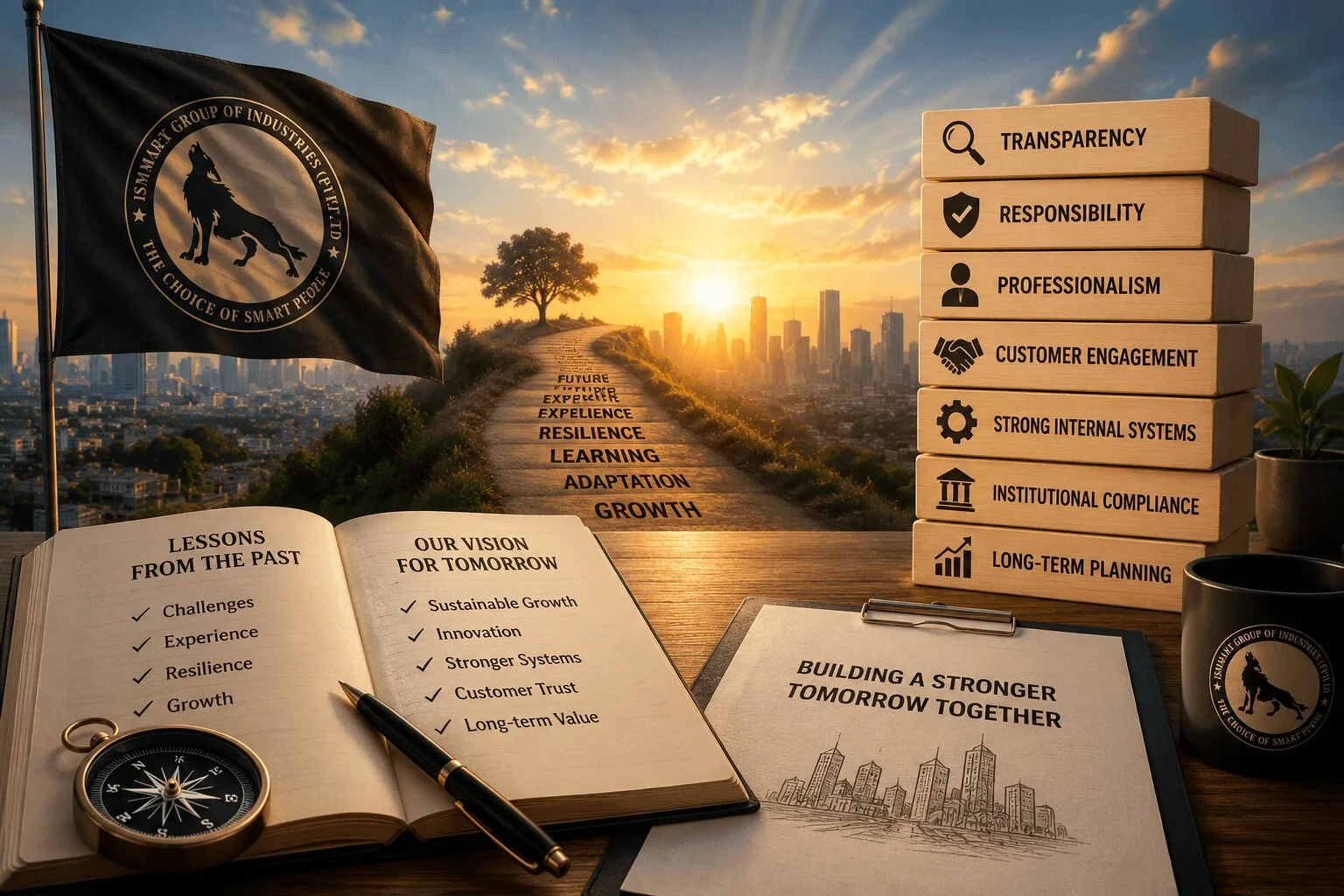
Every successful business experiences challenges. What separates long term organizations from short lived ventures is not the absence of obstacles but the ability to overcome them with resilience, transparency, and a clear vision.

ISMMART has followed this philosophy throughout its journey. While the company encountered operational and business challenges during 2024, it continued to strengthen its foundation, improve governance, and focus on sustainable growth.

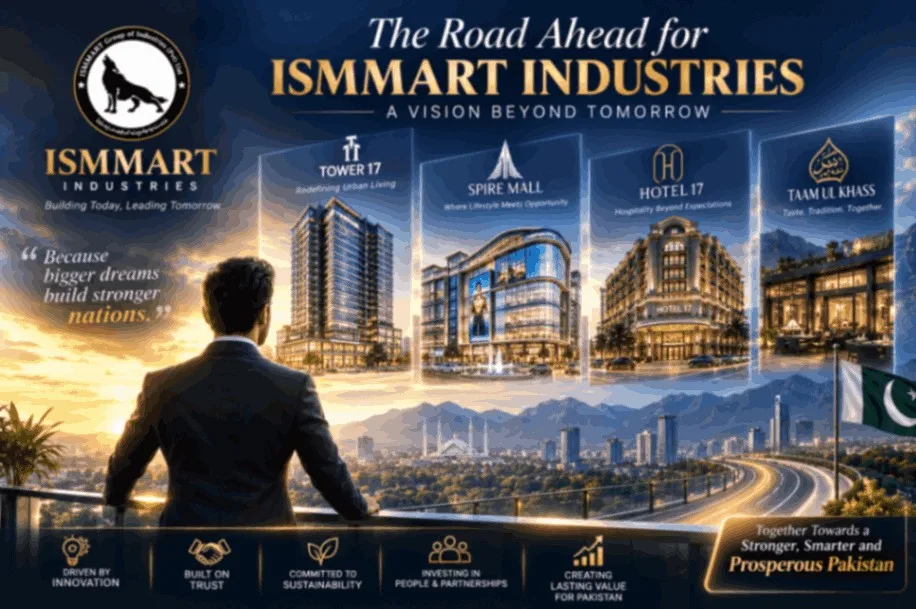
Today, ISMMART is entering a new phase of expansion through four strategically aligned subsidiaries, each serving a unique role in creating long-term value for customers, investors, and Pakistan’s economy.

From Challenges to Growth

Like many businesses operating in Pakistan’s changing economic environment, ISMMART experienced a period of restructuring and adjustment during 2024.

These challenges encouraged the organization to:

  • Improve internal governance.
  • Strengthen operational systems.
  • Enhance compliance procedures.
  • Focus on sustainable business practices.
  • Build greater transparency for stakeholders.

A New Era of ISMMART

Rather than slowing down, ISMMART used this period to reorganize its long term business strategy.

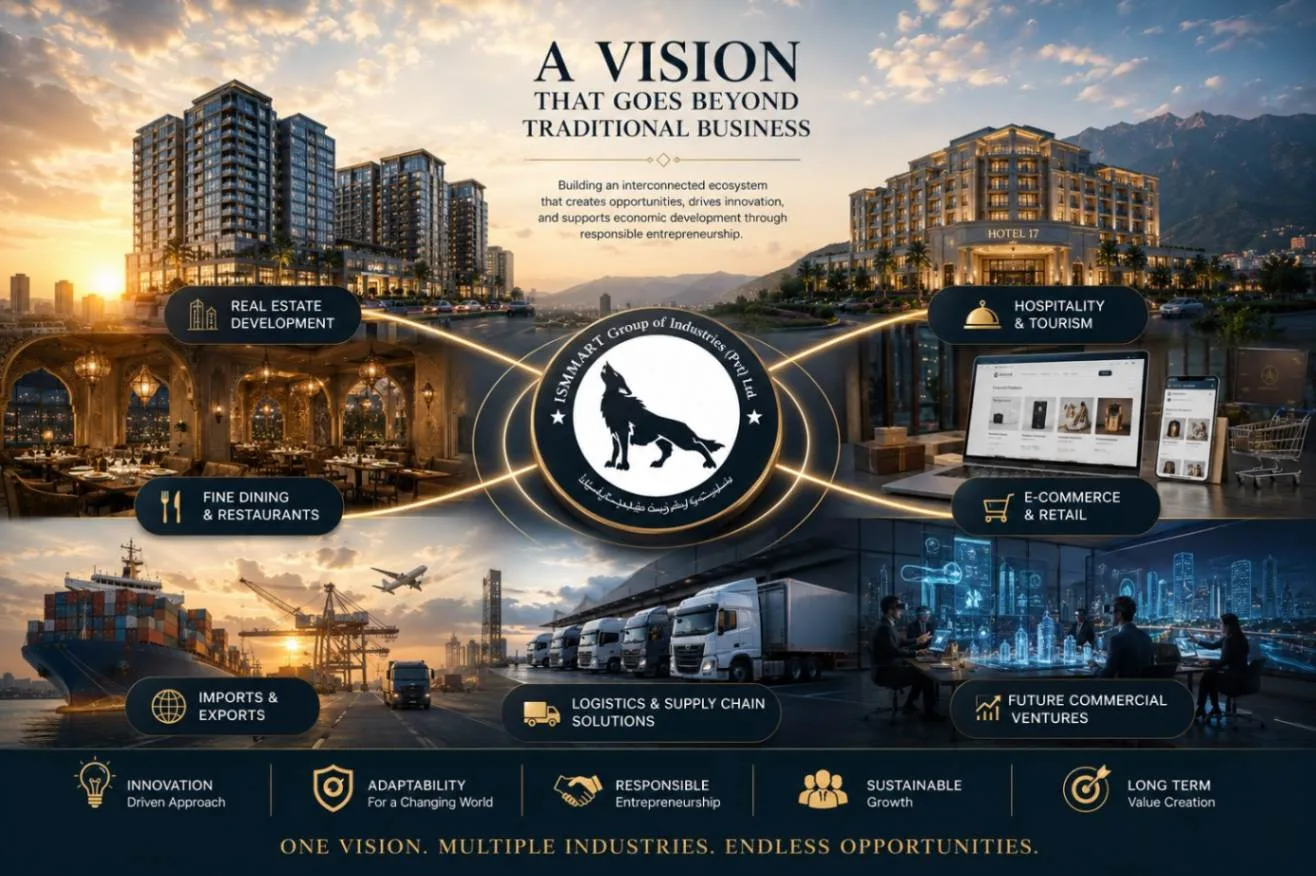
The company’s focus shifted toward creating a diversified group of specialized businesses operating under one vision.

Today, ISMMART is expanding through four subsidiaries designed to complement one another and build sustainable value.

https://ismmartindustries.com/ 

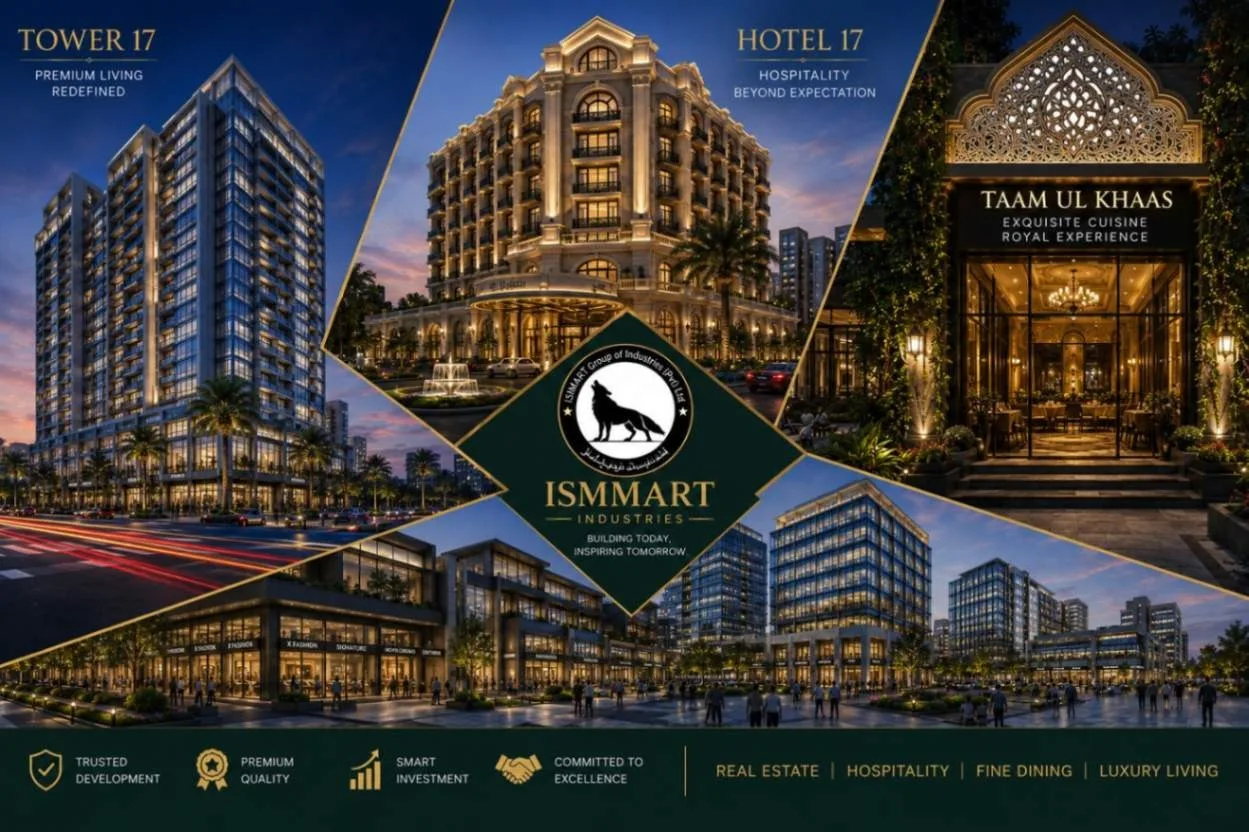
Tower 17

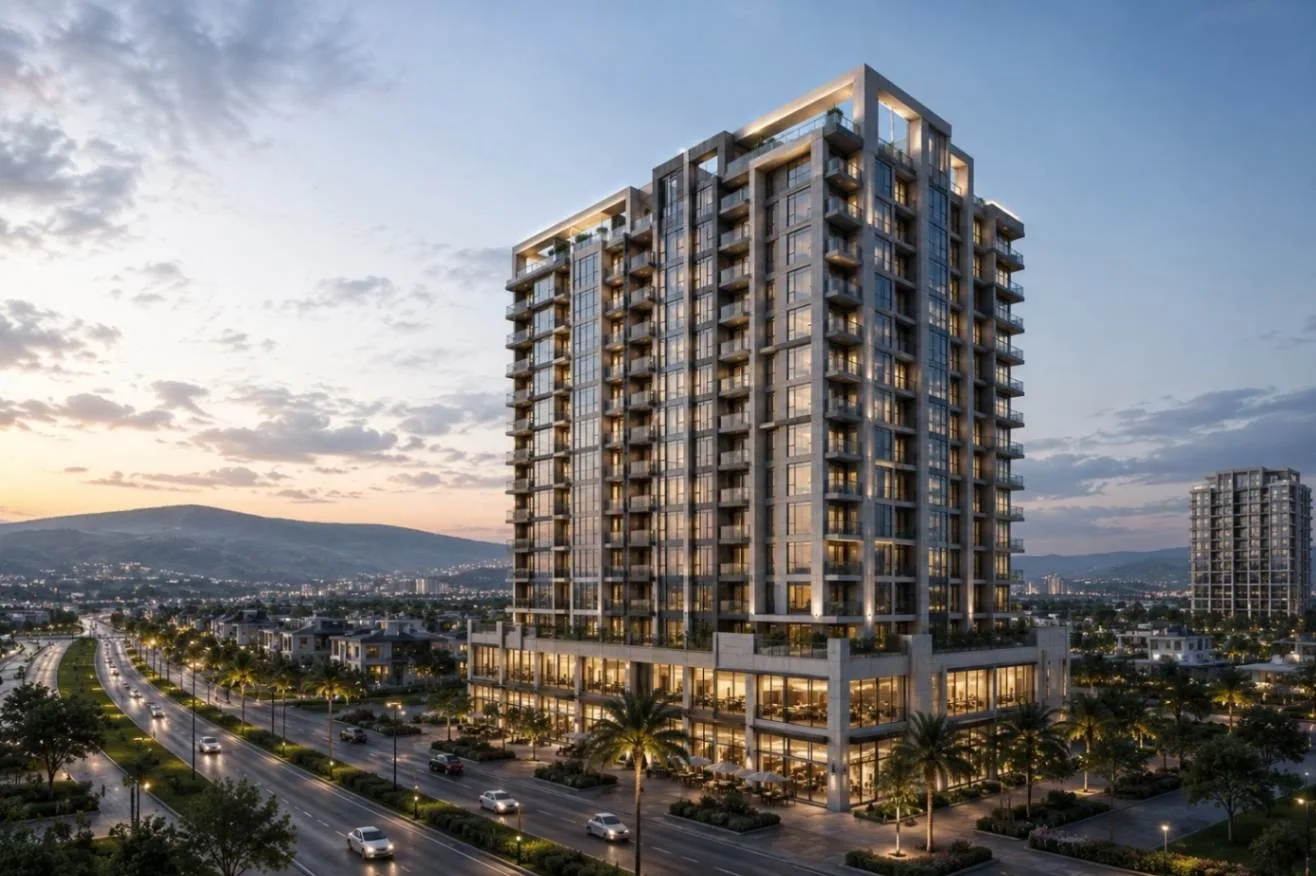
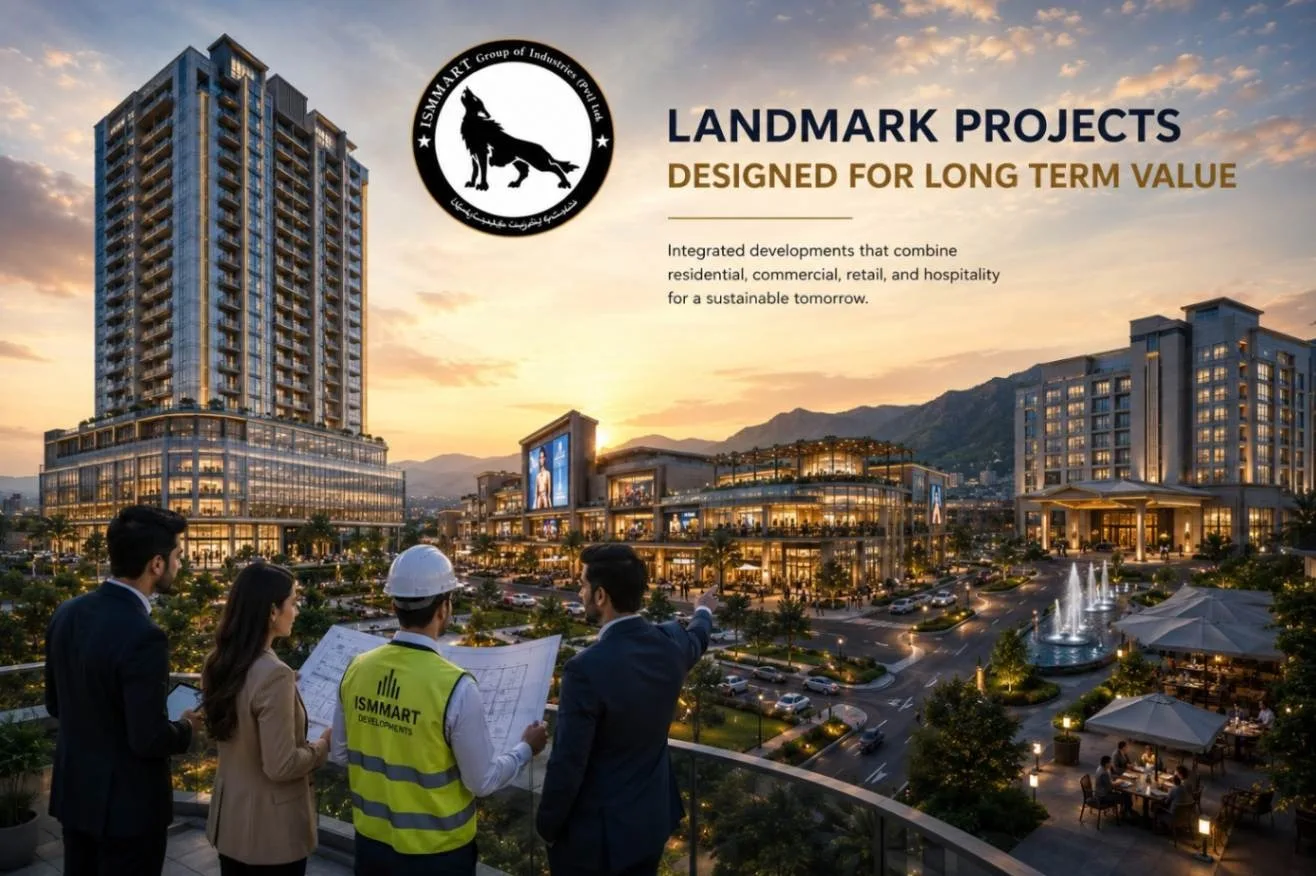
Tower 17 represents ISMMART’s vision for premium real estate and modern commercial development.

The company focuses on delivering projects that combine innovation, strategic planning, and long term investment value.

Future Focus

Apex Estates

Apex Estates is dedicated to providing professional real estate services, investment opportunities, and property development solutions.

Its objective is to connect investors with projects designed for long-term growth while maintaining transparency throughout the investment process.

Services

  • Property investment
  • Real estate consultancy
  • Land development
  • Commercial property solutions
  • Investment planning

https://apexestatespak.com/ 

Taam-ul-Khas Restaurant & Industry

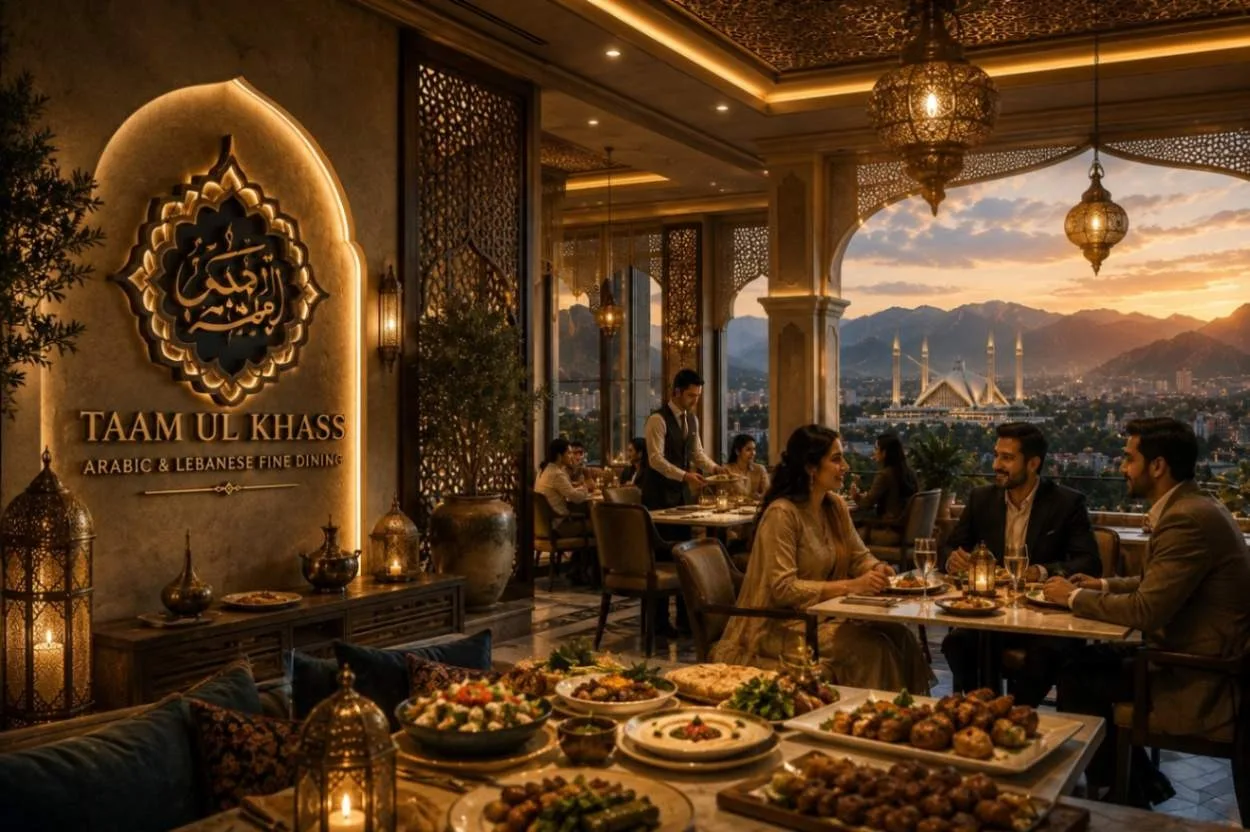
Taam-ul-Khas represents ISMMART’s expansion into hospitality and food services.

The company aims to combine premium dining experiences with high standards of quality and customer satisfaction.

Its vision extends beyond restaurants toward developing food-related industrial opportunities in the future.

Business Focus:

  • Premium dining
  • Traditional cuisine
  • Modern hospitality
  • Food production opportunities
  • Customer experience

https://www.facebook.com/share/v/1EoyxEKTfR/

Hotel 17

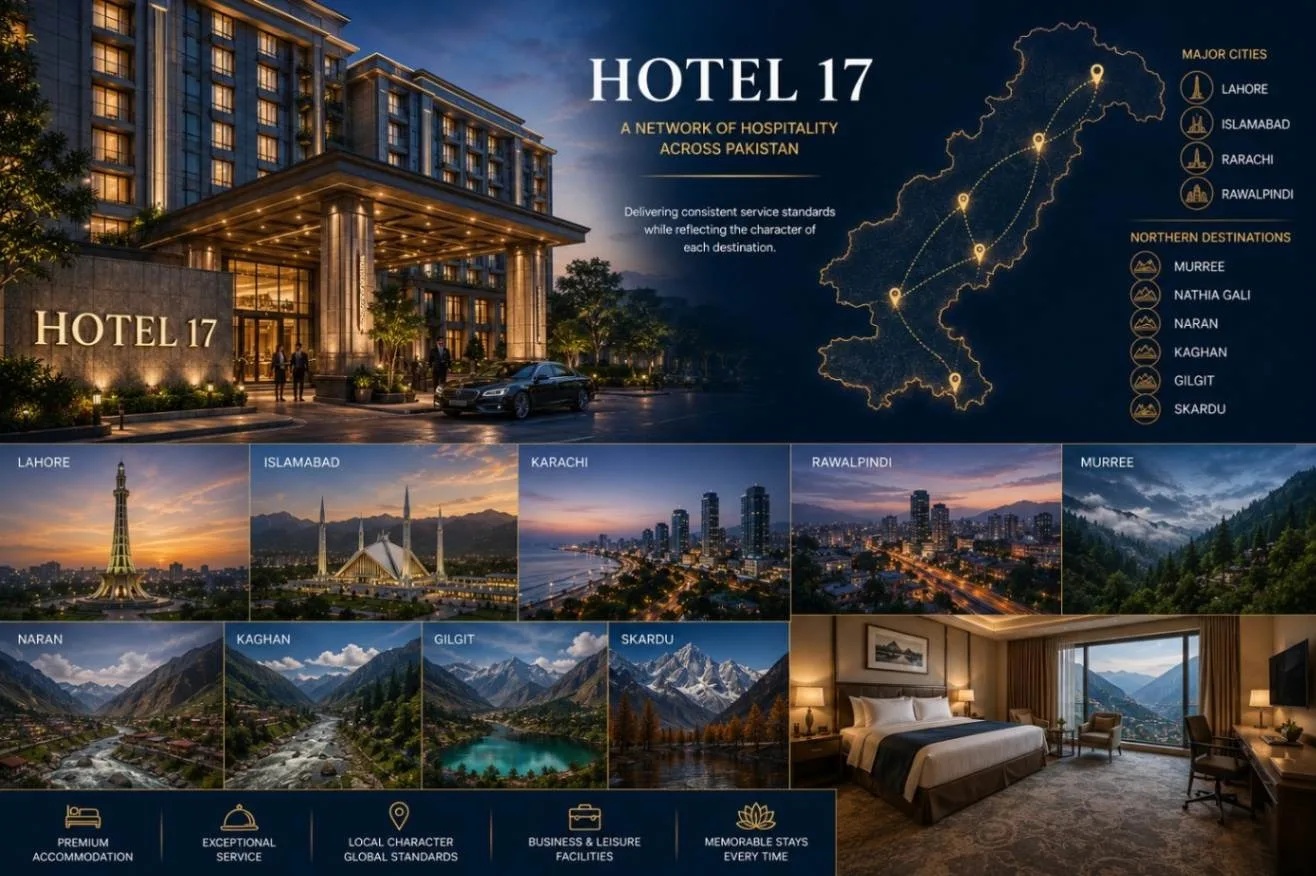
Hotel 17 represents one of ISMMART’s most ambitious upcoming hospitality projects.

The brand is currently under development and is planned for major tourist destinations including:

  • Karachi
  • Islamabad
  • Northern Pakistan

The project aims to provide modern accommodation while promoting domestic tourism and supporting Pakistan’s hospitality sector.

Hotel 17 is also expected to create opportunities for strategic investment.

https://www.facebook.com/profile.php?id=61570993469261#

Why Diversification Matters

Instead of depending on one industry, ISMMART has developed multiple business segments that support one another.

This strategy helps:

  • Reduce business risk.
  • Create multiple revenue opportunities.
  • Strengthen long-term sustainability.
  • Increase operational flexibility.
  • Build investor confidence.

Looking Beyond 2024

Every successful organization has defining moments.

For ISMMART, 2024 became a year of learning, restructuring, and preparing for future expansion.

The company now enters a new phase focused on:

  • Expansion
  • Investment
  • Innovation
  • Hospitality
  • Real Estate
  • Customer Experience
  • Sustainable Growth

Invitation to Investors

ISMMART welcomes individuals and organizations interested in becoming part of its future growth.

Investment opportunities are available across selected projects, with detailed information to be announced.

Conclusion

The journey of ISMMART demonstrates that sustainable businesses are not defined solely by periods of growth, but by how they respond to challenges. By refining its operations, strengthening governance, and expanding through four focused subsidiaries Tower 17, Apex Estates, Taam-ul-Khas Restaurant & Industry, and Hotel 17 the company is positioning itself for its next phase of development.

With ongoing projects, future investment opportunities, and a commitment to responsible growth, ISMMART aims to contribute to Pakistan’s economic development while creating long term value for customers, partners, and investors.


How to Verify an Investment Management Company’s Credibility Before Doing Business

There’s a specific feeling everyone in Pakistan knows. You’ve found a company that looks perfect, the website is polished, the sales rep is friendly, the offer sounds almost too good. And right underneath the excitement, there’s a small, quiet voice asking: “But is this actually real?”

That question isn’t paranoia. It’s a good instinct. And the good news is, you don’t have to guess anymore. Pakistan actually has a clear, simple system for checking whether a company is genuine — you just need to know where to look. This guide walks you through it, step by step, in plain language, so the next time you’re about to sign a contract, book a property, or hand over your hard-earned savings, you can do it with real peace of mind instead of crossed fingers.

Why This Small Habit Matters So Much

Think about it from a human angle. When you trust a company with your money, you’re really trusting them with something bigger a plan, a dream, maybe your family’s future. Every year, people across Pakistan hand over savings to companies that looked convincing on the surface but had nothing solid behind them. It’s not that people are careless. It’s that most of us were never taught how to check. We rely on gut feeling, on what a friend said, on how nice the office looked.

Here’s the shift in mindset that changes everything: a genuinely good company wants you to verify it. A company with nothing to hide will happily point you to its registration number, its tax records, its approvals. It’s only the companies with something to hide that get uncomfortable when you ask questions. So verifying a company isn’t an act of distrust, it’s simply good practice, and any solid, established business will respect you more for doing it.

Step One: Check the Government Records (This Is Easier Than You Think)

Pakistan has real, working institutions built exactly for this purpose. Here’s how each one helps you, in order of how often you’ll actually use them.

SECP — Confirm the Company Legally Exists

The Securities and Exchange Commission of Pakistan (SECP) is the main body that registers companies in Pakistan. As of 2025, there are over 180,000 registered companies in the country. (Source) Every registered company gets a CUIN (Company Incorporation Number), and you can search any company’s name for free on the SECP eServices portal. Within seconds, you’ll see whether the company is legally incorporated, when it was formed, whether it’s active, and its registered office address. If a company can’t be found there and claims to be a private limited company, that’s your cue to ask more questions.

FBR — Confirm the Company Pays Its Taxes

The Federal Board of Revenue (FBR) issues every legitimate business an NTN (National Tax Number). You can check any company’s NTN and see whether they’re on the Active Taxpayer List (ATL) completely free, no login needed through the FBR’s online verification portal. A company that files its taxes regularly and appears on the ATL is telling you something important: it’s playing by the rules, in a system where doing so is completely visible and checkable by anyone. 

CDA — Confirm a Real Estate Project Is Actually Approved

If you’re specifically looking at property or a construction project in Islamabad, the Capital Development Authority (CDA) is your best friend. CDA approves housing and commercial schemes in two stages first the Layout Plan (LOP), then the No Objection Certificate (NOC) and only issues these once a project meets legal, safety, and infrastructure requirements. (Source) You can check any project’s exact approval status directly on CDA’s website before paying a single rupee in booking or token money. A project with a clear LOP and NOC gives you a real legal foundation to build your investment on.

NAB — A Quiet but Reassuring Check

The National Accountability Bureau (NAB) is Pakistan’s anti-corruption body, responsible for investigating financial fraud and corruption across public and private sectors. (Source) NAB doesn’t hand out “certificates” the way SECP or FBR do but a company (and its leadership) with no NAB inquiries or cases attached to their name is a genuinely reassuring sign. It simply means nothing has raised a red flag with Pakistan’s accountability system.

Put simply: if a company is verifiable through SECP, active with FBR, and where relevant properly approved by CDA, with a clean record and no accountability concerns, that’s about as solid a legal foundation as a business can have in Pakistan. At that point, anyone can comfortably do business with them.

Step Two: Look Beyond the Paperwork the Human Side of Trust

Government records tell you a company is legal. They don’t tell you whether a company is actually good to work with. For that, you need to look at the human story behind the business.

Background and history. How long has this company actually been operating? Do they have real, physical offices you can walk into, or just a phone number and a Facebook page? A company with a visible footprint offices, ongoing projects you can literally go and see has already put real skin in the game.

Customer reviews and word of mouth. This is honestly one of the most powerful signals there is. Search the company’s name along with words like “reviews” or “experience.” Look at what past customers say, not just on the company’s own page, but on independent platforms and social media. A pattern of happy, long-term customers speaks louder than any advertisement ever could.

How they treat their customers. Pay attention to how a company responds when something goes wrong. Do they respond to messages? Do they resolve complaints, or go quiet? A company that genuinely values its customers will have systems in place a proper support team, clear contact details, transparent policies because it knows that trust, once built, is worth protecting.

Customers’ past experience. If a company has delivered on past promises finished a project on time, followed through on what they said they would do that history becomes one of its biggest assets. It’s also exactly why established groups with a visible, ongoing track record tend to earn more social trust over time than newer, unproven names.

A Real Example: What This Looks Like in Practice

ISMMART Group of Industries is a good example of what this whole verification process looks like when you actually walk through it. According to the company’s own official LinkedIn page, ISMMART Group of Industries is described as a group of six companies registered under SECP. (Source) It operates with real, physical offices a Central HQ in Islamabad, a global office in Dubai’s Business Bay, and branches in Lahore and Karachi and it has ongoing, visible projects like Tower 17 that anyone can look up, visit, and follow the progress of, rather than a business that exists only online. It also lists direct contact details publicly (+92 337 330 9872, businesses@ismmartindustries.com), which is exactly the kind of transparency a trustworthy company should offer.

Here’s the most important part, and the same advice we’d give about any company: don’t just take this article’s word for it, or the company’s own word for it either. Search ISMMART’s name on the SECP portal yourself. Check the FBR taxpayer list. Look at customer reviews online. Ask about Tower 17’s approval status directly with their team. That’s not a lack of confidence in any one business that’s simply what smart, informed customers do everywhere, and any credible company will welcome the question rather than avoid it.

Your Quick Credibility Checklist

Next time you’re about to do business with any company in Pakistan, run through this in five minutes:

  1. Search the company on the SECP eServices portal confirm it’s legally registered and active.
  2. Check their NTN and ATL status on FBR’s portal confirm they’re a compliant taxpayer.
  3. For real estate specifically, check CDA’s approval status for the exact project and phase.
  4. Search their name plus “reviews” and read what real customers are saying.
  5. Visit their physical office if you can, or at least confirm it exists.
  6. Ask them directly for documentation registration certificates, NOCs, tax records. A confident, transparent company will hand these over without hesitation.

The Warm Truth About Trust

Verifying a company isn’t about being suspicious of the world it’s about giving your money, your time, and your trust to the businesses that have genuinely earned it. The best part? Once you know these few simple steps, you’ll never have to rely on gut feeling alone again. You’ll walk into every business decision with confidence, clarity, and the quiet peace of mind that comes from knowing exactly who you’re dealing with.

And honestly, that’s good for everyone for you, and for every company out there doing things the right way, who has nothing to hide and everything to show.


Real Estate vs Pharma vs Hospitality: Which Is the Best Investment in Pakistan 2026?

Real Estate vs Pharma vs Hospitality: Which Is the Best Investment in Pakistan 2026?

Every family in Pakistan has had this conversation at least once. Maybe it happened at a dinner table, maybe on a phone call with a brother or cousin living abroad. Someone has some money saved  could be PKR 500,000, could be PKR 5,000,000, could be years of remittance sitting quietly in a foreign bank account  and the same question always comes up:

“Where should I actually put this money — real estate, pharma, or hospitality?”

It’s not a small question, and it shouldn’t be answered on gut feeling alone. Put your money in the wrong place and it just sits there, quietly losing value to inflation. Put it in the right place and it can change your family’s future for the next twenty years.

This guide is written to help you answer that question properly. We’ll start with the big picture — Pakistan’s economy, what each sector is really worth, how fast each one is growing — and then bring it all the way down to a personal decision: which sector actually suits you, your city, and your comfort with risk. By the end, you’ll also see how one Pakistani group, ISMMART Group of Industries, has built real, working projects across all three of these sectors, so you can see the theory turned into something you can actually visit and invest in.

Table of Contents

  1. Why This Question Matters in Pakistan Right Now
  2. Real Estate in Pakistan
  3. Pharma in Pakistan
  4. Hospitality in Pakistan
  5. Side-by-Side Comparison: Returns, Risk, and Entry Cost
  6. Introducing ISMMART Group of Industries
  7. Apex Estate
  8. Tower 17 — Faisal Hills, Islamabad
  9. Spire Mall
  10. ISMMART Pharmaceuticals
  11. ISMMART Hospitality — Taam-ul-Khaas & Hotel 17
  12. What Makes ISMMART Different From Other Companies
  13. Frequently Asked Questions
  14. Final Verdict


1- Why This Question Matters in Pakistan Right Now

Pakistan’s economy has had a rough few years, and most of us felt it directly — in grocery bills, in school fees, in how far a salary actually stretches. But 2025 and 2026 have brought a bit of breathing room. Inflation has cooled down sharply from the painful highs of 2023. Interest rates have dropped from over 20% to around 11%, which means loans and installment plans are finally affordable again. And remittances from overseas Pakistanis have crossed 30 billion dollars a year, with a big share of that money actively looking for a home in local projects rather than sitting untouched abroad.That’s exactly the kind of moment where the “where should I invest” question stops being a lazy dinner-table debate and becomes urgent. Three sectors keep coming up in that conversation, and for good reason — they’re all real, all proven, and all genuinely open to a normal investor, not just billionaires. Let’s go through each one honestly, one at a time.

2- Real Estate in Pakistan

If you grew up in a Pakistani household, you already know real estate isn’t just an “asset class” here — it’s personal. It’s the plot your father talked about buying for twenty years. It’s the file your uncle still keeps in a drawer. This emotional connection is real, and it’s part of why real estate keeps winning the trust of ordinary Pakistanis, generation after generation. Groups like ISMMART Group of Industries have built their entire real estate business around that same trust, which we’ll come back to later in this guide.

The Numbers, In Simple Terms

Why Pakistanis Trust Real Estate

  • You can see it and touch it. A flat or a plot isn’t a number on a screen — it’s something real, and that matters a lot, especially to overseas Pakistanis who want something tangible tied to home.
  • It keeps up with inflation. Property tends to grow in value at least as fast as prices rise, often faster.
  • Installments make it accessible. Most large developers now offer 2 to 4-year payment plans, so you don’t need the full amount sitting in your account on day one.
  • There’s an entry point for almost every budget — from a small booking payment to a full commercial purchase.

What Nobody Tells You Upfront

  • Paperwork problems are common. A lot of property deals in Pakistan still happen informally, which is exactly why you should only deal with developers who have clean, verifiable land titles.
  • Selling fast isn’t easy. Unlike a bank account, you can’t turn property into cash overnight.
  • Construction can slow down. Cement and steel prices went up in late 2024, and construction activity actually dropped 3.1% for a while because of it. (Source: Gulberg Islamabad — Pakistan Real Estate Market 2025, citing Pakistan Bureau of Statistics)
  • Not every area grows the same way. Some parts of Karachi and Quetta stayed flat through 2024, so location really is everything.

In simple words: real estate is still Pakistan’s most trusted way to build long-term wealth — especially in Islamabad, Lahore, and areas close to new roads and infrastructure — but only when you invest with a developer who has clean paperwork, a clear payment plan, and an actual history of finishing what they start.

3- Pharma in Pakistan

Pharma doesn’t get talked about at the dinner table the way real estate does, but it might be the most quietly dependable sector on this list. People don’t stop buying medicine when times are hard — if anything, they need it more. This is exactly why groups that already run pharmaceutical operations, like ISMMART Pharmaceuticals under the ISMMART Group, are worth understanding before you write pharma off as “too technical” for a normal investor.

The Numbers, In Simple Terms

  • By the end of 2025, Pakistan’s pharma market crossed Rs 1 trillion in yearly value for the first time — making it one of the biggest industrial sectors in the entire country. Exports also crossed 450 million dollars in 2025, one of the fastest growth rates the sector has seen in over twenty years, with Pakistani companies now selling more medicine to Africa, Central Asia, and the Middle East than ever before. (Source: The News Pakistan — Pharma Sector in 2025)
  • Retail pharma sales alone crossed Rs 1.049 trillion, with local Pakistani companies growing their sales volume by almost 5% in just one year. (Source: Profit by Pakistan Today, citing IQVIA data)
  • There are more than 750 licensed pharmaceutical companies and around 800 manufacturing plants across the country, serving a population of over 240 million people. The market is dominated by a small group of strong players — the top 10 companies control about 48% of it, which tells you that trust and scale matter more here than almost any other sector. (Source: Wikipedia — Pharmaceutical Industry in Pakistan)
  • The biggest weakness is that Pakistan still imports over 90% of raw material used to make medicine, mostly from China and India. This is also the biggest long-term opportunity for any company willing to build local manufacturing. (Source: Wikipedia — Pharmaceutical Industry in Pakistan)

Why Pakistanis Are Starting to Take Pharma Seriously

  • People always need medicine, recession or no recession. That’s rare stability in an otherwise unpredictable economy.
  • Exports are genuinely growing. As other countries look for suppliers outside a single source, Pakistan’s lower costs and skilled workforce are winning new business.
  • Recent government reforms helped. Price rules loosened up in 2024-25, giving manufacturers room to actually make a fair margin again after years of rising costs.

The Honest Risks

  • The rupee matters a lot here. Since most raw material is imported, a weaker rupee immediately makes medicine more expensive to produce.
  • Government pricing decisions can change quickly and affect profits.
  • This isn’t a sector you enter alone easily. Building a pharma factory needs serious capital, labs, and regulatory approval. For most people, the smarter way in is backing a group that already has the manufacturing, the research labs, and the approvals in place.

In simple words: pharma is one of the steadiest, most demand-guaranteed sectors in Pakistan, with real export growth ahead of it — but it rewards patience and partnership with an established manufacturer far more than it rewards someone trying to start from zero on their own.

4- Hospitality in Pakistan

Hospitality is the sector that moves fastest and feels the most alive. Think about it — every wedding hall, every new restaurant opening in your city, every hotel your relatives stayed at during a family trip, that’s this sector. It’s also the one where you can actually watch your investment work, because a good restaurant or hotel starts generating income almost immediately, unlike a plot that just sits there appreciating quietly. This is the space where ISMMART Hospitality operates, running dining brands like Taam-ul-Khaas and hospitality projects like Hotel 17, which we’ll cover in detail further down.

The Numbers, In Simple Terms

  • Pakistan’s restaurant industry alone was worth close to 8 billion dollars in 2025, and it’s expected to keep growing at around 7% every year. Full-service, sit-down restaurants — the kind of dining experience people actually plan an evening around — have been growing even faster, close to 7.8% a year, as more people in cities want a proper dining experience, not just fast food. (Source: MarketIntelo — Pakistani Restaurant Market Research Report)
  • The wider hospitality industry, which includes hotels and accommodation, is projected to grow at more than 5% every year through 2033, with premium and luxury hotels and restaurants growing faster than the budget segment as more people in cities like Lahore, Islamabad, and Karachi have extra income to spend on dining out and quality stays. (Source: Data Insights Market — Hospitality Industry in Pakistan 2025)
  • Karachi, Lahore, and Islamabad together generate close to 970 million dollars a year in restaurant and food-service revenue alone — a huge, proven local market before you even think about tourism. (Source: MarketIntelo — Pakistani Restaurant Market Research Report)

Why Hospitality Is Worth a Serious Look

  • You see returns fast. A well-run restaurant or hotel earns from month one, unlike real estate, which mostly pays you back through appreciation over years.
  • Entry cost can be lower than real estate or pharma, especially through a partnership with an already-established brand.
  • People in Pakistan love eating out, and that habit has only grown stronger with a younger, more urban population.
  • Multi-cuisine and multi-location brands spread the risk — if one branch has a slow month, others carry the business.

The Honest Risks

  • It needs daily attention. Unlike a plot you can simply lock and leave, a restaurant or hotel needs active, hands-on management every single day.
  • Security and public mood affect business fast. A bad news cycle can quiet down footfall for weeks.
  • Not every city has the same appetite. Big cities support premium dining much better than smaller towns right now.

In simple words: hospitality gives you the fastest, most visible return of the three sectors, and Pakistan’s growing, younger, more urban population is only going to eat out more, not less — but it rewards backing an established, well-run brand over a single, standalone outlet.

5- Side-by-Side Comparison: Returns, Risk, and Entry Cost

Factor Real Estate Pharma Hospitality
Size in Pakistan Roughly 2% of GDP, hundreds of trillions in rupee value Crossed Rs 1 trillion in 2025 Restaurant sector alone worth US$1.8 billion in 2025
Yearly Growth Around 4%, higher in fast-growing areas like Islamabad Small overall market growth, but exports growing over 20% per year 6.5% to 8% per year
Money Needed to Start Low to high — installment bookings make it flexible High — best entered through an existing manufacturer Low to medium — franchise or partnership friendly
How Fast You Can Sell / Exit Slow — property takes time to sell Medium — usually accessed through partnership or shares Medium to fast — an operating business earns from day one
When You See Returns Later — mostly through appreciation over years Later — needs time to scale manufacturing Fast — revenue starts almost immediately
Biggest Risk Paperwork and construction delays Rupee value and import costs Security news and daily management
Best Suited For Long-term wealth building, especially overseas Pakistanis Patient investors who want stability People who want to see their money working sooner


The honest answer: there’s no single “best” sector on its own — there’s a best combination, based on your own timeline and how much risk you’re comfortable carrying. That’s exactly why groups working across all three sectors at once, like ISMMART, have become so appealing to Pakistani investors — instead of putting all your eggs in one basket, you get a taste of all three growth stories under one name you can actually meet and talk to.

6- Introducing ISMMART Group of Industries


ISMMART Group of Industries carries the tagline “The Choice of Smart People”  and it’s built around a simple idea: instead of asking an investor to bet everything on one sector, build real, working businesses across the sectors that actually matter to people’s lives. Today the group operates across nine industries, including Real Estate, Pharma, Hospitality, E-Commerce, Garments, Energy, Cosmetics, Sports, and IT & Electronics.

This matters for this exact guide, because ISMMART isn’t a theory — it’s a working example of what we’ve been describing since the introduction. It has real estate projects going up in Islamabad, a real pharmaceutical arm making medicine, and real restaurants and hospitality projects serving people every day.

Where you’ll actually find ISMMART:

  • Global Headquarters: Citadel Tower, Business Bay, Dubai, UAE
  • Central Headquarters (Pakistan): 72-West, Blue Area, Islamabad
  • Branches in Pakistan: Islamabad, Lahore, and Karachi
  • International footprint: the group states a presence across more than 70 locations worldwide, including the UK, Singapore, Nigeria, Qatar, Turkey, and Kuala Lumpur.

The group also talks openly about sustainability  building with ESG (Environmental, Social, and Governance) principles in mind, which matters a lot given that Pakistan is one of the countries most affected by climate change. This shows up in how projects like Tower 17 are being planned, with a stated focus on green construction and community investment through the ISMMART Foundation.

One honest note: ISMMART’s website shares its mission, its industries, and its projects clearly, but it doesn’t currently publish a detailed year-by-year ranking or performance table for 2019 through 2023. If you’re seriously considering investing, it’s worth asking their Investor Relations team directly for audited numbers, past project completion history, and any formal awards or certifications  that’s simply good practice with any developer or group, ISMMART included, not a red flag specific to them.

7- Apex Estate

Apex Estate is part of ISMMART’s growing real estate portfolio in Pakistan, aimed at investors looking for options beyond the flagship Tower 17 project. For full, up-to-date details on unit types, pricing, and booking, it’s best to reach out directly to the ISMMART sales team through the contact details below — this is a newer addition to the portfolio and we want to give you accurate, current information rather than guesswork.

8Tower 17 — Faisal Hills, Islamabad

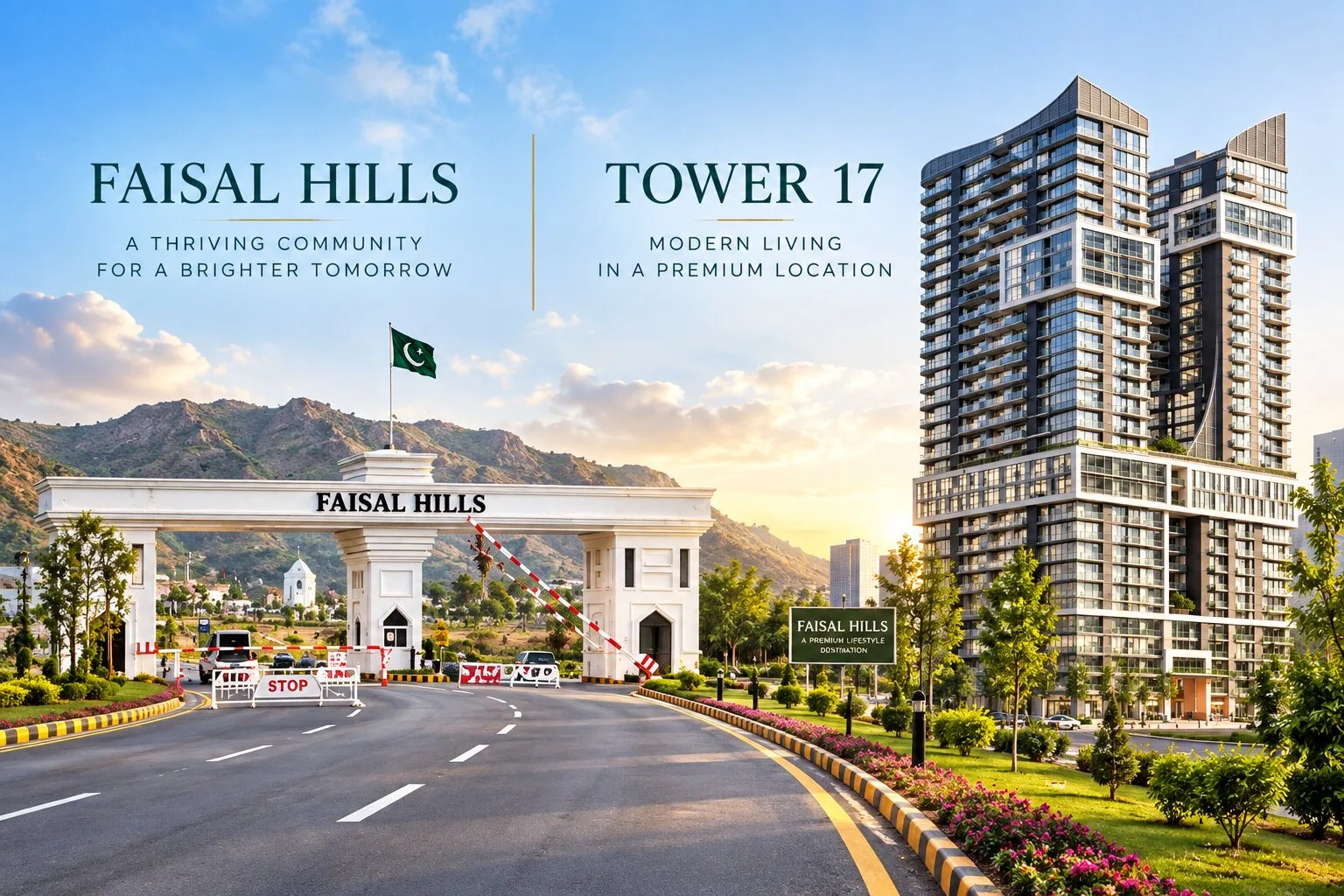
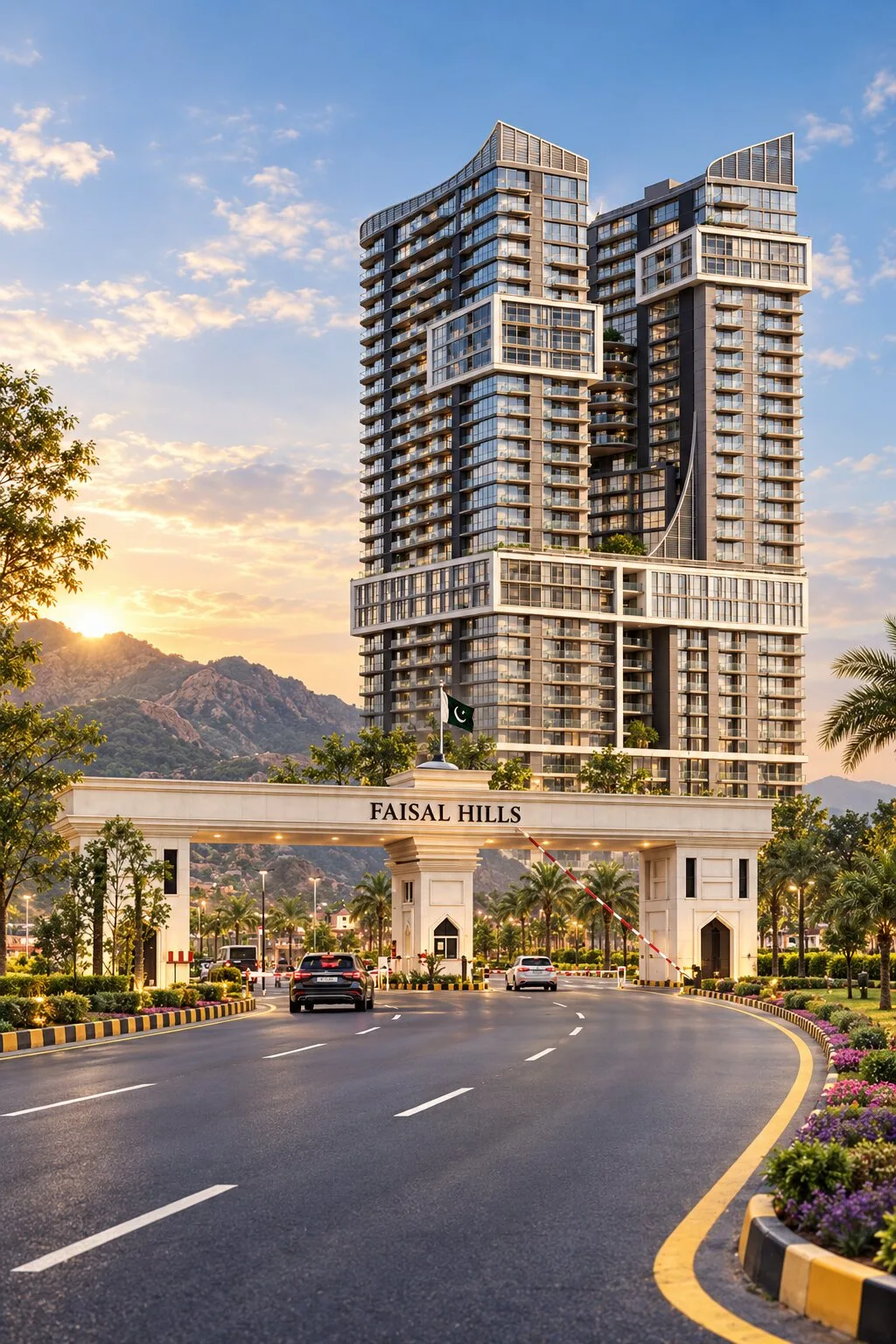
This is ISMMART’s flagship project, and the clearest proof of everything real estate can offer when done right. Located on Faisal Hills Block-B along the Main G.T. Road, close to the Islamabad Expressway and Motorway M-1, with a direct view of the Margalla Hills, it spans 786,425 square feet across 23-plus floors. You can choose from Studio, 1-Bed, 2-Bed, 3-Bed, and Penthouse units, with booking starting from just PKR 1,000,000 and a 20% down payment spread over 4 annual installments. It also comes with a company-backed buyback plan — a rare feature that solves real estate’s biggest weakness, not being able to exit quickly. Possession is targeted for December 2028.

For full pricing, floor plans, and amenities, see the Tower 17 project page.

9- Spire Mall

Spire Mall represents ISMMART’s move into organised commercial and retail space — the kind of project that brings shops, food outlets, and business space together in one location, similar in spirit to the Commercial Hubs the group has also developed in Peshawar and Nowshera. As with Apex Estate, speak directly with ISMMART for the latest floor plans, retail unit pricing, and booking status.

Why this matters for this guide: Tower 17 alone is a real-world example of everything Section 2 described — an easy installment entry starting from PKR 1,000,000, a location in one of the fastest-growing corridors in the country, and a buyback plan built specifically to solve real estate’s biggest weakness, which is not being able to sell quickly when you need to.

10- ISMMART Pharmaceuticals

Under this name, ISMMART makes everyday medicine — heart medication, antibiotics, pain relief, and digestive treatments, both prescription and over-the-counter. Their stated mission is simple: safe, effective medicine, built on integrity and quality. What they’ve built includes modern manufacturing facilities, dedicated R&D labs, a specialised packaging unit, and a stage-by-stage quality control process. This puts ISMMART right inside Pakistan’s pharma growth story — a domestic market that just crossed Rs 1 trillion, with real export demand opening up across Africa, Central Asia, and the Middle East. For anyone wanting healthcare-sector exposure without building a factory from scratch, backing an already-established manufacturer is the realistic way in.

11- ISMMART Hospitality — Taam-ul-Khaas & Hotel 17

ISMMART’s hospitality business runs on a simple promise: “Make you feel at home.” Taam-ul-Khaas is its dining brand, bringing Turkish, Lebanese, Arabic, and Iranian cuisine together in one place — the kind of authentic, multi-cuisine experience that used to mean traveling abroad. Hotel 17 extends the same Tower 17 brand into hospitality, offering guests a comfortable, modern stay. Together, they tap into Pakistan’s fastest-growing appetite for eating out and quality stays, while spreading the risk that comes with betting on just one restaurant or hotel.

For more details, visit the ISMMART Hospitality page.

12- What Makes ISMMART Different From Other Companies

  1. It doesn’t ask you to choose just one sector. Most companies specialise in one thing. ISMMART runs real estate, pharma, and hospitality  plus six more industries  under one name, spreading risk the same way a smart personal portfolio would.
  2. A real technology system behind its real estate, called REMS, instead of the paper-based, manual process most Pakistani developers still use  this matters enormously given how much documentation risk exists in Pakistani property.
  3. Investor protection built into its flagship project. Tower 17’s buyback plan directly answers real estate’s biggest weakness of not being able to exit quickly, something not every Islamabad developer offers.
  4. A genuinely international presence. With a global headquarters in Dubai and a stated footprint across 70-plus locations, ISMMART brings an international investor base to its Pakistani projects, which matters a lot for the overseas Pakistani community.
  5. A clear sustainability commitment, with green building practices referenced specifically for Tower 17, at a time when Pakistan is facing real climate pressure.
  6. Physical branches in exactly the three cities that matter most  Islamabad, Lahore, and Karachi  meaning you can actually walk into an office and talk to someone, not just fill out a form online.

Where the group is working best right now:

  • Islamabad is clearly the strongest branch at the moment, anchored by Tower 17 and the city’s broader 10 to 12% property growth in 2025.
  • Lahore is well positioned because of the city’s strength in pharma manufacturing and its huge appetite for dining out.
  • Karachi is positioned around commercial real estate and larger-scale opportunities, given the city’s outsized share of Pakistan’s total economy.

13- Frequently Asked Questions

Is real estate, pharma, or hospitality the best investment in Pakistan?
There isn’t one single winner. Real estate gives you the strongest protection against inflation and works best for long-term, low-effort wealth building. Pharma gives you steady, recession-resistant demand. Hospitality gives you the fastest, most visible return. Smart investors in Pakistan usually hold a mix, not just one.

How much money do I actually need to start investing in real estate in Pakistan? Much less than people assume. Projects like Tower 17 let you book with as little as PKR 1,000,000, with the rest spread across yearly installments  a big change from the old days when you needed the full amount ready upfront.

Is it safe for overseas Pakistanis to invest in property back home? It can be, as long as you check land titles properly through the Punjab or Sindh land record authorities, choose developers with clear, verifiable paperwork, and, where possible, pick projects that offer a buyback or guaranteed exit option to solve real estate’s usual problem of being hard to sell quickly.

Why is pharma called a “safe” or “defensive” investment? Because people keep buying medicine even when the economy slows down. Pakistan’s pharma retail sector still grew close to 5% in unit sales even during a tough economic stretch. (Source: Profit by Pakistan Today, citing IQVIA data)

Which city is doing best for real estate right now? Islamabad has the strongest momentum at the moment, with prices up 10 to 12% in early 2025 and land near new roads jumping 20 to 40% in a year. Lahore still holds the highest luxury property prices per square foot, and Karachi leads in commercial real estate because of its sheer size and business activity.

Does ISMMART Group actually operate in all three sectors? Yes. ISMMART Group of Industries runs real estate projects including Tower 17, Apex Estate, and Spire Mall, a pharmaceutical arm called ISMMART Pharmaceuticals, and a hospitality business that includes Taam-ul-Khaas restaurant and Hotel 17 — all from head offices in Islamabad, Lahore, Karachi, and Dubai.

14- Final Verdict

Once you take away the sales talk every sector uses to promote itself, the honest comparison is actually simple: real estate builds your wealth slowly but reliably, and protects you against inflation. Pharma protects your money through hard economic times that would hurt other investments. Hospitality moves the fastest and pays you back the soonest, but it needs your attention.

You don’t have to pick just one. The smarter move is understanding your own timeline, how quickly you might need your money back, and how much you actually want to be involved day-to-day — and then choosing a partner who lets you access whichever sector, or combination of sectors, genuinely fits you. Whether that means booking a unit in Tower 17 for long-term growth in one of Islamabad’s fastest-growing areas, exploring a pharma partnership, or backing a hospitality brand like Taam-ul-Khaas with real, proven footfall, doing it through an already-established group like ISMMART Group of Industries takes away a lot of the guesswork — and a lot of the risk — that comes with figuring it out completely on your own.

Always do your own research, verify documentation directly with the developer, and invest according to your own financial situation. This article is written for information purposes and is not financial advice.


Building a Future of Growth and Opportunities

At ISMMART Industries, we believe in building a future where innovation, collaboration, and excellence go hand in hand. As a multi-sector organization, we are dedicated to creating impactful solutions that drive economic development and open new doors for professionals and businesses alike. Our diverse portfolio allows us to explore new possibilities while maintaining a strong commitment to quality and customer satisfaction. With a focus on continuous improvement and global expansion, ISMMART Industries is working towards becoming a leading force in shaping the industries of tomorrow.

Driving Innovation Across Multiple Industries

ISMMART Industries is a dynamic and fast-growing organization focused on transforming traditional business models through innovation and technology. With operations spanning multiple sectors including real estate, technology, manufacturing, and services, the company is committed to delivering value-driven solutions that meet modern market needs. Our mission is to create sustainable growth opportunities while empowering businesses and individuals to achieve long-term success. By combining strategic thinking with advanced systems, ISMMART continues to shape a smarter and more connected future for industries across the region.